
Welcome to your essential guide for color speaking part 1 in the IELTS test!
Colors is one of the most common topics in IELTS Speaking Part 1, where examiners assess your ability to discuss familiar, everyday subjects naturally and fluently. While these questions may seem simple, knowing how to express your preferences and opinions confidently can significantly boost your performance.
This guide provides you with the most frequently asked color ielts speaking part 1 questions, natural sample answers, essential vocabulary, and expert tips to help you communicate smoothly during your test. Remember, success in Part 1 isn’t about perfect answers—it’s about speaking naturally and keeping the conversation flowing.
Let’s prepare you to tackle any color question with confidence and fluency!
Getting Started: What is IELTS Speaking Part 1?
In the IELTS Speaking test, Part 1 includes simple, friendly questions about routine topics such as colors, hobbies, and daily habits. These questions help the examiner assess your ability to speak naturally and fluently using everyday English.
In this article, you will learn common questions used in the color speaking part 1, along with sample answers, vocabulary, and expert tips to speak with confidence in the test.
Top Common Questions of Color Speaking Part 1
When the topic of color comes up in Part 1, you’ll be expected to express your preferences, opinions, and observations. Below are several typical questions related to color ielts speaking part 1 that may be asked in the exam:
- What is your favorite color?
- Do you usually wear clothes in bright colors or dark colors?
- Are colors important to you when choosing things like clothes or furniture?
- Do you think people’s favorite colors can change over time?
- What colors are popular in your country?
These color speaking part 1 questions aim to test your ability to talk about familiar topics clearly, without needing complex vocabulary.
Sample Answers to Color Speaking Part 1
In IELTS color speaking part 1 are light and personal. You don’t need technical language—just express your opinions clearly and naturally. These questions help the examiner assess your fluency when discussing simple topics from daily life.
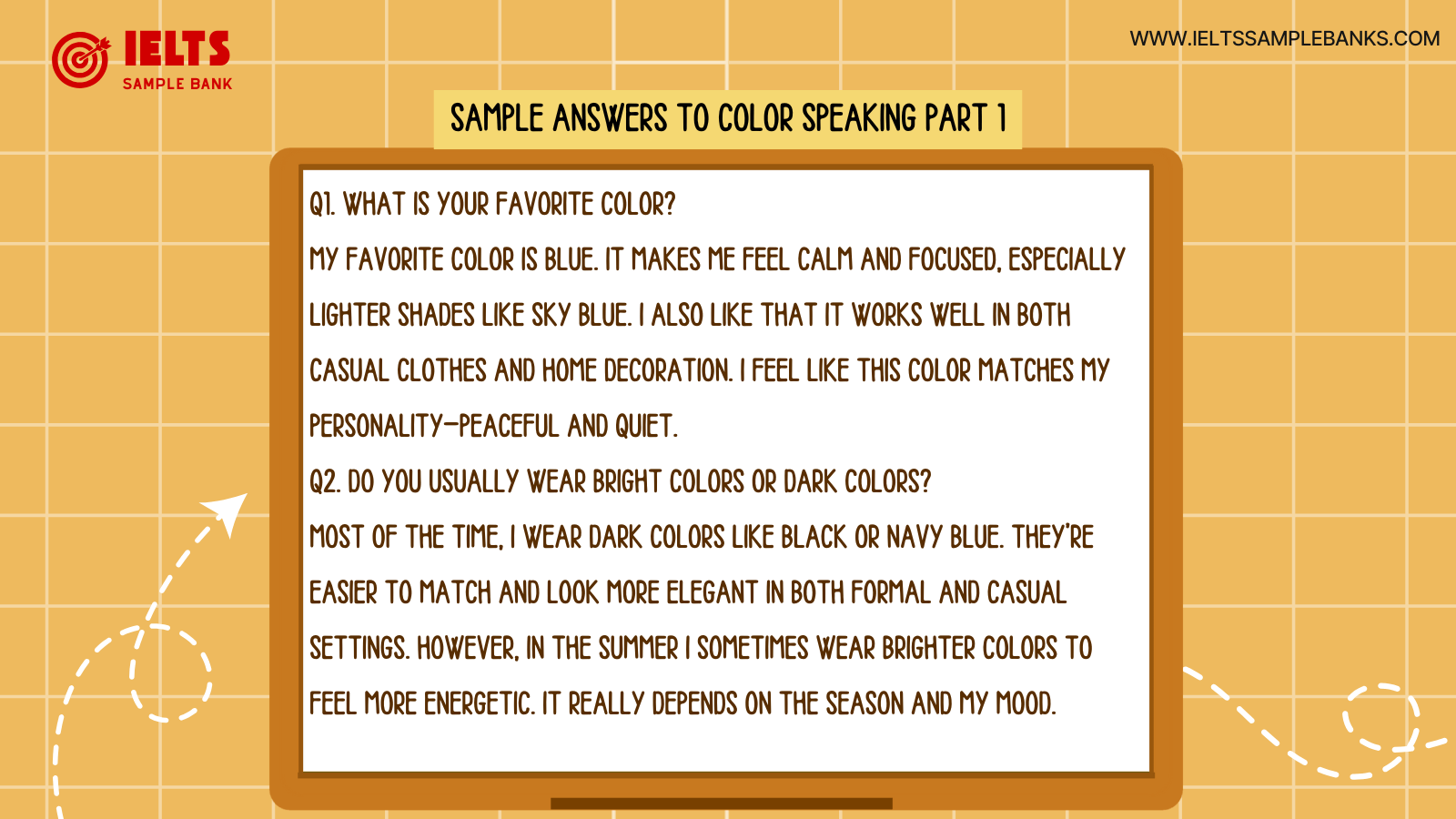
Below are 10 common questions the examiner may ask related to the color speaking part 1 topic. Each answer uses topic-specific vocabulary and sentence patterns appropriate for IELTS success.
Q1. What is your favorite color?
My favorite color is blue. It makes me feel calm and focused, especially lighter shades like sky blue. I also like that it works well in both casual clothes and home decoration. I feel like this color matches my personality—peaceful and quiet.
Vocabulary:
- shade (noun): a lighter or darker version of a color
- calm (adj): peaceful and not stressed
- decoration (noun): the way something is made to look attractive
Q2. Do you usually wear bright colors or dark colors?
Most of the time, I wear dark colors like black or navy blue. They’re easier to match and look more elegant in both formal and casual settings. However, in the summer I sometimes wear brighter colors to feel more energetic. It really depends on the season and my mood.
Vocabulary:
- elegant (adj): stylish and graceful
- match (verb): to go well with something else
- mood (noun): your current emotional feeling
Q3. Are colors important when you choose clothes or furniture?
Yes, color is one of the first things I think about. I like neutral tones for furniture because they make my room feel clean and relaxing. For clothing, I might choose bold colors sometimes if I want to make a strong impression. The color really affects how I feel in that space or outfit.
Vocabulary:
- neutral tone (noun): light, simple colors like beige or grey
- bold colors (noun): strong or bright colors that stand out
- impression (noun): the effect you have on other people’s opinions
Q4. Do you think people’s color preferences change over time?
Yes, I think they do. When I was younger, I liked bright colors like orange or yellow. But now I prefer softer tones like grey or navy because they feel more mature and calming. Our tastes can change as we grow and experience different things.
Vocabulary:
- preference (noun): what someone likes more than other things
- soft tones (noun): gentle, less intense colors
- mature (adj): more adult or sophisticated
Q5. What colors are popular in your country?
In my country, red is very popular, especially during national festivals. It represents luck and happiness in our culture, so you’ll see a lot of red decorations and clothes during holidays. White is also common, but it’s often used for more serious or traditional occasions. People usually choose colors based on symbolism.
Vocabulary:
- represents (verb): symbolizes or stands for something
- festival (noun): a celebration or cultural event
- symbolism (noun): the use of symbols with meaning
Q6. Is color important in your daily life?
Yes, it affects my mood and how I feel throughout the day. I choose light colors when I want to relax and bright colors if I need a boost of energy. Even small things, like the color of my notebook or coffee mug, can influence my motivation and focus.
Vocabulary:
- influence (verb): to have an impact on something
- boost (noun): an increase or improvement
- focus (noun): ability to concentrate
Q7. Have you ever painted a room in your home?
Yes, we recently painted our living room light grey. It feels modern and makes the space look bigger and brighter. I helped choose the color because I wanted something that would stay fresh-looking for a long time. Everyone in my family liked the result.
Vocabulary:
- paint (verb): to cover a wall or surface with color
- fresh-looking (adj): clean and new in appearance
- modern (adj): stylish and up-to-date
Q8. What color would you never wear?
I don’t really like wearing bright yellow. It’s too strong for my skin tone and makes me feel uncomfortable. I prefer wearing subtle colors like beige, navy, or light green because they look better on me and feel more natural.
Vocabulary:
- skin tone (noun): the natural color of someone’s skin
- subtle (adj): soft, not intense
- uncomfortable (adj): not feeling relaxed or confident
Q9. What color would you choose to decorate your future home?
I’d probably choose calming colors like white, grey, and soft green. These tones are easy on the eyes and can make a space feel peaceful. I think using natural shades helps reduce stress and improve the mood at home, especially after a long day.
Vocabulary:
- easy on the eyes (phrase): visually comfortable
- natural shades (noun): colors found in nature, like green, brown
- reduce stress (v phrase): to help someone feel less anxious
Q10. Are there any colors you associate with specific feelings?
Yes, definitely. For example, I associate red with energy and excitement, and blue with calmness and peace. Colors can really influence how we think and feel, even without us realizing it. That’s why I try to surround myself with positive colors.
Vocabulary:
- associate (verb): to connect something with a feeling or idea
- influence (verb): to affect or change something
- positive colors (noun phrase): colors that make you feel good
Words You Can Use: Helpful Color Vocabulary
Memorizing relevant vocabulary allows you to answer color speaking part 1 questions smoothly and with clarity. Here are some useful expressions for the color topic, with simple explanations.
| Word / Phrase | Part of Speech | Pronunciation | Meaning |
| Shade | noun | /ʃeɪd/ | A lighter or darker version of a color, such as light blue or dark red. |
| Bright | adjective | /braɪt/ | Very strong or vivid in color; easy to notice visually. |
| Neutral tones | noun phrase | /ˈnjuːtrəl təʊnz/ | Light or plain colors like grey, beige, or white that aren’t too bold. |
| Vibrant | adjective | /ˈvaɪbrənt/ | Full of energy and strong in color, especially bold and eye-catching tones. |
| Pastel | adjective | /ˈpæstəl/ | Soft and light color tones like pale pink or baby blue. |
| Earth tones | noun phrase | /ˈɜːθ təʊnz/ | Natural colors such as brown, green, tan—all related to nature. |
| Subtle | adjective | /ˈsʌtl/ | Delicate and not obvious or intense; often used for soft, low-key colors. |
| Bold color | noun phrase | /bəʊld ˈkʌlə/ | A bright or strong color that stands out, like red or deep blue. |
| Mood-lifting color | noun phrase | /muːd ˈlɪftɪŋ ˈkʌlə/ | A color that helps improve mood or emotional state, like yellow or green. |
| Skin tone | noun | /skɪn təʊn/ | The natural color of a person’s skin, sometimes affected by clothing color. |
| Decoration | noun | /ˌdekəˈreɪʃn/ | Items or colors used to make a room or space more attractive. |
| Match | verb | /mætʃ/ | To go well with something in terms of appearance, often color or style. |
| Elegant | adjective | /ˈelɪɡənt/ | Stylish, classy, or tasteful in appearance, especially with soft tones. |
| Impression | noun | /ɪmˈpreʃn/ | The idea or feeling you give to others, often affected by color choice. |
| Preference | noun | /ˈprefrəns/ | A stronger liking for one thing over another, such as color or style. |
| Mature | adjective | /məˈtʃʊə/ | Grown-up or developed in taste, often linked to subtle color choices. |
| Represent | verb | /ˌreprɪˈzent/ | To symbolize or stand for something, especially in culture or tradition. |
| Symbolism | noun | /ˈsɪmbəlɪzəm/ | The use of colors or images to carry specific meaning or emotion. |
| Influence | verb | /ˈɪnfluəns/ | To have an effect on how someone feels, behaves, or decides something. |
| Boost | noun | /buːst/ | A quick improvement to your mood or energy, often linked to color. |
Using this vocabulary can help you explain your choices and preferences more naturally in the color ielts speaking part 1 section.
Expert Advice: Tips for Speaking Confidently on IELTS Part 1
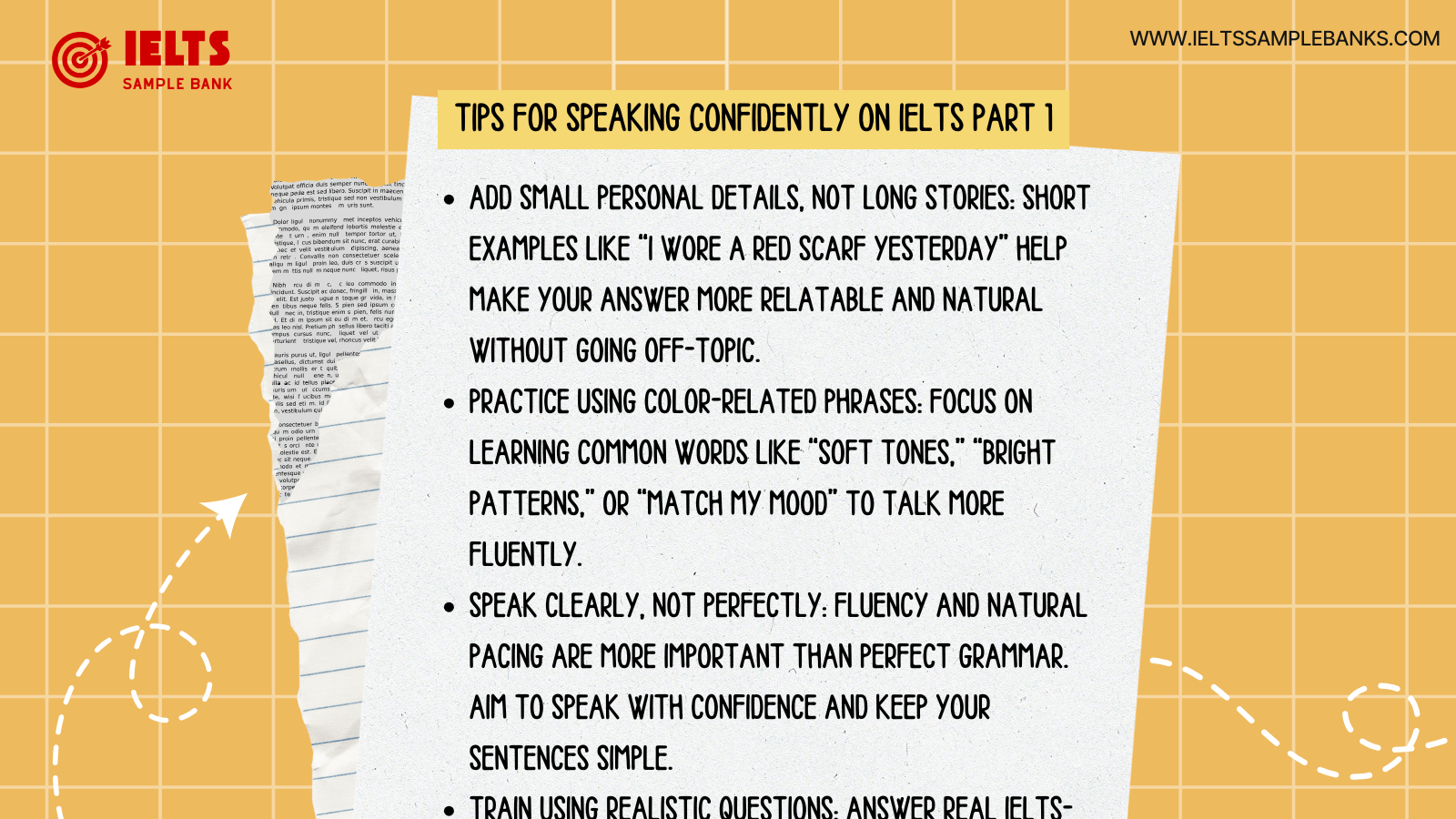
Here are some helpful strategies to improve your fluency and confidence when answering color speaking part 1 questions:
- Add small personal details, not long stories: Short examples like “I wore a red scarf yesterday” help make your answer more relatable and natural without going off-topic.
- Practice using color-related phrases: Focus on learning common words like “soft tones,” “bright patterns,” or “match my mood” to talk more fluently.
- Speak clearly, not perfectly: Fluency and natural pacing are more important than perfect grammar. Aim to speak with confidence and keep your sentences simple.
- Train using realistic questions: Answer real IELTS-style questions aloud, especially about easy topics like color or clothing. Familiarity helps reduce hesitation.
- Record yourself and reflect: Listening to your own color speaking part 1 answers helps you notice where you hesitate, repeat too much, or use the same word often. Improving these areas will boost your speaking score.
Consistent practice will improve your performance not just in color ielts speaking part 1 but in any everyday topic during your IELTS test.
Final Notes: Why Practice Matters
Preparing well for color speaking part 1 gives you the confidence to start your Speaking test smoothly. Since the questions are personal and easy, the key is to sound friendly and fluent.
Practice with real questions, focus on frequently used words, and review your answers regularly. Don’t forget to ask for feedback or work with a study partner so you can improve consistently.
The more you practice speaking about common topics like color, the more natural and confident you’ll become on test day.