

Stop memorizing endless connector lists—you’re preparing the wrong way. Most IELTS candidates believe sophisticated linking words automatically improve their Coherence and Cohesion score (25% of total Writing marks), but this misconception keeps proficient writers stuck at Band 6.5. The examiner truth: fancy connectors don’t earn points; logical, flowing arguments do.
Today, ieltssamplebanks.com reveals why “Firstly, Secondly, Thirdly” signals memorization, teaches precise semantic distinctions between similar connectors, and unveils Band 8+ techniques including pronoun referencing and lexical chains. You’ll discover the three critical mistakes that lower scores and master strategic connector deployment that demonstrates analytical thinking. Transform from decorating sentences with linking words to architecting naturally coherent arguments.
Understanding IELTS Examiners’ Coherence and Cohesion Scoring Criteria
Before learning specific connectors for task 2, grasp what examiners truly value: logical argument flow and clear organization, not connector variety.
Here’s the revelation most candidates miss—examiners assess whether your essay guides readers through ideas effortlessly. Connectors support this flow, but they cannot create it. A well-organized essay with simple connectors scores Band 7.5+, while a poorly structured essay with sophisticated linking words remains stuck at Band 6.0-6.5.
The Critical Distinction: High band writers organize ideas so clearly that cohesion feels invisible. Readers focus on arguments, not transitions. Band 6.5 writers use correct connectors within unclear progression, forcing readers to work hard following their logic.
This understanding transforms connector for task 2 usage from decoration into strategic support for already-strong organization.
Essential Categories of Connectors for Task 2 with Practical Examples
Understanding the specific functions of connectors for Task 2 and applying them strategically is essential. Each type serves a distinct purpose in enhancing the logical flow of your argument. For more insights on improving your IELTS writing, visit IELTS Sample Bank
To Sequence an Argument & Introduce Main Points
The most sophisticated essays move beyond basic sequencing words. Instead of relying on “Firstly, Secondly, Thirdly,” consider these powerful alternatives:
- The primary reason is…
- Another significant factor is…
- An equally important consideration is…
- The most compelling evidence suggests…
- A fundamental aspect involves…
- The central issue concerns…
These connectors for task 2 demonstrate analytical thinking rather than simple listing. They signal to examiners that you’re prioritizing and evaluating ideas, not just presenting them in random order. Additionally, if you’re looking for tips on how to build a strong vocabulary for your writing, check out Vocab for Writing Task 2
For example: “The primary reason why remote work benefits companies is increased productivity, as employees experience fewer office distractions and can focus on deep work during their most productive hours.”
To Add a Similar or Reinforcing Idea
When building upon existing points, precision matters more than variety. Understanding these connectors for task 2 prevents awkward transitions and creates smoother flow:
- Furthermore
- Moreover
- In addition
- Additionally
- Similarly
- Likewise
Consider this example: “Remote work reduces commuting stress significantly. Moreover, this reduction in daily stress leads to improved employee mental health and higher job satisfaction rates.” The connector “Moreover” signals that the health benefit is a more significant consequence than just stress reduction alone.
>>Read more IELTS writing task 2 samples:
- In their advertising business nowadays
- Many museums charge for admission while others are free
- Government should spend money on railways rather than roads
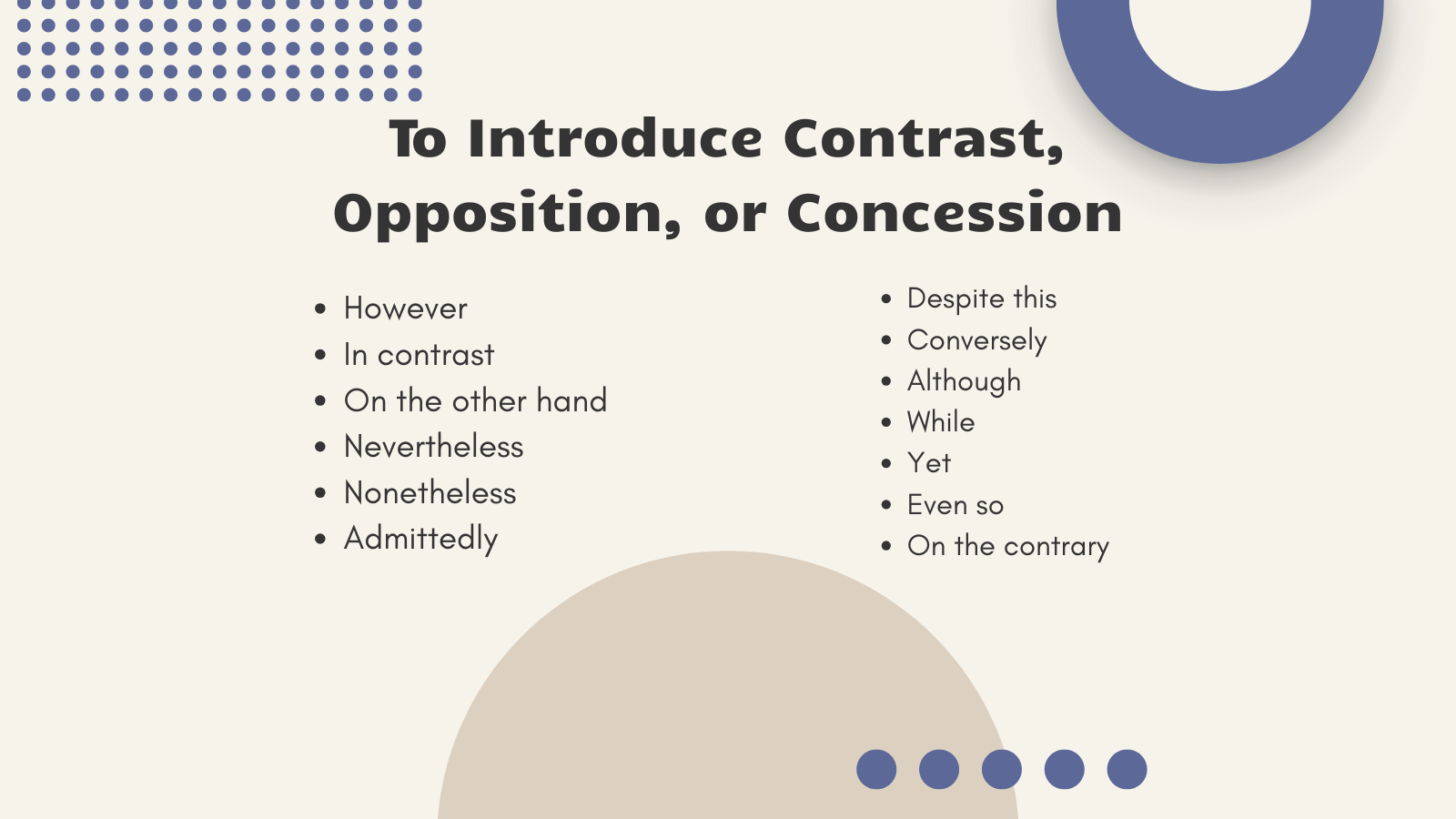
To Introduce Contrast, Opposition, or Concession
Contrasting ideas requires careful selection of connectors for task 2. The key is matching the connector to your intended relationship between ideas:
- However
- In contrast
- On the other hand
- Nevertheless
- Nonetheless
- Admittedly
- Despite this
- Conversely
- Although
- While
- Yet
- Even so
- On the contrary
Connectors for task 2, “However” creates direct opposition to your previous statement. “In contrast” presents a completely different perspective on the same issue. “On the other hand” introduces a balanced alternative viewpoint. “Admittedly” acknowledges potential weaknesses in your argument while maintaining your overall position. “Many companies embrace remote work for cost savings. However, some organizations struggle with maintaining team cohesion in virtual environments.” Here, “However” creates a direct contradiction between benefits and challenges.
To Explain Cause, Effect, or Result
Logical reasoning depends on clear cause-and-effect relationships. Strong cause-and-effect writing demonstrates analytical thinking:
- Therefore
- As a result
- Consequently
- Thus
- Hence
- This leads to
- For this reason
Therefore indicates a direct logical conclusion. As a result emphasizes the outcome of previous conditions. Consequently suggests an inevitable outcome following naturally from circumstances. “Companies implementing flexible work policies report 23% higher employee retention rates. Therefore, businesses seeking competitive advantage should consider workplace flexibility as a strategic priority rather than just an employee perk.”
To Provide Examples & Illustrate Your Points
Use these linking words for ielts essay to concrete examples strengthen abstract arguments significantly. Effective example of connectors for task 2 introduction requires smooth integration:
- For instance
- To illustrate
- A case in point is…
- For example
- Specifically
- In particular
- Such as
“For instance” introduces specific cases that demonstrate your point. To illustrate signals that you’re providing a clarifying example. A case in point is… introduces particularly relevant examples that perfectly demonstrate your argument. “Technology has revolutionized traditional business models across industries. For instance, companies like Uber and Airbnb have created entirely new markets by connecting consumers directly with service providers through digital platforms.”
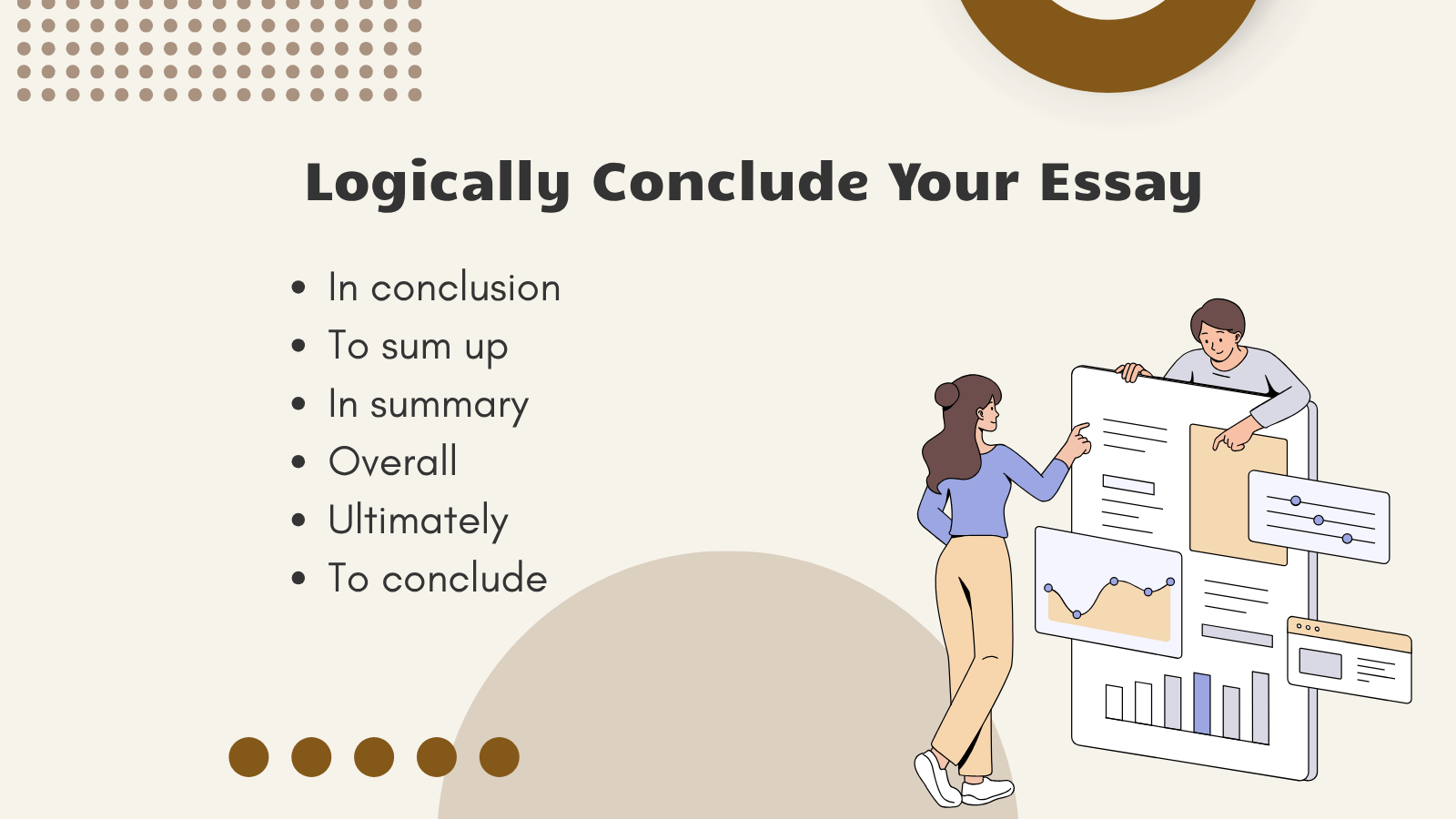
To Logically Conclude Your Essay
Strong conclusions require appropriate connectors that signal completion without redundancy. Your conclusion in IELTS writing task 2 should synthesize rather than simply repeat:
- In conclusion
- To sum up
- In summary
- Overall
- Ultimately
- To conclude
“In conclusion” works effectively for formal IELTS academic writing. “To sum up” provides a slightly less formal alternative while maintaining professionalism. Avoid overly casual phrases like “All in all” or complex constructions like “Taking everything into consideration.” “In conclusion, remote work represents a fundamental shift in how organizations operate, offering significant benefits for both employees and employers when implemented thoughtfully with appropriate support systems.”
Common Connector for Task 2 Mistakes That Lower Your Band Score
Understanding common errors helps you avoid the pitfalls that prevent many students from achieving their target band scores with connectors for task 2.
The Predictable “Firstly, Secondly, Thirdly” Trap
This robotic approach with connectors for task 2 like “firstly”, “secondly”, etc immediately signals to examiners that you’re following a memorized template rather than developing sophisticated arguments. Consider these contrasting examples:
- Don’t write: “Firstly, remote work saves money. Secondly, it improves work-life balance. Thirdly, it increases productivity.”
- Do write: “The most compelling advantage of remote work lies in its cost-effectiveness for both employers and employees. Beyond financial benefits, this arrangement creates opportunities for improved work-life integration, allowing professionals to design schedules that accommodate personal responsibilities while maintaining high performance standards.”
The revised version demonstrates analytical thinking and natural flow rather than mechanical listing.
Starting Every Sentence with Connectors for Task 2
Overusing connectors for writing task 2 creates choppy, unnatural writing that interrupts rather than enhances flow. Skilled writers achieve cohesion through varied techniques including pronouns, parallel structure, and logical organization.
- Problematic paragraph: “However, remote work has disadvantages. Furthermore, some employees feel isolated. Moreover, communication becomes more challenging. Additionally, team building suffers in virtual environments.”
- Improved version: “Remote work certainly presents challenges that organizations must address. Employee isolation emerges as a significant concern, particularly for workers who thrive on social interaction and collaborative energy. Communication barriers compound this issue, as virtual meetings often lack the spontaneous brainstorming and relationship-building that occur naturally in shared physical spaces.”
Using the Wrong Tool for the Job (Mismatched Meanings)
Misunderstanding meanings of connectors for task 2 creates logical confusion and reduces your Coherence and Cohesion score. Common errors include confusing “However” (which shows contrast) with “Moreover” (which adds supporting information).
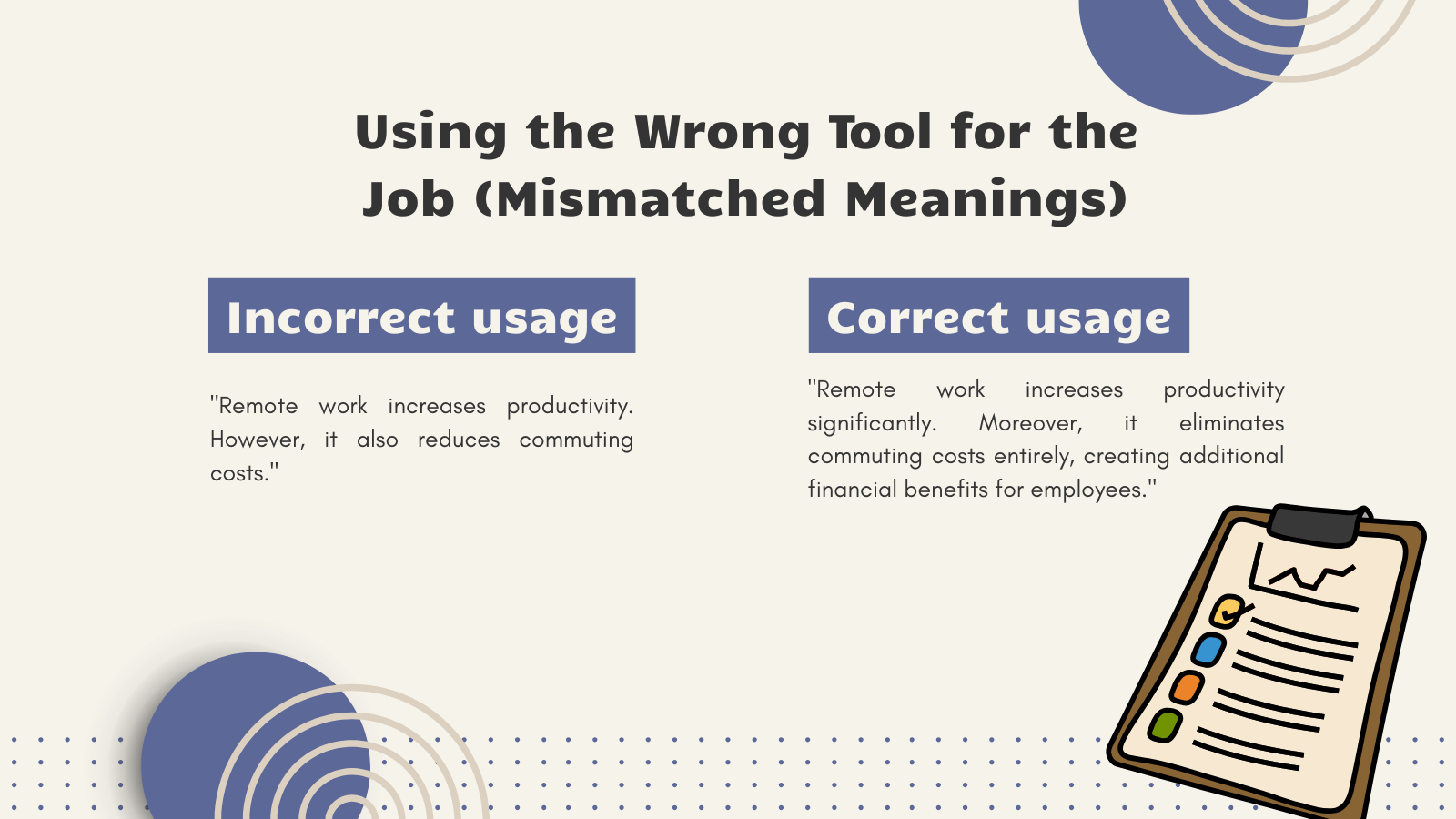
- Incorrect usage: “Remote work increases productivity. However, it also reduces commuting costs.” (This suggests a contradiction when both points support remote work.)
- Correct usage: “Remote work increases productivity significantly. Moreover, it eliminates commuting costs entirely, creating additional financial benefits for employees.” (This properly adds supporting information.)
Band 8+ Cohesion Techniques Beyond Basic Connectors for Task 2
True cohesion transcends basic connectors for task 2 and creates seamless intellectual progression through sophisticated linguistic techniques that demonstrate advanced English proficiency.
The Power of Pronoun Referencing
Expert writers create natural links through strategic pronoun usage rather than constantly repeating key terms or forcing connections with obvious ielts writing task 2 linking words. This trend can refer back to a pattern you’ve described. That issue connects to a problem you’ve identified. These developments encompass multiple changes you’ve discussed.
Consider this example: “Globalization has fundamentally altered how businesses operate across international markets. This phenomenon has created unprecedented opportunities for small companies to access global customers while simultaneously intensifying competition from international rivals.”
Building Lexical Chains (Synonyms)
Beside these connectors for task 2 above, advanced cohesion emerges through related vocabulary that creates thematic consistency throughout your essay. Instead of repeating “globalization” constantly, skilled writers develop lexical chains: globalization → this international phenomenon → worldwide interconnectedness → global integration → transnational commerce.
This technique demonstrates sophisticated vocabulary while maintaining clear connections between ideas. “The digital revolution has transformed global commerce fundamentally. This technological transformation enables small businesses to compete internationally through e-commerce platforms. Such worldwide connectivity has democratized market access while creating new challenges for traditional retail models.”
Conclusion
Mastering connectors for task 2 IELTS writing requires strategic thinking rather than mechanical memorization. Focus on creating logical flow through varied techniques including appropriate linking words, pronoun referencing, and lexical chains. Remember that examiners reward clear communication and sophisticated argument development over complex connector usage. Practice integrating these techniques naturally until they become instinctive elements of your writing process, and you’ll see significant improvement in your Coherence and Cohesion scores.