

The IELTS Writing Task 2 question “it is important for children to learn” represents a sophisticated opinion essay that challenges test-takers to analyze moral education and disciplinary approaches in childhood development. This comprehensive guide provides the strategic framework and practical tools needed to achieve band scores of 7.0 and above, incorporating insights from successful high-scoring responses and expert analysis.
When you encounter essays exploring whether “it is important for children to learn” moral distinctions, you’re dealing with complex educational philosophy that requires balanced analysis of teaching methods, punishment effectiveness, and child development principles. IELTS writing task 2 discuss both views demands thoughtful consideration of educational approaches while demonstrating sophisticated language skills that distinguish high-achieving candidates from average performers.
Understanding the Essay Question Type
Full Question Requirement: “Is it important for children to learn the difference between right and wrong at an early age? Punishment is necessary to help them learn this distinction. To what extent do you agree or disagree with this opinion? What sort of punishment should parents and teachers be allowed to use to teach good behavior to children?”
This question combines opinion and recommendation formats with two distinct parts. First, evaluate punishment’s necessity in teaching moral distinctions. Second, discuss specific disciplinary approaches for parents and teachers. Your response must address both components separately, examining punishment’s role in moral education while identifying suitable methods for different authority figures.
Planning Your Response in 5 Minutes
Begin your IELTS writing task 2 essay preparation by carefully analyzing both parts of the question to ensure comprehensive coverage. The first component requires your opinion on punishment’s necessity, while the second demands specific recommendations for appropriate disciplinary measures in educational and home environments.
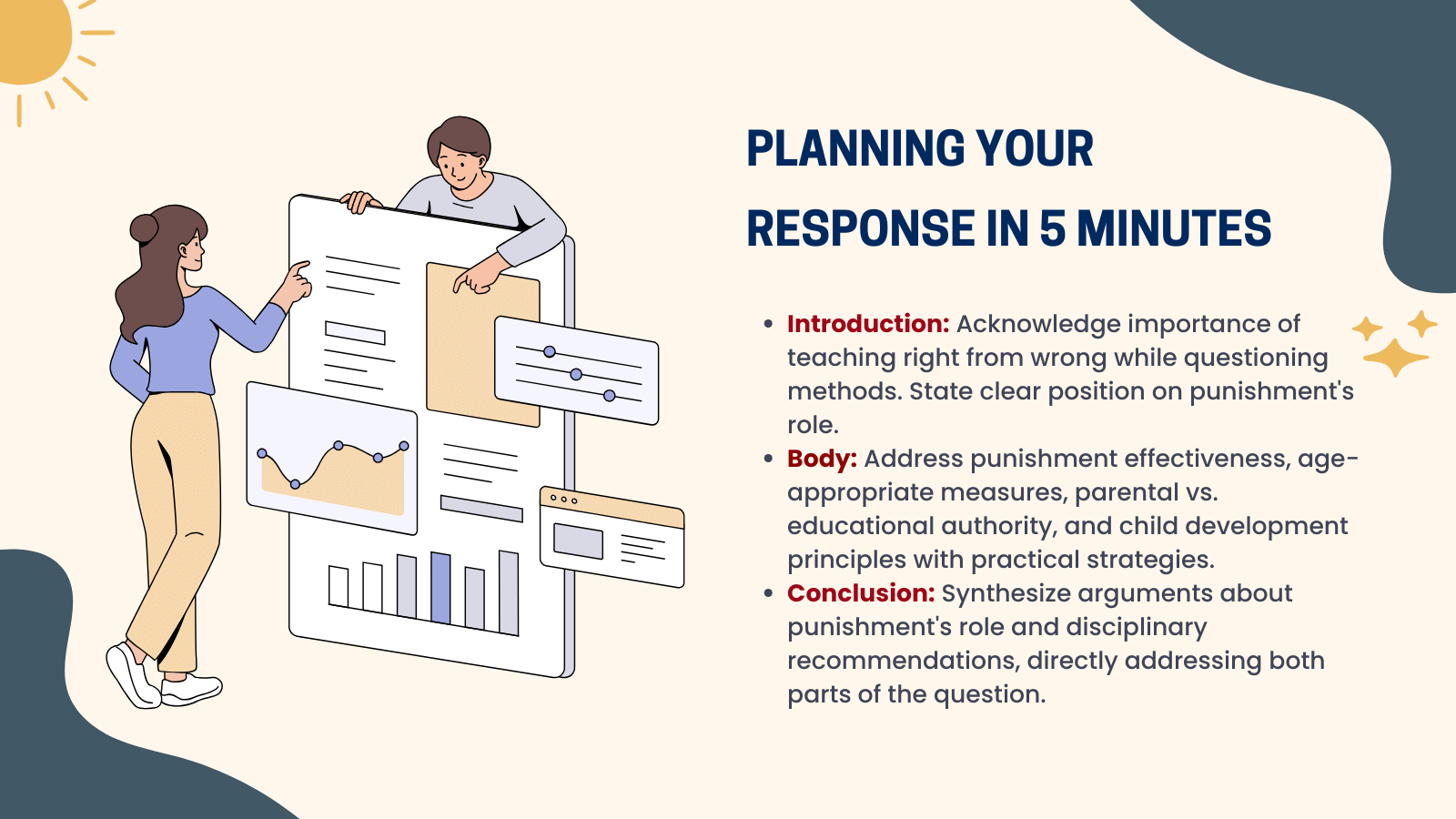
- Introduction Strategy: Acknowledge that while “it is important for children to learn” right from wrong, the methods employed deserve careful consideration. Establish your clear position on punishment’s role while indicating you will address both components systematically.
- Body Paragraph Development: Address each aspect thoroughly, ensuring balanced treatment of punishment effectiveness, age-appropriate disciplinary measures, and the distinction between parental and educational authority in moral instruction. Your arguments should demonstrate understanding of child development principles while maintaining focus on practical implementation strategies.
- Conclusion Approach: Synthesize your main arguments about both punishment’s role in moral education and specific disciplinary recommendations, ensuring your conclusion directly addresses both parts of the original question while reinforcing your stated position throughout the essay.
Step-by-Step Essay Outline to Address the Task
- Introduction (50-60 words): State that early moral education is important but disagree that punishment is necessary. Preview that you’ll discuss why early learning matters, problems with punishment, and better alternatives.
- Body Paragraph 1 (100-120 words): Argue that early moral education is crucial. Use examples like children learning honesty, sharing, and empathy at ages 3-8. Explain how this builds better adults and stronger communities.
- Body Paragraph 2 (100-120 words): Argue against punishment effectiveness. Explain that punishment creates fear rather than understanding. Children comply when watched but don’t develop internal moral compasses. Can damage parent-child trust.
- Body Paragraph 3 (100-120 words): Recommend specific alternatives: time-outs for reflection, natural consequences (clean up mess they made), removing privileges, having children apologize and repair harm. Avoid physical punishment completely.
- Conclusion (40-50 words): Restate that early moral education matters but punishment isn’t the answer. Emphasize guidance, explanation, and natural consequences work better.
IELTS Task 2 Model Essays: Three Levels of Performance
Essay Topic: Is it important for children to learn the difference between right and wrong at an early age? Punishment is necessary to help them learn this distinction. To what extent do you agree or disagree with this opinion? What sort of punishment should parents and teachers be allowed to use to teach good behavior to children?
Band 5.5–6.5 Sample Essay
It is important for children to learn about right and wrong when they are young. However, I partially disagree that punishment is always necessary to teach them these lessons. This essay will discuss my views and suggest appropriate ways to guide children’s behavior.
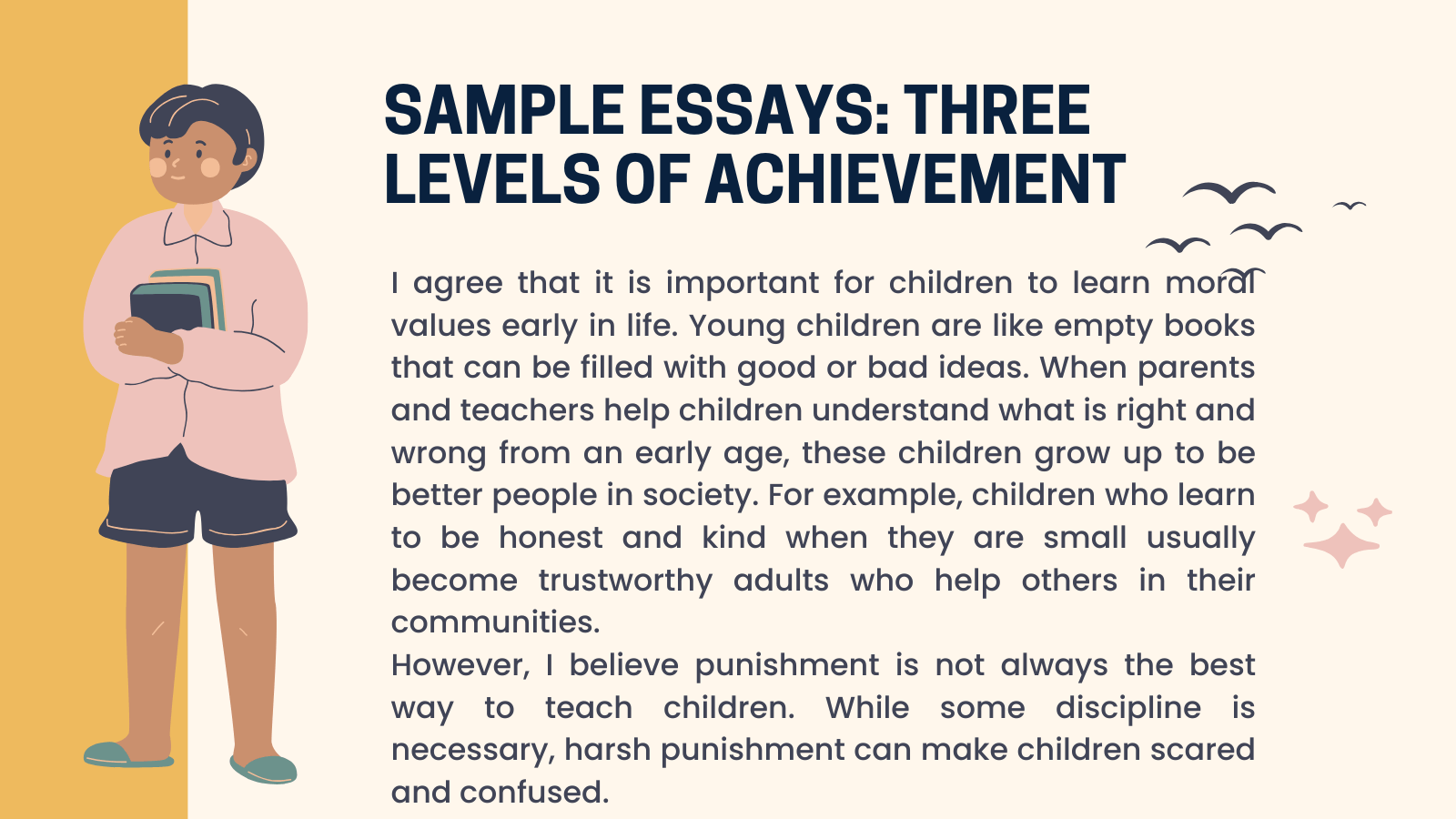
I agree that it is important for children to learn moral values early in life. Young children are like empty books that can be filled with good or bad ideas. When parents and teachers help children understand what is right and wrong from an early age, these children grow up to be better people in society. For example, children who learn to be honest and kind when they are small usually become trustworthy adults who help others in their communities.
However, I believe punishment is not always the best way to teach children. While some discipline is necessary, harsh punishment can make children scared and confused. Instead of learning why something is wrong, they might just avoid doing it because they fear getting punished. This does not help them develop their own sense of right and wrong. Research shows that children learn better when they understand the reasons behind rules.
Regarding appropriate discipline, parents and teachers should use gentle but firm methods. Time-out periods can help children think about their actions without causing harm. Taking away privileges like screen time or favorite activities can also be effective. Parents might assign extra chores as consequences for bad behavior. However, physical punishment should never be used as it can hurt children emotionally.
In conclusion, although it is important for children to learn moral values early, punishment should be used carefully. Parents and teachers should focus on explaining why certain behaviors are wrong and use gentle methods that help children understand.
Band Analysis:
- Task Response: Addresses both parts adequately but lacks depth in analysis
- Coherence: Basic linking with clear progression
- Lexical Resource: Simple vocabulary with some topic-specific terms
- Grammar: Mix of simple and complex sentences with occasional errors
Band 6.5-7.5 Sample Essay
The question of whether it is important for children to learn ethical distinctions early and punishment’s role in this process remains contentious in educational psychology. While I strongly agree that early moral education is crucial for healthy development, I partially disagree that punishment is necessary for effective moral learning.
Undoubtedly, it is important for children to learn fundamental moral principles during their formative years, as this period represents the optimal window for developing ethical reasoning capabilities. Children’s brains are remarkably adaptable during early childhood, making this the ideal time for establishing foundational values that guide decision-making throughout life. When children understand basic moral concepts such as honesty, empathy, and respect from an early age, they develop stronger social skills and demonstrate better behavioral regulation. Children who learn to consider others’ feelings naturally become more cooperative and less likely to engage in antisocial behaviors.
However, punishment’s necessity in moral education deserves careful examination, as research increasingly demonstrates that positive reinforcement often proves more effective than punitive measures. While corrective guidance is necessary when children make poor choices, harsh punishment can actually impede moral development by fostering fear rather than understanding. Children who experience excessive punishment may become compliant with authority figures but fail to develop intrinsic moral reasoning skills.
Concerning appropriate disciplinary measures, parents and teachers should employ developmentally appropriate strategies that maintain child dignity while establishing clear expectations. Natural consequences, such as requiring children to repair damage they caused or apologize for hurtful words, help them understand their actions’ direct impact. Time-out periods provide reflection opportunities without psychological harm, while privilege removal teaches that choices have consequences.
In conclusion, while early moral education is crucial, methods should emphasize understanding and natural consequences rather than punitive punishment, focusing on building intrinsic ethical development.
Band Analysis:
- Task Response: Comprehensive coverage with well-developed ideas
- Coherence: Smooth flow with sophisticated linking
- Lexical Resource: Wide range of vocabulary with precise usage
- Grammar: Complex structures with good control
Band 7.5+ Sample Essay
The intersection of moral education and disciplinary approaches represents one of contemporary educational philosophy’s most complex challenges. While I wholeheartedly endorse that it is important for children to learn ethical distinctions during formative years, I fundamentally disagree that punishment constitutes a necessary component of effective moral instruction, based on compelling developmental psychology evidence.
The significance of early moral education cannot be overstated, as neuroscientific research demonstrates that it is important for children to learn fundamental ethical principles during critical periods when neural pathways responsible for moral reasoning are most malleable. Children receiving consistent moral guidance between ages three and eight develop more sophisticated ethical frameworks and demonstrate superior social integration throughout their lives. This early foundation enables them to navigate complex moral landscapes with greater confidence and empathy, as longitudinal studies show children with strong early moral education exhibit lower antisocial behavior rates and higher community engagement levels in adulthood.
However, punishment’s purported necessity reflects a fundamental misunderstanding of how children develop ethical reasoning capabilities. Contemporary developmental psychology conclusively demonstrates that punitive approaches often undermine the very moral development they purport to enhance. Children subjected to frequent punishment may exhibit behavioral compliance but typically fail to develop critical thinking skills necessary for independent moral judgment. Instead of understanding why behaviors are problematic, they learn to avoid detection or comply only with authority figures present.
The most effective disciplinary strategies emphasize restorative rather than punitive principles, focusing on helping children understand consequences while maintaining dignity and psychological safety. Natural consequences allowing children to experience direct results of their choices prove remarkably effective in developing moral understanding. For instance, children damaging property should participate in repair, learning about responsibility and their actions’ impact on others.
In conclusion, while early moral education remains unquestionable, methods must align with child development understanding, embracing restorative approaches fostering intrinsic ethical reasoning.
Band Analysis:
- Task Response: Sophisticated analysis addressing all aspects comprehensively
- Coherence: Excellent flow with advanced cohesive devices
- Lexical Resource: Precise, sophisticated vocabulary with natural collocations
- Grammar: Wide range of complex structures with excellent control
Tips to Get High Score / Pitfalls Need to Avoid

1. Question Analysis Excellence When addressing essays where “it is important for children to learn” appears, recognize the dual-component structure requiring separate treatment of moral education importance and disciplinary method effectiveness. Many candidates focus exclusively on one aspect while neglecting the second component, resulting in incomplete responses that cannot achieve higher band scores.
2. Position Consistency and Clarity Maintain clear, consistent positioning throughout your essay when discussing whether “it is important for children to learn” through punitive measures versus alternative approaches. Your thesis statement should clearly indicate your stance on both punishment necessity and appropriate disciplinary measures, providing roadmap for readers to follow your logical development.
3. Evidence Integration and Cultural Sensitivity Support arguments about childhood moral education with specific examples that demonstrate cultural awareness while avoiding stereotypical generalizations about different societies’ approaches to child-rearing and discipline. Reference research findings, educational theories, and real-world applications that strengthen your analysis.
4. Balanced Development of Complex Ideas Present nuanced analysis that acknowledges the complexity inherent in discussions about whether “it is important for children to learn” through various educational approaches. Address counterarguments to demonstrate sophisticated thinking while distinguishing between different types of consequences and punishment.
5. Practical Recommendations with Ethical Considerations Provide specific, actionable recommendations for appropriate disciplinary measures while demonstrating understanding of ethical boundaries in child guidance and education. Balance idealistic approaches with realistic considerations of diverse family circumstances and practical limitations that parents and teachers face.
Read more about children topic in IELTS writing task 2:
- “In Some Cultures Children Are Often Told” Essay Guide
- IELTS Writing Task 2: In Many Countries Children Are Engaged
- Writing Sample: Some People Believe That Allowing Children
Conclusion
Mastering essays about whether “it is important for children to learn” through various educational approaches requires a comprehensive understanding of child development principles, moral education philosophy, and practical disciplinary strategies. Success depends on systematic analysis of multi-component questions, consistent position maintenance, and balanced argumentation that demonstrates cultural sensitivity while providing evidence-based recommendations.
Apply these advanced strategies to achieve your target band score through thoughtful analysis and sophisticated expression of complex educational concepts that distinguish exceptional responses from average performances.