

Some people think that parents should teach children how to be good members of society. Others, however, believe that school is the place to learn this. Discuss both views and give your own opinion.
Mastering the IELTS Writing Task 2 essay where “some people think that parents should teach children” requires more than memorizing sample answers with ieltsamplesbanks. This comprehensive blueprint dissects a Band 9 model response, revealing the strategic framework that elevates an ordinary essay into an exceptional one. Understanding this blueprint enables you to replicate success across similar topics while demonstrating the analytical depth and coherent argumentation that examiners reward at the highest band levels.
Understanding the Core Topic and Question Type
The phrase “some people think that parents should teach children” typically appears in discuss both views essay about responsibility for developing good citizens. This topic examines the balance between parental guidance and institutional education in shaping young minds.
Key Elements for Success:
- Define “good members of society” through concrete qualities: civic responsibility, ethical decision-making, respect for law and order, empathy, and community participation
- Address both perspectives equally: parents as primary moral educators vs. schools/institutions taking this role
- Present a clear, consistent opinion that acknowledges complexity while maintaining a definitive stance
- Use specific, measurable examples to demonstrate engagement with abstract concepts
Failure to address all components—both views plus your opinion—results in lower Task Achievement scores, regardless of writing quality. Your position must be clearly stated and supported throughout the essay.
Read more samples of IELTS discuss both views essay:
- IELTS Writing Task 2: “In Some Cultures Children Are Often Told” Essay Guide
- IELTS Writing Task 2: In Many Countries Children Are Engaged
- Writing Sample: Some People Believe That Allowing Children
The 5-Minute Pre-Writing Strategy for a High-Scoring Essay
Effective planning transforms the overwhelming complexity of IELTS Writing Task 2, specifically for some people think that parents should teach children topics, into a manageable, systematic process that produces coherent arguments and logical flow. This strategic approach ensures comprehensive coverage of all required elements while maintaining focus throughout your writing.
Brainstorming Arguments
Creating a balanced argument matrix before writing prevents the common pitfall of developing one side more thoroughly than the other. Consider these contrasting perspectives:
- View 1: Parents’ Primary Role – Parents provide consistent moral modeling through daily interactions, understand their child’s individual character and needs, establish foundational values during crucial early development years, and maintain the strongest emotional connection that facilitates meaningful guidance.
- View 2: Schools’ Institutional Role – Educational institutions offer systematic curriculum design for character development, provide diverse peer interactions that mirror real societal dynamics, employ trained professionals with expertise in child development, and ensure standardized quality across all students regardless of family background.
Strategic Framework for Some People Think That Parents Should Teach Children Essays
Essay Type: Discuss Both Views and Give Your Opinion
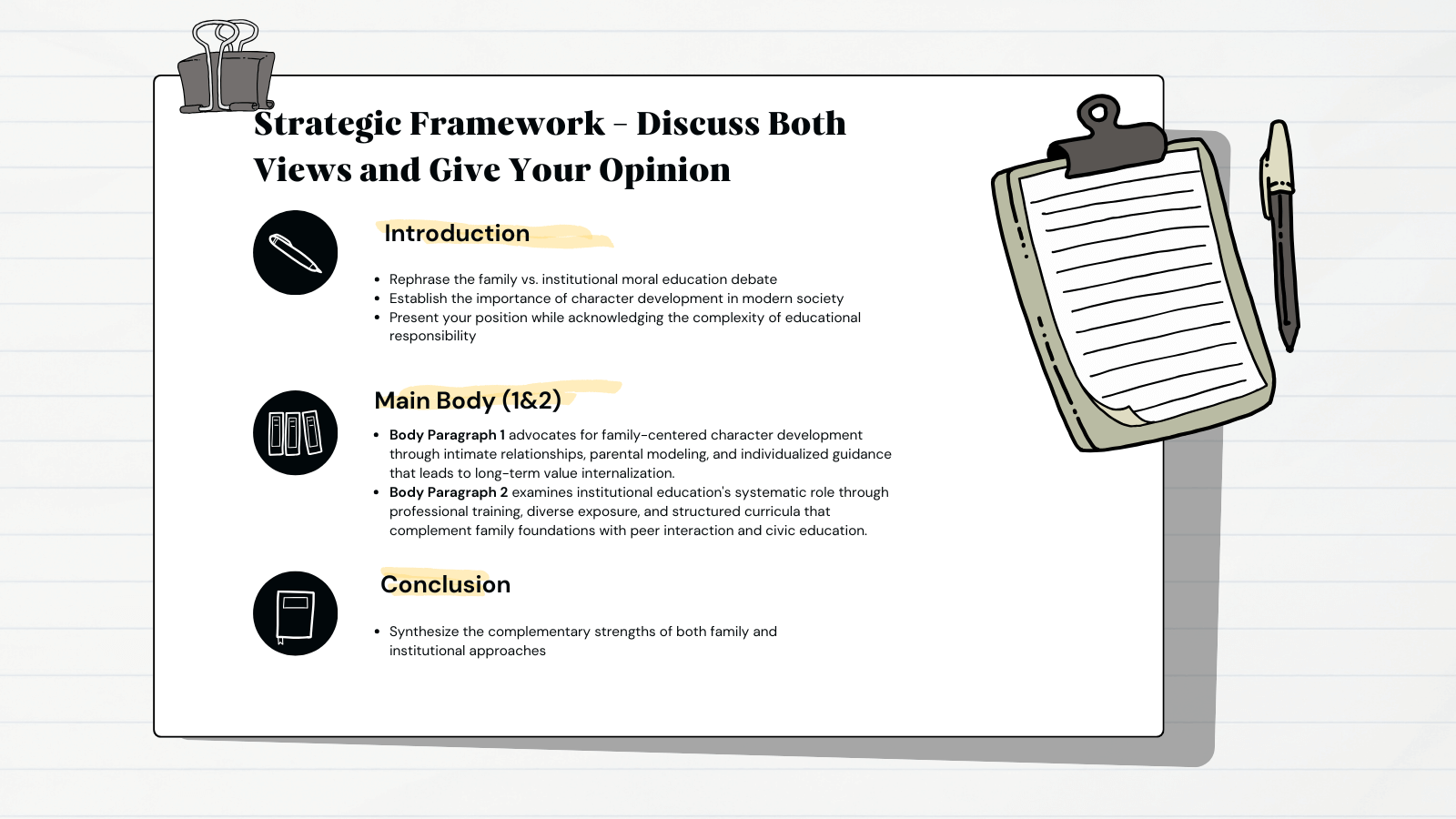
Introduction Structure
- Rephrase the central debate between family-based and institutional moral education
- Establish the significance of character development in contemporary society
- Present your position while acknowledging the complexity of this educational responsibility
Body Paragraph 1 Framework
- Advocate for family-centered character development through intimate relationships and continuous guidance
- Demonstrate understanding through examples of parental modeling, emotional security, and individualized instruction
- Connect family influence to long-term character formation and value internalization
Body Paragraph 2 Framework
- Examine institutional education’s role in systematic character development and social preparation
- Support arguments with evidence of professional training, diverse exposure, and standardized curricula
- Illustrate how schools complement family foundation through structured peer interaction and civic education
Conclusion Strategy
- Synthesize the complementary strengths of both family and institutional approaches
- Reaffirm your position on primary responsibility while acknowledging collaborative necessity
- Connect character education to broader societal goals and future citizenship development
Some People Think That Parents Should Teach Children Essay Samples
The following model answers demonstrate how strategic planning translates into execution across different band levels, providing practical examples that illustrate the progression from competent to exceptional IELTS writing performance.
Band 7 Sample Essay
Introduction
Many individuals believe that developing good citizenship begins at home, where parents play the central role in shaping their children’s moral compass. However, others contend that educational institutions provide the ideal environment for learning social responsibility. From my perspective, while both contribute meaningfully, parents hold greater responsibility for establishing fundamental values that guide children throughout their lives.
Body Paragraph 1
Parents possess several advantages when teaching social behavior to their children. The family environment offers continuous opportunities for moral instruction through daily interactions and real-life situations. Children naturally observe and copy parental behavior, making consistent modeling of respect, honesty, and community engagement particularly effective. Additionally, parents understand their child’s individual personality and can adapt their teaching methods accordingly, ensuring that lessons resonate more deeply than standardized approaches might achieve.
Body Paragraph 2
Supporters of school-based character education emphasize the structured approach that educational institutions can provide. Teachers receive professional training in child development and can implement comprehensive programs that address various aspects of citizenship. Schools also expose children to diverse peer groups, helping them learn tolerance and cooperation with individuals from different backgrounds. Furthermore, classroom environments offer controlled settings where children can practice social skills under expert guidance.
Conclusion
While schools certainly contribute valuable elements to character development, I believe parents bear primary responsibility for teaching children to become productive society members. The intimate family bond and continuous contact create optimal conditions for instilling lasting moral principles that schools can later reinforce and expand upon.
Band 8 Sample Essay
Introduction
The question of who bears responsibility for developing ethical citizens has sparked considerable debate among educators and families alike. While some advocate for parental leadership in moral instruction, others champion institutional education as the superior approach. I maintain that although schools provide important supplementary guidance, families serve as the cornerstone for establishing the fundamental values that shape responsible citizenship throughout an individual’s lifetime.
Body Paragraph 1
Family units possess unique capabilities for fostering moral development that extend beyond what formal education can accomplish. Parents maintain intimate knowledge of their child’s temperament, learning preferences, and developmental stage, enabling personalized instruction that adapts to individual needs. The home environment provides authentic contexts where ethical principles apply to genuine situations, creating meaningful learning experiences that abstract classroom discussions cannot replicate. Moreover, the emotional security within family relationships facilitates deeper internalization of values compared to external institutional influences.
Body Paragraph 2
Educational advocates highlight the systematic methodology and professional expertise that schools bring to character formation. Trained educators implement research-based curricula designed to address comprehensive aspects of civic responsibility across diverse student populations. Classroom interactions expose children to varied perspectives and cultural backgrounds, promoting tolerance and collaborative problem-solving skills essential for modern society. Additionally, schools maintain consistent standards and expectations that ensure all students receive baseline moral education regardless of their family circumstances or background.
Conclusion
Although educational institutions undoubtedly enhance character development through professional programs and diverse social exposure, families remain the primary architects of moral foundation. The combination of emotional intimacy, individualized attention, and authentic learning contexts positions parents as the most influential teachers of social responsibility, with schools serving as valuable partners in this essential developmental process.
Band 9 Sample Essay
Introduction
The cultivation of ethical citizenship represents one of society’s most critical challenges, generating substantial discourse regarding the optimal distribution of educational responsibility between familial and institutional spheres. While proponents of academic-centered moral instruction emphasize systematic curriculum development and professional pedagogical expertise, advocates for family-based character formation highlight the profound psychological bonds and individualized guidance that parents uniquely provide. I contend that although educational institutions contribute indispensable structural support and diverse social exposure, parents constitute the fundamental architects of moral development whose influence transcends any systematic institutional intervention.
Body Paragraph 1
The familial environment presents unparalleled advantages for moral instruction through its integration of authentic emotional connections and continuous behavioral modeling. Parents possess intimate understanding of their child’s psychological development, enabling nuanced adaptation of ethical instruction to individual temperament and cognitive capacity. The domestic sphere provides genuine contexts where moral principles manifest in daily decision-making, creating experiential learning opportunities that theoretical classroom discussions cannot authentically replicate. Furthermore, the neurological foundations of attachment theory demonstrate that children internalize values most effectively within secure relational frameworks that families uniquely establish and maintain throughout formative developmental periods.
Body Paragraph 2
Institutional education advocates present compelling arguments regarding systematic curriculum design and equitable access to moral instruction across diverse populations. Educational establishments employ professionally trained specialists who utilize evidence-based methodologies for character development, ensuring comprehensive coverage of civic responsibilities and ethical reasoning skills. Schools facilitate crucial socialization experiences through structured peer interactions that mirror the complexity of adult social environments, preparing children for multicultural collaboration and democratic participation. Additionally, institutional frameworks provide standardized benchmarks for moral education that transcend individual family limitations or cultural biases that might constrain comprehensive character development.
Conclusion
While educational institutions undeniably enhance moral development through systematic programming and diverse social engagement, the foundational responsibility for cultivating ethical citizenship resides within family structures that provide the emotional security and individualized guidance essential for profound character formation. The optimal approach integrates parental primacy in establishing core values with institutional support that broadens perspective and reinforces ethical principles across varied social contexts.
Key Vocabulary for some people think that parents should teach children topic
| Band Level | Vocabulary | Definition |
| Band 7 | Moral compass | Internal sense of right and wrong |
| Contend | Assert or argue a position | |
| Fundamental | Basic and essential principles | |
| Modeling | Demonstrating behavior for others to follow | |
| Resonate | Connect meaningfully with someone | |
| Comprehensive | Complete and thorough | |
| Tolerance | Acceptance of different viewpoints | |
| Controlled settings | Managed environments for learning | |
| Intimate bond | Close personal relationship | |
| Productive | Contributing positively to society | |
| Band 8 | Sparked considerable debate | Initiated significant discussion |
| Champion | Strongly support or advocate for | |
| Cornerstone | Fundamental basis or foundation | |
| Temperament | Natural personality characteristics | |
| Authentic contexts | Genuine real-life situations | |
| Internalization | Making external values part of oneself | |
| Systematic methodology | Organized approach to teaching | |
| Collaborative problem-solving | Working together to find solutions | |
| Baseline | Minimum standard or starting point | |
| Architects | Designers or creators of something important | |
| Band 9 | Cultivation | Careful development and growth |
| Discourse | Formal discussion or debate | |
| Pedagogical expertise | Specialized teaching knowledge | |
| Transcends | Goes beyond or surpasses | |
| Unparalleled | Without equal or comparison | |
| Nuanced adaptation | Subtle adjustment to circumstances | |
| Neurological foundations | Brain-based scientific principles | |
| Attachment theory | Psychological framework about relationships | |
| Equitable access | Fair and equal opportunity | |
| Democratic participation | Involvement in democratic processes |
Conclusion
Achieving target band on IELTS Writing Task 2, particularly for some people who think that parents should teach children topics, requires systematic analysis, strategic planning, and confident execution across all assessment criteria—not just memorized answers or vocabulary. This framework transforms challenging prompts about parental versus institutional responsibility into opportunities to showcase analytical thinking and sophisticated language control. By applying these principles consistently and adapting them to different topics, you develop the flexibility and confidence to excel on test day, regardless of the specific prompt.