


Cause and effect writing consistently challenge IELTS candidates who struggle to establish clear connections between events and their outcomes. The examination format demands precise analytical thinking within tight time limits, yet many test-takers conflate causes with effects or resort to superficial listing rather than meaningful explanation.
Understanding the structural differences between cause-effect and problem-solution formats proves essential for achieving higher band scores. Effective responses require strategic planning, appropriate organizational frameworks, and systematic paragraph development that demonstrates genuine analytical capability rather than memorized templates.
How to Instantly Recognize Cause and Effect Writing Question Types
The foundation of successful cause and effect writing lies in your ability to quickly identify what the examiner expects from your response. These types of IELTS essay require you to explore the relationships between events, circumstances, and their consequences in a logical, well-structured manner that demonstrates clear analytical thinking.
Three distinct variations of cause and effect questions appear regularly in IELTS Writing Task 2, each demanding a slightly different approach while maintaining the same fundamental principles.
- Pure Cause and Effect: “What are the causes of increasing obesity rates, and what effects does this trend have on society?”
- Cause with Solutions: “What causes urban pollution, and what measures can be taken to address this problem?”
- Cause with Opinion: “What factors contribute to youth unemployment, and do you think government intervention is the most effective solution?”
Cause/Effect vs. Problem/Solution Essays
Many candidates confuse cause and effect writing with problem-solution essays, leading to significant scoring penalties across multiple marking criteria. Think of a medical diagnosis: a doctor first identifies the underlying causes of an illness before prescribing appropriate treatment, and your essay must follow this same logical progression.
| Aspect | Cause and Effect Essays | Problem/Solution Essays |
| Primary Focus | WHY something happens + WHAT results | WHAT is wrong + HOW to fix it |
| Key Question Words | “causes,” “reasons,” “effects,” “consequences” | “problems,” “solutions,” “measures,” “address” |
| Structure | Causes → Effects | Problems → Solutions |
| Language Signals | “leads to,” “results in,” “due to,” “as a consequence” | “can be solved by,” “measures include,” “address through” |
| Example Question | “What causes youth unemployment, and what effects does this have?” | “Youth unemployment is serious. What solutions can be implemented?” |
| Examiner Expects | Analysis of cause-effect relationships | Practical, viable interventions |
To understand how cause–effect differs from other IELTS Writing Task 2 structures like Problem and Solution essays or Advantages and Disadvantages essays, check out these detailed guides for comparison.
5-Minute Pre-Writing Blueprint for an IELTS Essay
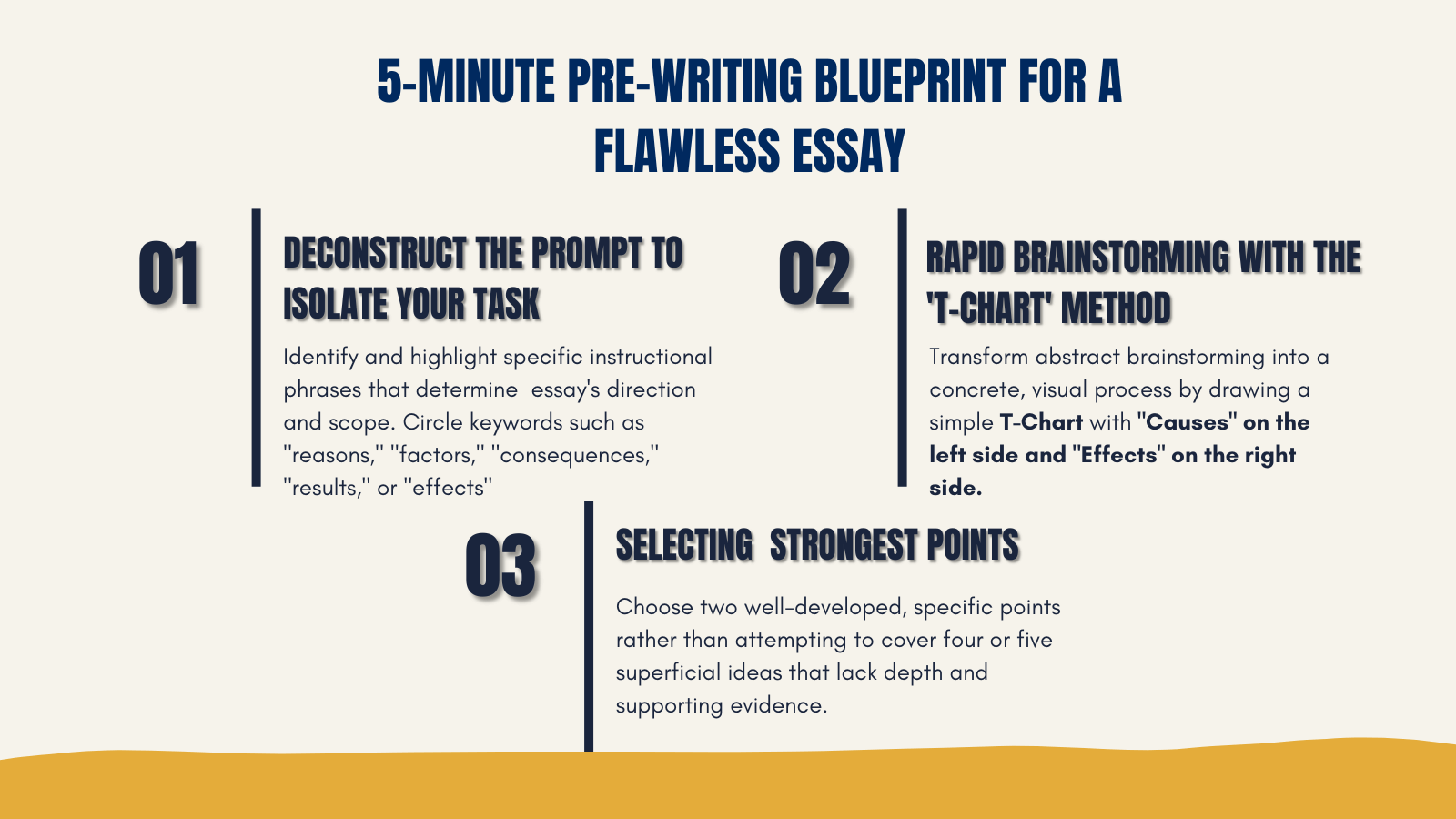
1. Deconstruct the Prompt to Isolate Your Task
Reading like an examiner means identifying and highlighting specific instructional phrases that determine your cause and effect writing essay’s direction and scope. Circle keywords such as “reasons,” “factors,” “consequences,” “results,” or “effects” to understand exactly what analysis the question demands from your response.
2. Rapid Brainstorming with the ‘T-Chart’ Method
Transform abstract brainstorming into a concrete, visual process by drawing a simple T-Chart with “Causes” on the left side and “Effects” on the right side. This systematic approach helps you generate relevant ideas for cause and effect writing quickly while maintaining the logical connections that examiners expect to see in high-scoring responses.
Spend exactly two minutes filling both columns with any relevant ideas, then move to the selection phase rather than continuing to brainstorm, as time management remains crucial for overall essay completion.
3. Selecting Your Strongest Points for Maximum Impact
- In cause and effect writing, choose two well-developed, specific points rather than attempting to cover four or five superficial ideas that lack depth and supporting evidence.
- Your selected causes and effects should be ideas you can easily explain with concrete examples, specific statistics, or real-world illustrations that demonstrate your knowledge and analytical capabilities.
- Remember that examiners reward depth over breadth, and a thoroughly explained point with relevant supporting details always scores higher than multiple underdeveloped ideas that lack substance or clear connections to the main argument. For more ideas on organizing complex essay arguments, explore our guide on Connectors for Task 2 Writing — it explains how to create smooth cause–effect relationships naturally.
Two Proven Structures for IELTS Cause and Effect Writing
When writing a cause and effect writing, choosing the right structure is crucial for clearly presenting your ideas. Two commonly used formats are the Block and Chain structures. Each serves a different purpose depending on the topic’s complexity and the nature of the relationships between causes and effects. The table below compares these two approaches to help you decide which one best suits your writing goals.

|
Feature
|
Block Structure
|
Chain Structure
|
|---|---|---|
|
Organization
|
Divides essay into large sections: Introduction → Causes → Effects → Conclusion
|
Each body paragraph links a specific cause directly to its effect
|
|
Best for Topics
|
Broad, multifaceted issues with multiple causes and outcomes
|
Specific issues with direct, identifiable cause-effect relationships
|
|
Examples of Suitable Topics
|
Urbanization, climate change, technological advancement
|
Social media and mental health, economic policy and employment
|
|
Logical Flow
|
Categorizes ideas broadly; reader sees all causes first, then all effects
|
Follows a linear, analytical progression—each paragraph shows a cause-effect pair
|
|
Simplicity vs. Complexity
|
Simple and clear; ideal for beginner or general audiences
|
More advanced; demonstrates higher-level critical thinking
|
|
Purpose
|
To show how a variety of factors lead to wide-ranging consequences
|
To show how specific causes lead to specific outcomes in a logical sequence
|
Cause and Effect writing Band 9 Model Answer – Specific Analysis
Question: “In many countries, the number of people suffering from stress-related illnesses is increasing dramatically. What do you think are the causes of this problem, and what measures could be taken to tackle it?”
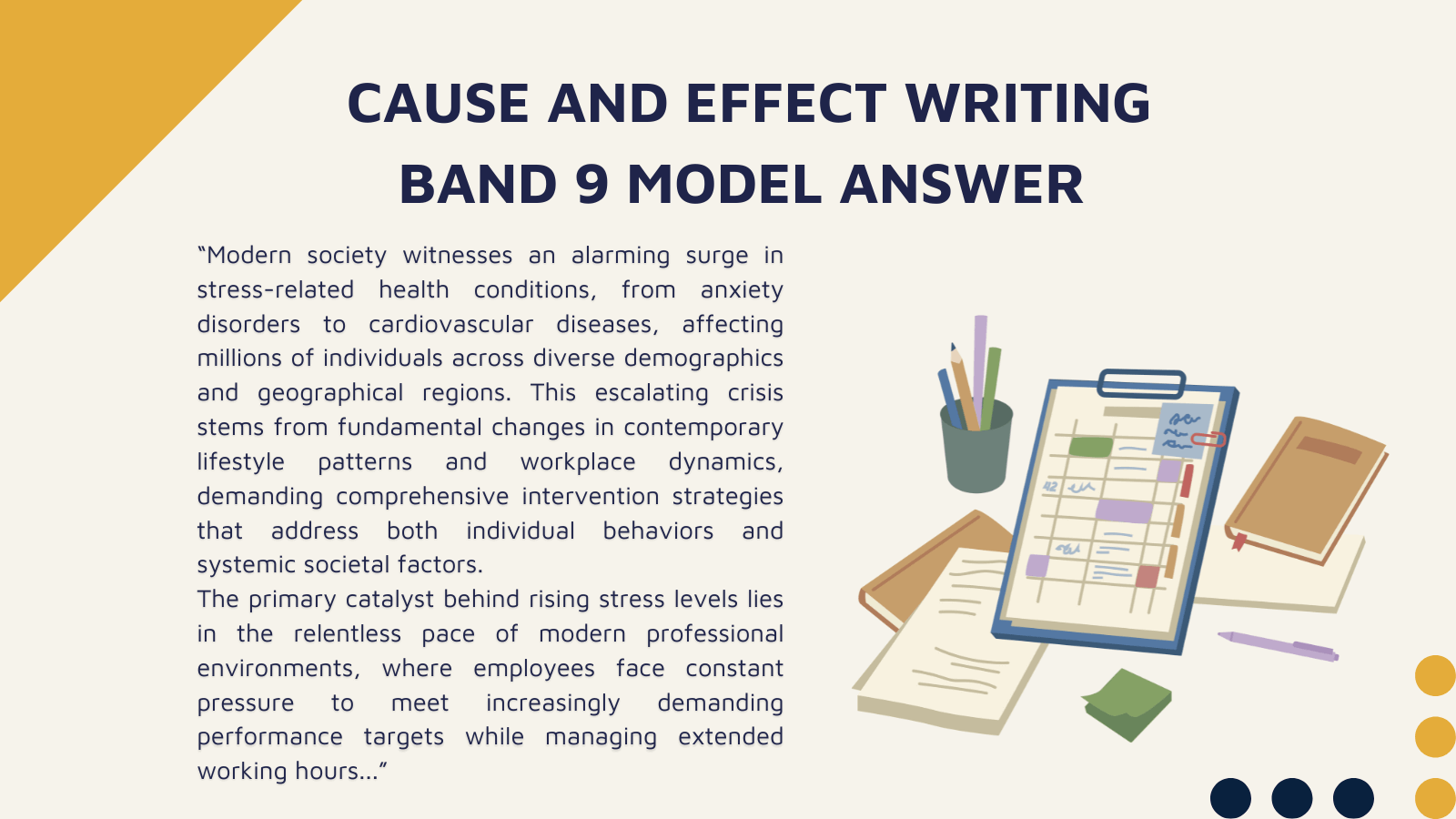
Modern society witnesses an alarming surge in stress-related health conditions, from anxiety disorders to cardiovascular diseases, affecting millions of individuals across diverse demographics and geographical regions. This escalating crisis stems from fundamental changes in contemporary lifestyle patterns and workplace dynamics, demanding comprehensive intervention strategies that address both individual behaviors and systemic societal factors.
The primary catalyst behind rising stress levels lies in the relentless pace of modern professional environments, where employees face constant pressure to meet increasingly demanding performance targets while managing extended working hours. As a direct consequence of this workplace intensity, individuals experience chronic fatigue, disrupted sleep patterns, and deteriorating mental health conditions that manifest as physical symptoms including hypertension, digestive disorders, and immune system dysfunction.
Additionally, the pervasive influence of digital technology creates unprecedented levels of information overload and social comparison, particularly through social media platforms that promote unrealistic lifestyle expectations and constant connectivity demands. This technological saturation results in reduced quality time for relaxation and personal relationships, leading to social isolation and heightened anxiety levels that compound existing stress factors from professional and personal responsibilities.
Addressing this multifaceted problem requires coordinated efforts from governments, employers, and individuals to create sustainable lifestyle changes and supportive environmental conditions. Governments should implement mandatory stress management programs in educational curricula while regulating maximum working hours to protect employee welfare, and employers must prioritize workplace wellness initiatives including flexible scheduling options and mental health support services that acknowledge the genuine impact of occupational stress on productivity and employee retention.
The Examiner’s Analysis:
- The opening paragraph demonstrates exceptional Task Response through its clear position statement and comprehensive overview that directly addresses both aspects of the two-part question. Notice how “this escalating crisis stems from fundamental changes” immediately signals the cause and effect essay format while promising detailed analysis in subsequent paragraphs.
- The thesis statement for cause and effect writing essay effectively previews the main arguments: workplace pressures and technological influences as primary causes, with specific health consequences clearly identified through phrases like “manifest as physical symptoms” that demonstrate sophisticated vocabulary usage.
- Body paragraph coherence shines through transitional phrases such as “As a direct consequence” and “Additionally,” which create seamless logical flow while maintaining clear cause-effect relationships that examiners actively seek in higher band responses.
You can also practice with real exam-style prompts such as In many countries, the proportion of older people is steadily increasing to strengthen your analytical writing skills.
Avoiding Common Traps in Cause and Effect Writing That Lower Scores
- Simply Listing Without Analysis – Many candidates present causes and effects as basic lists without explaining the relationships or mechanisms that connect them, resulting in superficial responses that fail to demonstrate analytical thinking required for higher bands.
- Confusing Causes with Effects – Misidentifying what leads to what creates logical inconsistencies that immediately signal poor understanding to examiners, particularly when candidates present solutions as causes or describe symptoms instead of underlying factors.
- Using Vague, Unsupported Claims – Statements like “stress affects everyone” without specific examples, statistics, or clear explanations fail to meet the evidence requirements that distinguish sophisticated academic writing from general observations.
- Ignoring the Question Balance – In cause and effect writing essays, focus heavily on causes while barely addressing effects (or vice versa) creates unbalanced responses that cannot achieve high Task Response scores, regardless of language accuracy or vocabulary sophistication.
- Weak Paragraph Development – Body paragraphs containing only one or two sentences lack the depth and development necessary for band 7+ scores, as examiners expect substantial explanation and support for each main point presented.
From Memorization to Mastery
The greatest threat to your IELTS success, specifically cause and effect writing, lies not in lacking a perfect template, but in failing to understand the underlying principles that govern effective cause and effect essay model responses. Memorized structures collapse under exam pressure, while mastered fundamentals adapt to any question variation, ensuring consistent performance that reflects genuine analytical capability rather than rehearsed responses that examiners easily identify and penalize accordingly. For full IELTS preparation, explore more free lessons and model essays on the IELTS Sample Bank homepage — your complete resource for mastering Writing Task 2.