

Picture this: you’re facing an IELTS Writing Task 2 question that asks you to explore two conflicting viewpoints, and instead of panic, you feel confident. You recognize the discuss both views essay format instantly, your mind already mapping out a strategic four-paragraph structure that will impress examiners.
This scenario isn’t wishful thinking—it’s entirely achievable with the right preparation. The discuss both views essay stands as both the most intellectually demanding and potentially rewarding task in IELTS Writing Task 2. While many candidates stumble by treating it like a simple opinion piece, those who master its nuanced requirements often achieve their highest scores.
I. How to Identify and Understand Discuss Both Views Essays
While Opinion Essays test your ability to argue persuasively, Discussion Essays assess a different critical skill: objective analysis before judgment. This IELTS essay type requires you to step back from personal bias, present both perspectives fairly with equal development, then deliver your informed conclusion.
1. Defining the Core Objective
What Is a Discuss Both Views Essay? A discuss both views essay requires you to present two opposing perspectives on a topic with equal detail before stating your personal position. You must explain why people hold each viewpoint, using specific reasons and examples, then conclude with your own reasoned judgment.
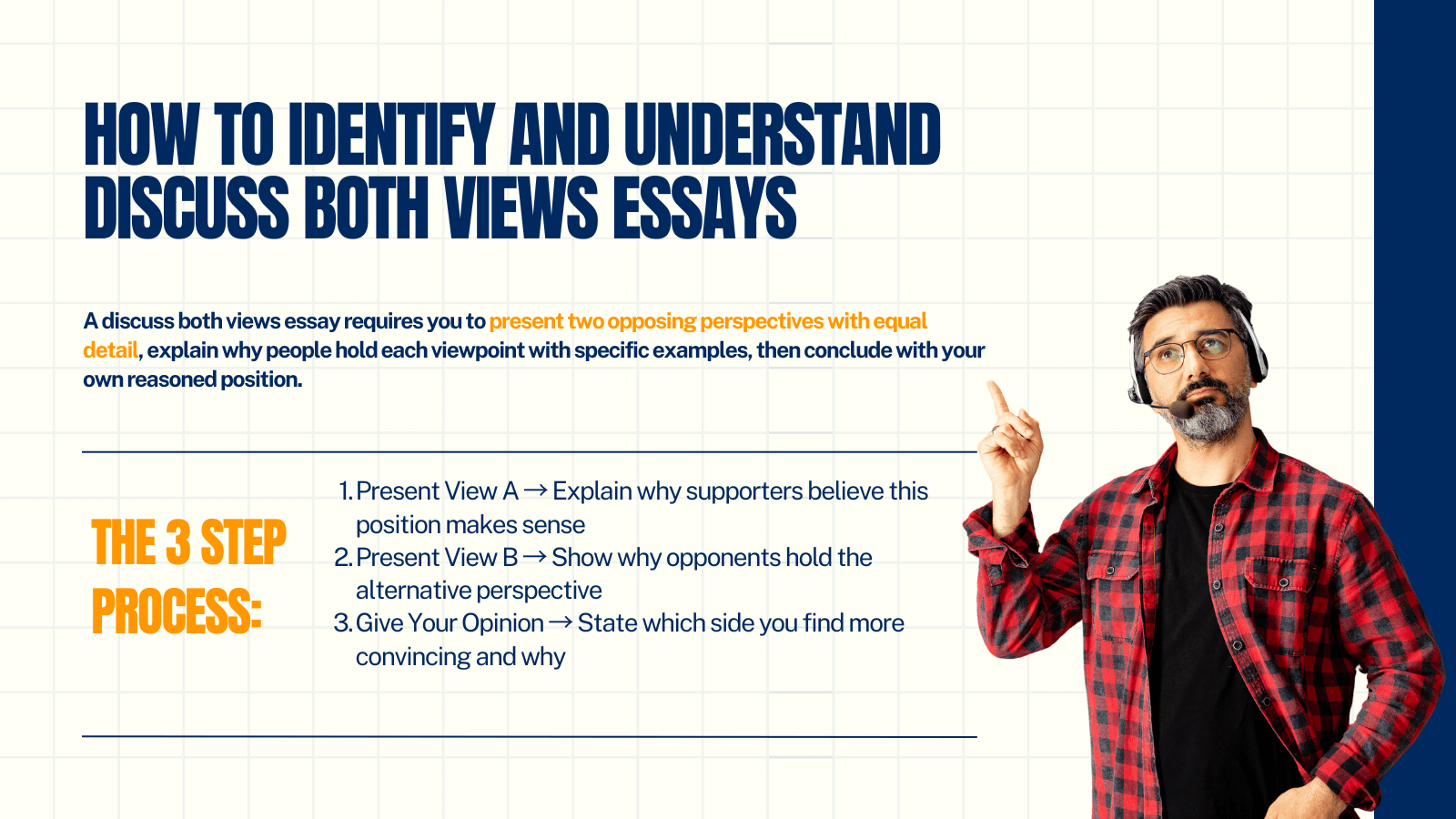
The Three-Step Process:
- Present View A → Explain why supporters believe this position makes sense
- Present View B → Show why opponents hold the alternative perspective
- Give Your Opinion → State which side you find more convincing and why
Essential vs. Forbidden Approaches:
| What You Must Do | What You Must Avoid |
| Give equal space to both viewpoints | Show obvious bias toward one side |
| Explain the logic behind each position | Dismiss either view as “wrong” or “stupid” |
| Use specific examples for both sides | Present one view superficially |
| Save your opinion for the conclusion | State your preference in body paragraphs |
Key Difference from Opinion Essays:
- Opinion Essay: “Here’s what I think and why I’m right”
- Discuss Both Views Essay: “Here’s what each side thinks, here’s why both have merit, and here’s my reasoned conclusion”
The Examiner’s Expectation: Examiners want to see that you can understand complex issues from multiple angles before forming your own judgment. This mirrors real-world decision-making where leaders must consider various stakeholder perspectives before choosing a course of action.
2. How to Instantly Recognize the Question
You can immediately identify a discuss both views essay through specific language patterns that explicitly request analysis of contrasting perspectives. These questions typically include phrases such as:
- Some people believe… while others argue
- Discuss both views and give your opinion
- What are the arguments on both sides of this debate?
The fundamental differences between discuss both views essays and opinion, agree or disagree IELTS essays become clear when examining their core requirements and structural approaches:
| Feature | Discuss Both Views Essay | Opinion Essay |
| Core Task | Present both perspectives equally before stating your position | Argue for your position throughout the essay |
| Body Paragraph Focus | One paragraph for each opposing view | All paragraphs support your main argument |
| Placement of Your Opinion | Clearly stated in conclusion after balanced analysis | Introduced early and reinforced throughout |
This distinction ensures that you approach each essay type with the appropriate strategy, avoiding the common mistake of treating a discuss both views essay as a simple opinion piece where you immediately take sides without proper consideration of alternative perspectives.
II. The 4-Paragraph Discuss Both Views Essay Structure That Works
Why This Structure Works: Professional IELTS examiners consistently award higher band scores to essays following the four-paragraph format because it demonstrates clear organization and systematic task completion. This structure has proven effective across thousands of successful IELTS responses, providing you with a reliable roadmap that addresses all assessment criteria without confusion or omission.
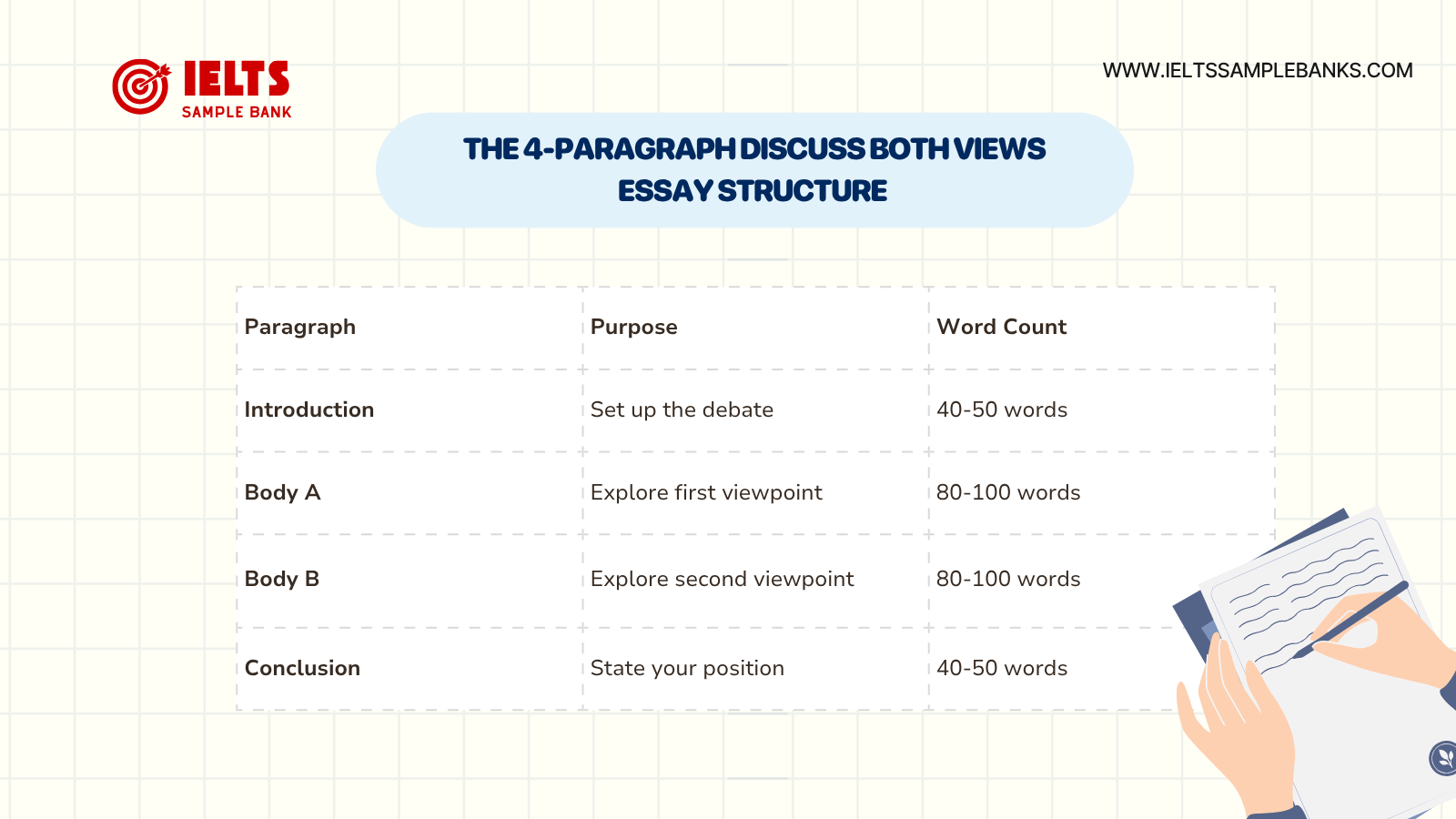
Discuss both views essay structure:
| Paragraph | Purpose | Word Count | Key Focus |
| Introduction | Set up the debate | 40-50 words | Introduce both views + thesis |
| Body A | Explore first viewpoint | 80-100 words | Detailed analysis of View A |
| Body B | Explore second viewpoint | 80-100 words | Balanced analysis of View B |
| Conclusion | State your position | 40-50 words | Summarize + give clear opinion |
Step-by-Step Construction Guide:
- Step 1: Introduction Framework Begin with context about the debate, then use transitional language like “While some people argue that [View A], others believe that [View B].” End with a clear thesis statement: “This essay will examine both perspectives before arguing that [your position].”
- Step 2: Body Paragraph Development Each body paragraph follows the same internal structure: topic sentence introducing the viewpoint, explanation of the reasoning behind this position, specific example supporting the argument, and linking sentence connecting back to the main debate.
- Step 3: Conclusion Strategy Open with “In conclusion” or “To summarize,” briefly restate both viewpoints in one sentence, then dedicate your remaining words to clearly expressing your opinion with supporting reasoning.
III. A Step-by-Step Guide for Discuss Both Views Essay
1. How to Write Strong Introductions and Conclusions
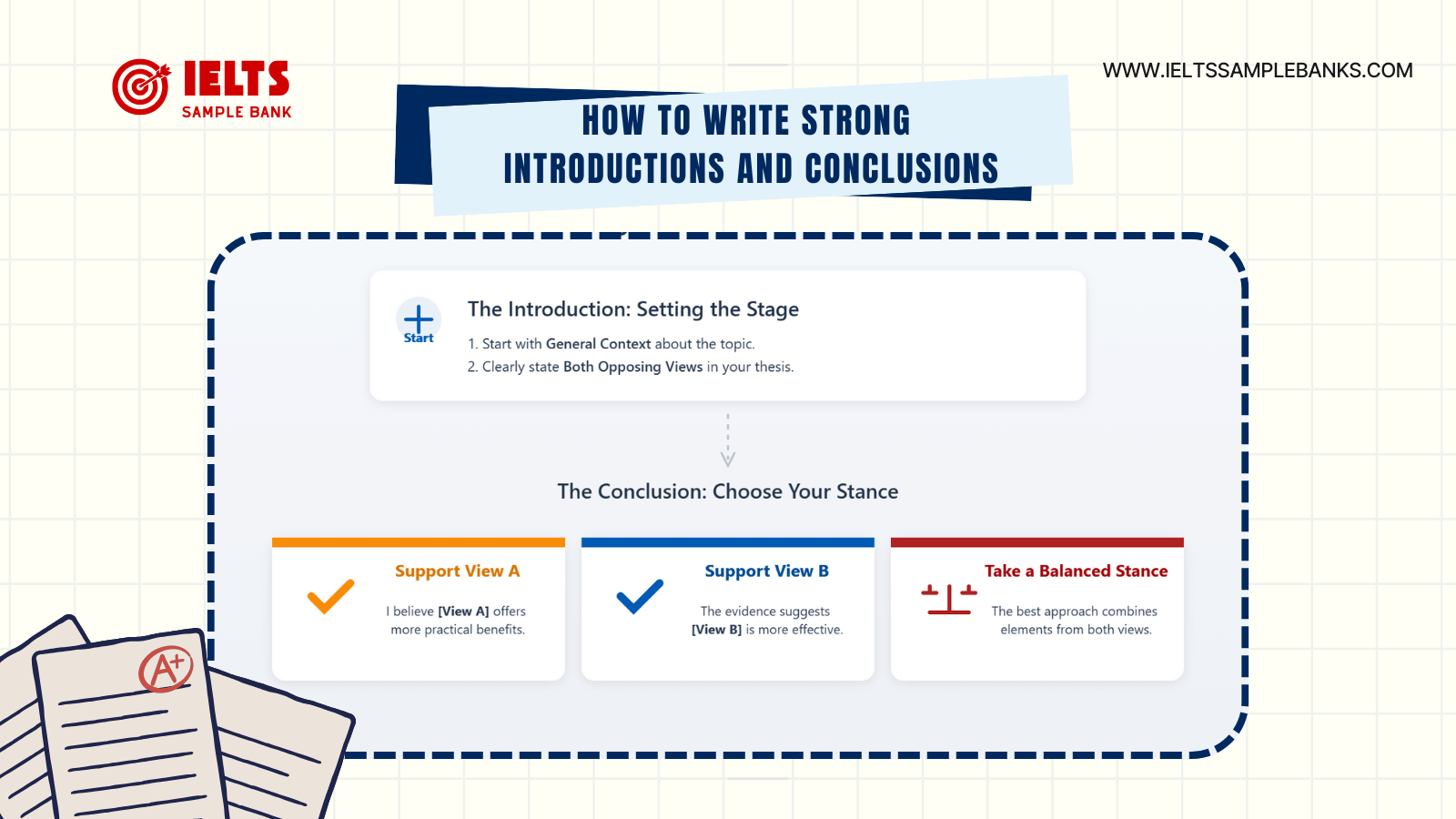
Introduction Strategy (2-sentence formula): Start with general context about the topic, then present both viewpoints clearly. Use this template: “While some individuals advocate for [Position A], others contend that [Position B] represents a more viable approach.”
Three Conclusion Options:
- Option 1: Support View A “After careful consideration of both arguments, I believe that [Position A] offers more practical benefits because…”
- Option 2: Support View B “While both perspectives have merit, the evidence suggests that [Position B] addresses the core issues more effectively…”
- Option 3: Balanced Stance “Upon reflection, the most reasonable position combines elements of both approaches depending on specific circumstances…”
2. Building Strong Body Paragraphs with PEEL Framework
P – Point (Topic Sentence) State the main argument clearly
“Supporters of traditional education argue that structured classroom learning provides essential discipline.”
E – Explain (Reasoning) Explain why people believe this viewpoint
“They contend that formal environments teach students responsibility and time management skills.”
E – Example (Specific Illustration) Provide concrete evidence or scenarios
“For instance, students attending regular classes develop punctuality through daily attendance requirements.”
L – Link (Connection) Connect back to the broader debate
“This structured foundation prepares students for professional environments where discipline determines success.”
Why PEEL Works: This method ensures each paragraph in “ielts discuss both views essay” contains substantial development rather than superficial statements. Examiners can easily identify your main point, understand your reasoning, see supporting evidence, and follow your logical progression throughout the discuss both views essay.
IV. The Full Writing Task 2 Discuss Both Views Sample
Consider this authentic IELTS Writing Task 2 discuss both views essay that exemplifies the discuss both views format:
Question: “Some people believe that studying at university or college is the best route to a successful career, while others believe that it is better to get a job straight after school. Discuss both views and give your opinion.”
Model Answer:
The debate over whether young people should pursue higher education or enter the workforce immediately after secondary school represents a fundamental question facing graduates worldwide. While university advocates argue that degrees provide essential career opportunities, employment supporters contend that work experience offers greater practical advantages.
Those who support university education maintain that higher qualifications significantly increase earning potential and career advancement opportunities. University provides specialized knowledge, critical thinking skills, and professional networks that cannot be replicated through on-the-job training alone. For instance, careers in medicine, law, and engineering require comprehensive theoretical understanding that only academic programs can deliver effectively. Furthermore, research indicates that degree holders earn approximately 60% more over their careers than non-graduates in most developed economies.
Conversely, advocates for immediate employment emphasize that real-world work experience provides practical skills and financial independence that university students lack. Entering the workforce early allows young people to discover their genuine career interests without accumulating significant student debt. Many successful entrepreneurs built thriving careers without degrees by gaining hands-on experience and developing practical problem-solving abilities. Additionally, early career starters accumulate valuable experience and income during the years their peers spend studying.
After carefully weighing both perspectives, I believe university education generally provides superior long-term prospects for most individuals, though the optimal choice depends on specific career goals. While immediate employment suits certain vocational paths, the specialized knowledge and higher earning potential associated with degrees make higher education more advantageous for the majority of careers in today’s knowledge-based economy.
Refer to more discuss both views IELTS essays:
- Some People Believe That Allowing Children to Make Their Own Choices
- Some People Believe That Nowadays We Have Too Many Choices
V. 4 Most Common Errors in Discuss Both Views Essay
Understanding and avoiding these critical mistakes, as identified by IELTS Sample Bank, can mean the difference between achieving your target band score and falling short of your IELTS goals, as these errors consistently appear in lower-scoring responses across all proficiency levels.
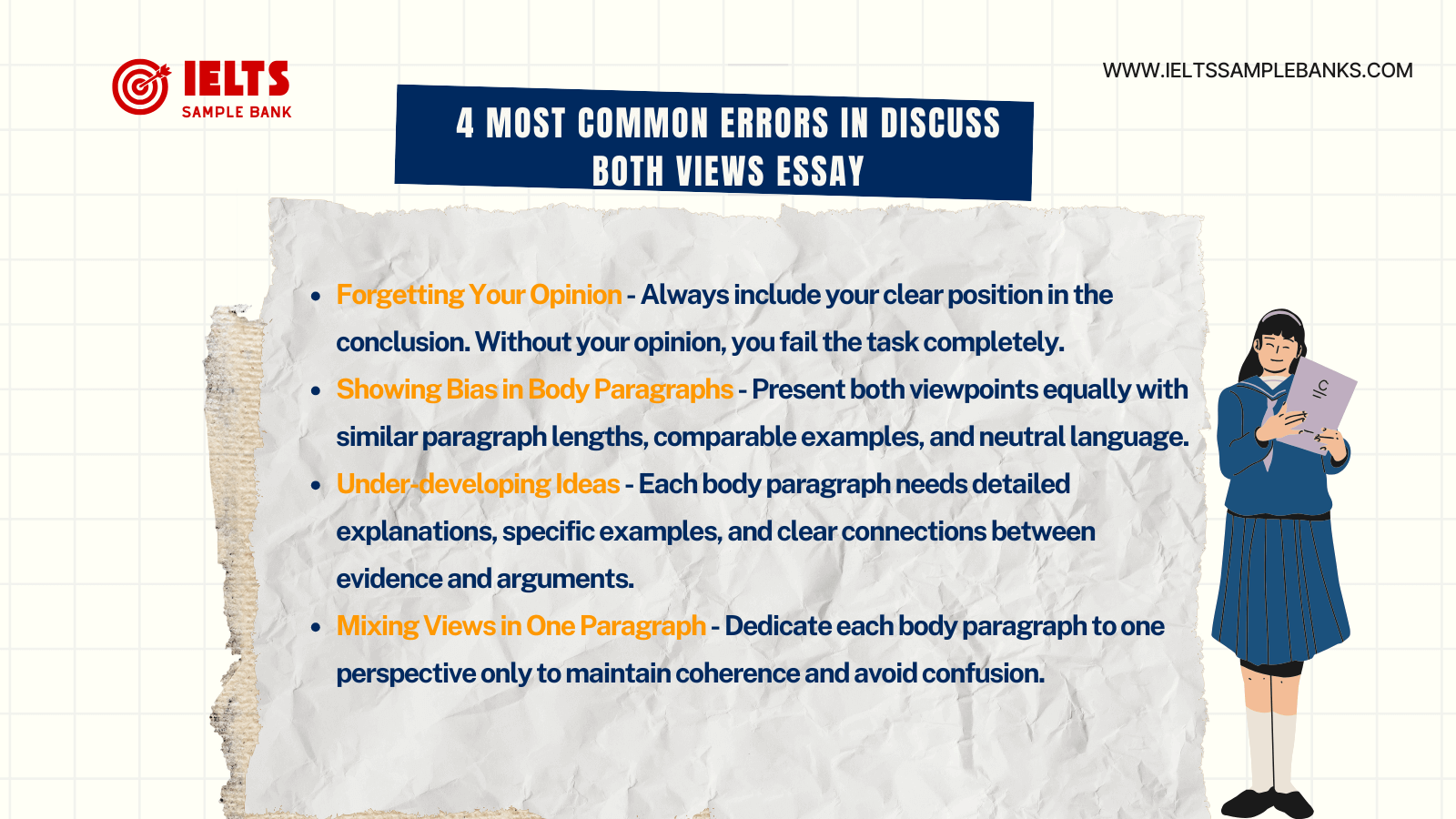
- Forgetting Your Opinion In discuss both views essay, the most serious error – always include a clear position in your conclusion. Without your opinion, you fail to complete the task regardless of how well you discuss both views.
- Showing Bias in Body Paragraphs Present both viewpoints equally using similar paragraph lengths, comparable examples, and neutral language. Avoid dismissive or emotional terms that favor one side.
- Under-developing Ideas Each body paragraph needs detailed explanations, specific examples, and clear connections between evidence and arguments. Superficial treatment prevents high band scores.
- Mixing Views in One Paragraph Dedicate each body paragraph to one perspective only. Combining both views in a single paragraph creates confusion and hurts your coherence score.
VI. Conclusion
Mastering the discuss both views essay develops critical thinking skills that extend far beyond IELTS, preparing you for academic study and professional decision-making throughout your career. The systematic approach outlined in this guide provides the tools necessary to tackle any discuss both views essay with confidence, from initial planning through final conclusion.
Success in this challenging format comes through practicing the structured methodology presented here, combined with balanced argumentation and sophisticated language use. Your ability to analyze complex topics fairly while presenting well-reasoned judgments will improve your IELTS Writing Task 2 scores and prepare you for the analytical thinking required in higher education and professional environments.