

Understanding how to tackle diagram-based questions in IELTS Writing Task 1 represents a crucial skill that many test-takers find challenging. When you encounter a water filtration diagram, you must demonstrate your ability to describe processes, identify key stages, and present information in a logical, coherent manner. IELTS Sample Bank will equip you with the essential strategies, vocabulary, and sample responses needed to excel in this specific task type.
The water filtration diagram typically appears as a process question, requiring you to explain how contaminated water transforms into clean drinking water through various filtration stages. Your success depends on accurately identifying the sequence of events, understanding the function of each component, and presenting this information using appropriate academic language and structures.
IELTS Writing Task 1 Question Water Filtration Diagram Analysis
Task Prompt: The diagram below shows how a simple water filter is constructed and how it functions to produce clean drinking water. Summarise the information by selecting and reporting the main features, and make comparisons where relevant. Write at least 150 words.
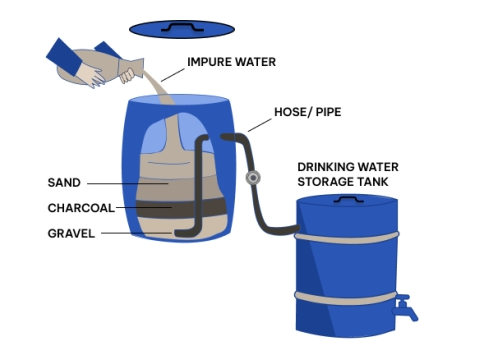
This question demands that you examine the water filtration diagram systematically, identifying each stage of the purification process from contaminated input to clean output. The task requires you to describe the construction elements and explain the functional relationship between different components. You must organize your response logically, typically following the chronological order of the filtration process while highlighting the most significant features and their roles in producing potable water.
The assessment focuses on your ability to select relevant information, avoid unnecessary details, and demonstrate understanding of the process through clear, accurate descriptions. Your response should maintain objectivity, using appropriate technical vocabulary while ensuring accessibility for a general academic audience.
Water Filtration Diagram Model Responses: Progressive Skill Development
Band 6 Model Answer – (Intermediate B1–B2)
The diagram shows a simple water filtration system that helps turn dirty water into drinkable water using natural materials.
At the top of the system, impure water is poured into a container. Inside this container, there are three layers of materials arranged one below another. The first layer is sand, which stops small dirt particles. The next layer is charcoal, which removes chemicals and bad smells. The last layer at the bottom is gravel, which traps larger dirt like leaves or stones.
After passing through all these layers, the water becomes much cleaner. A hose connected to the bottom of the filter carries the cleaned water into a drinking water storage tank, where it is collected and stored for later use.
This simple water filter does not use electricity. It works with gravity and natural materials, making it suitable for rural areas without modern equipment.
(Word count: 153)
Band 7+ Model Answer – (Advanced B2–C1)
The diagram illustrates a basic gravity-based water filtration system designed to purify contaminated water using a series of natural filtration materials.
The process begins when impure water is poured into the top of a cylindrical container. This container is divided into three vertical layers arranged from top to bottom: sand, charcoal, and gravel. As the contaminated water slowly percolates downward, each layer plays a distinct role in the purification process.
The top layer of sand removes fine particles, dust, and sediment. Next, the charcoal layer acts through chemical adsorption, effectively eliminating toxins, unpleasant odors, and impurities. Finally, the bottom gravel layer captures larger suspended solids and debris.
Once filtered, the treated water exits through a connected hose or pipe and is stored in a drinking water storage tank. This straightforward yet effective system relies entirely on gravity and common natural materials, offering a cost-efficient solution for producing potable water in remote or resource-limited locations.
(Word count: 170)
Systematic Response Development Guide
To write a high-scoring IELTS Writing Task 1 answer for a water filtration diagram, you need more than just describing steps—you must show clarity, structure, and precise academic language. The following guide breaks down the essential parts of your response, helping you organize ideas logically, use accurate vocabulary, and demonstrate strong task understanding.
- Opening Statement Construction: Begin your water filtration diagram response by paraphrasing the task prompt, clearly identifying the diagram’s purpose and the process it illustrates. Avoid copying the exact wording from the question, instead demonstrating your language flexibility by using synonymous expressions and varied sentence structures.
- Process Overview Presentation: After the introduction, provide a concise overview that captures the essential transformation occurring in the water filter assembly writing task 1. This overview should mention the starting point (contaminated water), the key stages involved, and the end result (clean drinking water) without delving into specific details.
- Sequential Stage Description: Organize your main body paragraphs to follow the logical progression of the filtration process. Start with the input stage, progress through each filtration layer systematically, and conclude with the output phase. Ensure smooth transitions between stages using appropriate linking expressions.
- Component Function Analysis: For each major component or stage, explain both its physical characteristics and its functional role in the overall process. Describe how each element contributes to the water purification objective and how it relates to adjacent components in the system.
Essential Language Resources for Water Filtration Diagram IETLS
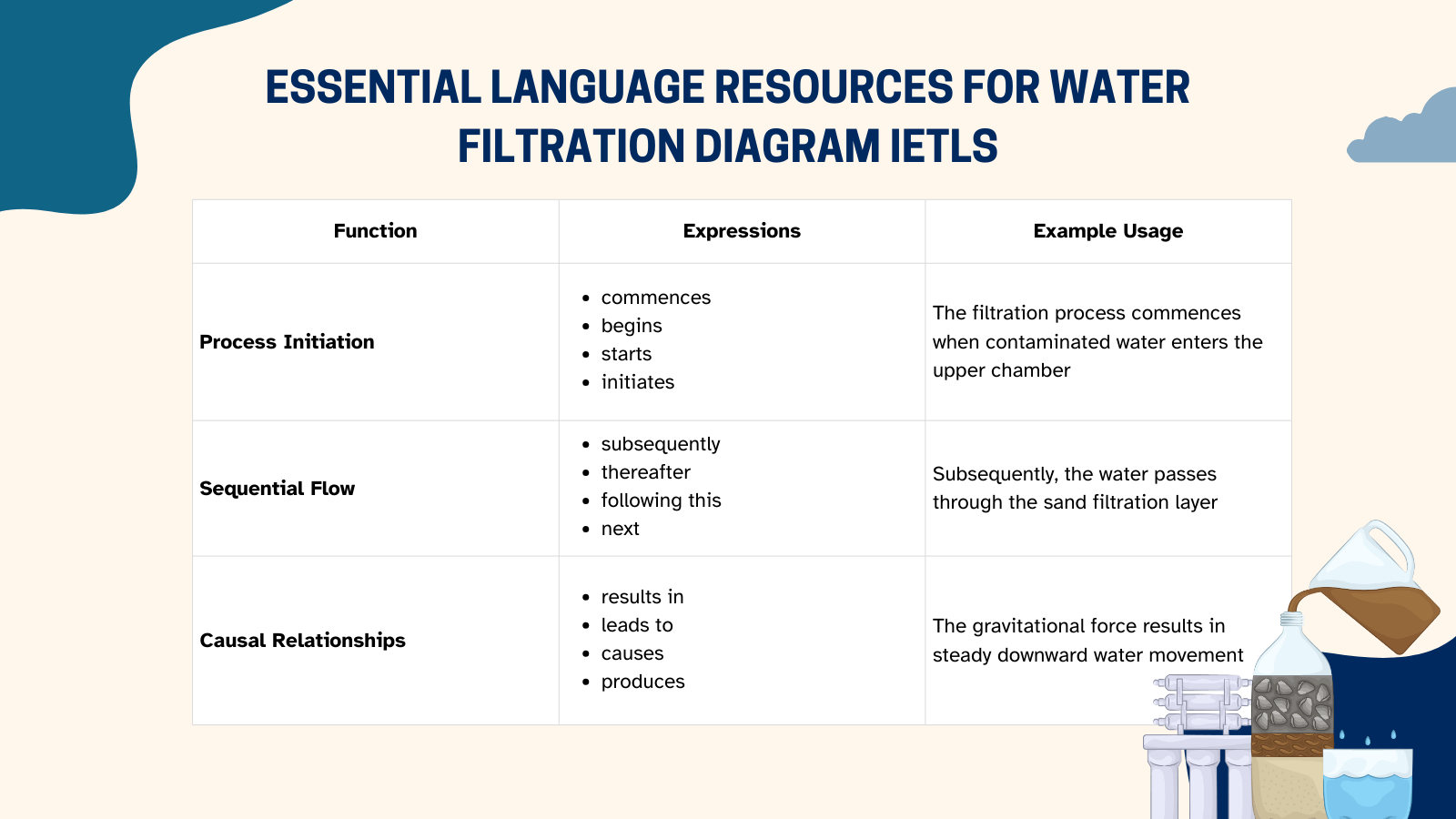
To effectively describe a water filtration diagram in Writing Task 1 IELTS, it’s important to use accurate vocabulary, clear sequencing, and passive voice structures. The table below summarizes essential words and phrases that will help you write a well-organized and coherent response.
|
Category
|
Examples / Phrases
|
|---|---|
|
Process Sequence Words
|
Firstly, then, next, after that, subsequently, meanwhile, eventually, finally
|
|
Process Verbs
|
is poured, is filtered, flows into, passes through, enters, exits, is stored, is purified, undergoes filtration
|
|
Water Filtration Terms
|
impure water, clean water, filtered water, sediment-laden water, portable water
|
|
Common Filter Materials
|
sand, gravel, charcoal, cotton, filter paper, iron mesh
|
|
Components/Devices
|
tank, container, pipe, faucet, filtration unit, collection chamber, chlorination tank
|
|
Contaminant Vocabulary
|
dirt, sediment, particles, microorganisms, impurities, contaminants
|
|
Passive Voice Examples
|
Water is collected in a container. It is passed through different layers.
|
|
Describing Purpose
|
used to remove impurities, in order to trap particles, for the purpose of purifying water
|
|
Location Phrases
|
at the top, below this layer, at the bottom, in the middle section, next to the container
|
|
Cause & Effect
|
As a result, consequently, this allows, this helps to, due to the presence of
|
|
Introductory Sentence
|
“The diagram illustrates a simple water filtration system used to purify dirty water for safe consumption.”
|
|
Describing Flow
|
“The process begins with dirty water entering the top container…”
|
Mastering Water Filtration Diagrams
Success with water filtration diagram tasks requires balancing technical accuracy with clear, accessible language that demonstrates English proficiency without excessive complexity. Focus on communicating the process clearly rather than showcasing technical knowledge. Select relevant features, organize information logically, and use appropriate academic language to describe the transformation from contaminated input to purified output. Practice with various filtration systems prepares you for test variations while building transferable skills.