

Examining high-quality model responses reveals exactly how successful candidates apply the principles discussed throughout this guide, transforming theoretical knowledge into practical writing that achieves Band 8 and 9 scores for IELTS Writing Task 1 Academic.
The following sample of IELTS Sample Bank demonstrates effective structure, appropriate vocabulary selection, and strategic data presentation in action, allowing you to see precisely how overview statements, body paragraph organization, and comparative language work together to create cohesive, high-scoring responses. Study not just what is written, but why specific choices strengthen the overall response and how you can replicate these techniques in your own practice.
What Is IELTS Writing Task 1 Academic?
The IELTS Academic Writing section includes Task 1, which tests your ability to interpret, describe, and summarize visual information within a strict 20-minute timeframe using formal academic English. Unlike Writing Task 2, which requires argumentative essays with personal opinions, IELTS Writing Task 1 Academic demands objective data reporting without speculation or viewpoint injection. This task also differs from General Training Task 1, where you compose letters rather than analyzing graphs, charts, tables, or diagrams that present factual information.
Examiners evaluate far more than simple data reporting—they assess your interpretation skills, command of precise academic language, and ability to identify meaningful patterns while filtering out insignificant details. Task achievement, one of four equally weighted scoring criteria, measures how completely you address all requirements while maintaining clarity and relevance, demonstrating that you understand both what the visual shows and what it means in a broader context.
The 6 Major IELTS Writing Task 1 Academic Types You Must Know
Understanding the specific visual formats you might encounter allows you to develop targeted strategies rather than approaching each examination with unnecessary anxiety about unknown challenges. The six fundamental task types appear with varying frequency, and recognizing their distinct characteristics enables you to respond with appropriate structure and vocabulary immediately upon seeing your assigned task.
1. Line Graph
A line graph is one of the most common visual types in IELTS Writing Task 1 Academic. It is used to represent changes or trends over a period of time. The data points are plotted on a grid and connected by lines, making the pattern of change easily visible. The x-axis typically represents time (years, months), while the y-axis shows numerical values such as percentages or population counts.
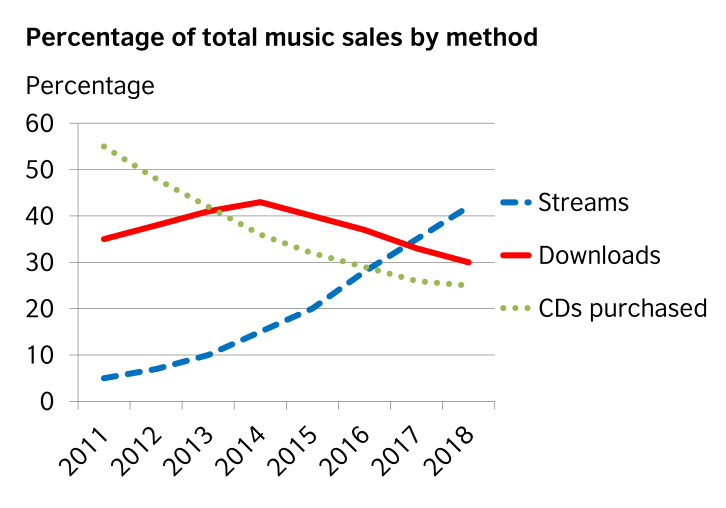
When writing your response:
- Identify the period of time shown and units of measurement on both axes.
- Determine the number of lines and what each one represents.
- Focus on key features in this IELTS Writing Task 1 Academic: starting values, ending values, peaks, lows, and periods of steady growth or decline.
- Avoid simply describing each point; instead, summarize trends and make comparisons between lines.
Use language that describes movement (e.g., “rose gradually”, “remained stable”, “declined sharply”) and apply appropriate tenses, usually past simple.
2. Bar Chart
Bar charts feature rectangular bars used to compare quantities among categories or groups. The bars can be vertical or horizontal, depending on the chart, but your reporting approach remains the same.
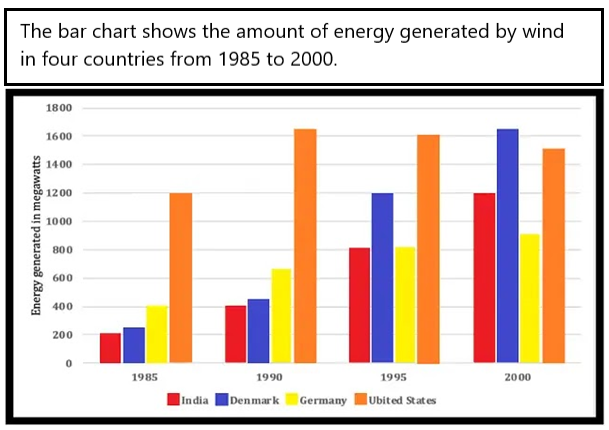
Key steps in this IELTS Writing Task 1 Academic type:
- Observe what each axis represents: categories vs. values.
- Compare the lengths of different bars across one or more groups.
- Identify which categories are the highest or lowest, and how the values shift over time (if a timeline is included).
Your overview should summarize 2–3 prominent trends or contrasts. In the main body paragraphs, group similar data instead of listing every detail.
Bar charts serve one main function in IELTS Writing Academic: comparative reporting. Strong linguistic control of comparative structures (e.g., “more than”, “the highest”, “slightly lower than”) will increase your score.
3. Pie Chart
A pie chart shows proportions and percentages of a total figure divided into segments. It is often used to illustrate how something is distributed or categorized.
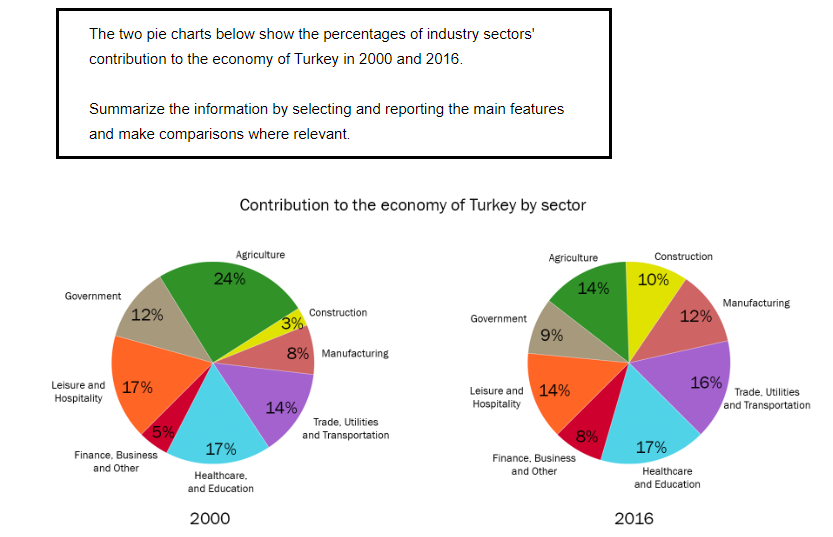
Common features:
- Each section in this IELTS Writing Task 1 Academic represents a category and is labeled or color-coded.
- Pie charts may compare two or more datasets from different years or categories.
- Your job is to highlight the largest, smallest, and relatively equal sections, and describe the shifts if shown across multiple periods.
Important rules:
- If the chart has a time component, focus on how proportions changed over time.
- If there is no time element, stick to static comparison — avoid using verbs like “increase” or “decline”; instead use: “was larger than”, “made up the majority”, “was the smallest proportion”.
4. Table
Table chart presents numerical data in rows and columns. Though not visual like IELTS Writing Task 1 Academic graphs, tables still require the same analytic description and group-based structure.
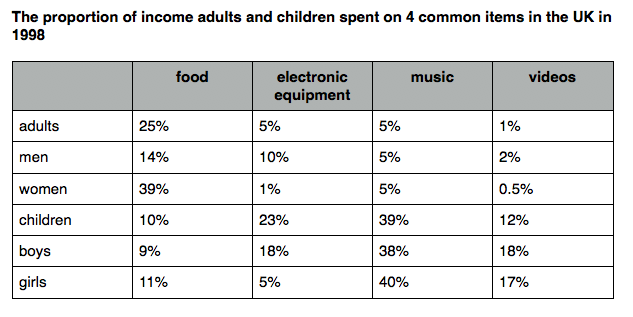
What to do:
- Read the headings carefully — identify categories, units, and time references.
- Scan for the highest, lowest, and unchanged figures.
- Focus on relevant comparisons between cells, not every number.
If the table includes time references, use appropriate tenses (past simple, present simple, etc.). Avoid copying all the data — summarization and selection are more valuable. Highlight patterns, group similarities, and use cautious numbers (“approximately”, “just under”) when needed.
5. Process Diagram
The process diagram task is different from other IELTS Writing Task 1 Academic visuals. Instead of numbers, it shows the stages of a process — either natural (e.g., the water cycle) or man-made (e.g., electricity production).
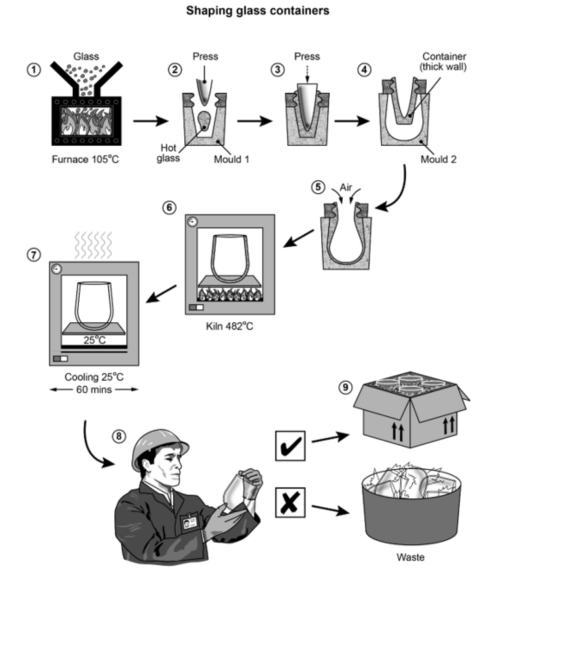
Natural process characteristics:
- No human involvement
- Use active voice to describe changes over time (e.g., “water evaporates”, “clouds form”)
Man-made process characteristics:
- Human-controlled stages like manufacturing or construction
- Use passive voice appropriately (e.g., “the material is heated”, “waste is removed”)
To structure your response, explain the steps in logical order. Choose linking phrases like: “first”, “then”, “after that”, “finally”. Include input, output, transformation, tools, or phases as shown.
6. Map
Map tasks test your ability to describe physical or spatial changes across a specific location, usually at two different times. They often show urban development, infrastructure expansion, or environmental modifications.
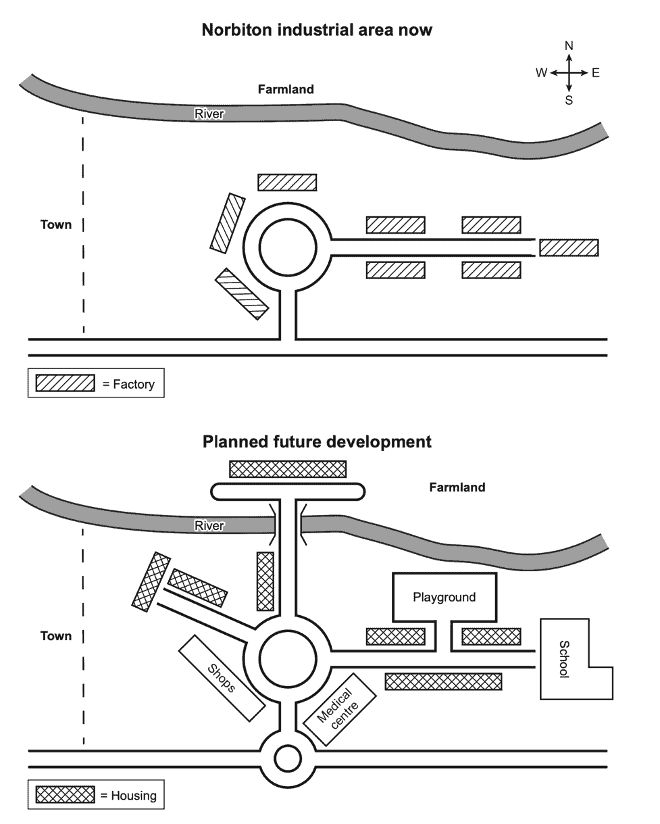
There are two types of map tasks:
- Single map describing the features of a location — focus on directions and positioning language (e.g., “to the north of”, “adjacent to”, “next to”).
- Comparison maps across different time periods (past/present/future) — emphasize added, removed, or modified features and use correct tenses.
For high marks:
- Group changes logically: buildings, roads, public/green spaces.
- Describe layout shifts and highlight new additions or demolitions.
- Use prepositions of place to guide the reader visually.
Maps may look simple, but poor spatial vocabulary and failure to compare stages can limit your IELTS Writing Task 1 Academic score.
7. Mixed Charts
Mixed or multiple visual types are increasingly popular in IELTS Writing Academic. These tasks present two visuals (sometimes more) such as a bar chart and a pie chart, or a table and a line graph.
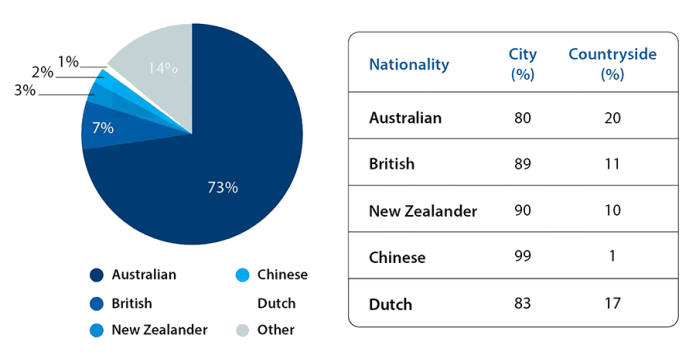
How to succeed:
- Analyze each visual in isolation first.
- Identify shared themes or categories (e.g., both show tourism in 2020, but one shows revenue and one shows visitor count).
- Organize your response by theme, not by visual — this helps create cohesion.
- Avoid repeating the same data across both charts.
In the overview, summarize the most important insights from both visuals together. In IELTS Writing Task 1 Academic body paragraphs, structure comparisons and contrasts logically, integrating information from both sources.
The Ideal Paragraph Structure for Task 1
Successful responses follow a predictable four-paragraph framework that allows examiners to quickly identify all required elements while ensuring your ideas progress logically from general observations to specific supporting details. Understanding this structure helps you write IELTS Writing Task 1 Academic efficiently within the 20-minute timeframe while meeting all assessment criteria.
Your response should include these four essential components:
- Introduction (1-2 sentences): Paraphrase the task prompt by restating what the visual shows using different vocabulary, avoiding direct copying while maintaining accuracy regarding the topic, timeframe, and units of measurement involved.
- Overview (2-3 sentences): Present two or three main trends, patterns, or key features that characterize the entire data set without including specific numbers or detailed support at this stage—this represents your most critical component for achieving Band 7+.
- Body Paragraph 1 (3-5 sentences): Explore your first major observation in depth, selecting relevant data points that illustrate the trend while using comparative language to highlight relationships between categories, time periods, or other elements present in the visual.
- Body Paragraph 2 (3-5 sentences): Address your remaining significant features, potentially examining secondary trends, notable exceptions, or additional comparisons that complement rather than repeat information from your first body paragraph, ensuring comprehensive coverage without redundancy.
This structure naturally produces a response of approximately 170-190 words, giving you a comfortable margin above the 150-word minimum while remaining concise enough to complete within your allocated time when you practice with IELTS Writing Task 1 Academic consistently.
Vocabulary and Grammar for a High Band Score
Achieving advanced band scores requires precise vocabulary that describes changes, comparisons, and patterns with specificity rather than relying on vague or repetitive expressions that limit your IELTS Writing Task 1 Academic lexical resource score. The table below provides essential language tools organized by function to help you construct Band 8+ responses.
| Language Category | High Band Examples | Purpose & Usage Notes |
| Verbs for Change/Movement | surge, plummet, plateau, fluctuate, stabilize, soar, plunge, peak, decline, expand, contract | Convey precise meaning beyond basic “increase” or “decrease”—demonstrate your command of topic-specific terminology that characterizes academic data description |
| Comparative Structures | significantly higher than, marginally less than, twice as much as, the most substantial, considerably greater, fractionally below, approximately equal to | Enable you to highlight relationships effectively and add analytical depth beyond simple statements of fact |
| Transition/Linking Phrases | in contrast, similarly, whereas, meanwhile, on the other hand, by comparison, conversely, likewise | Create coherence by showing relationships between ideas—use purposefully rather than mechanically inserting into every sentence |
| Passive Voice (Processes/Maps) | “the raw materials are transported,” “the residential area was relocated,” “impurities are removed,” “the mixture is heated” | Essential for describing processes and maps where agency isn’t specified—avoids awkwardly attempting to identify actors in every stage |
| Complex Sentence Structures | Subordinate clauses, participle phrases, relative clauses | Convey multiple pieces of information efficiently: “Having reached a peak in 2015, unemployment subsequently declined” demonstrates grammatical variety while maintaining clarity |
What to Avoid vs. What to Use in IELTS Writing Task 1 Academic
| Avoid (Informal/Basic) | Use Instead (Academic/Precise) |
| a lot of | a substantial quantity, a considerable amount, numerous |
| went up / went down | increased, rose, climbed / decreased, fell, declined |
| got bigger / got smaller | expanded, grew, enlarged / contracted, diminished, reduced |
| it’s, there’s, don’t | it is, there is, do not (always use full forms) |
| big difference | significant difference, substantial variation, marked disparity |
| stayed the same | remained stable, remained constant, showed no change |
Sample ielts writing task 1 responses at Band 8 and 9 consistently demonstrate this vocabulary range while maintaining natural flow—advanced responses showcase grammatical variety through complex sentences without sacrificing clarity or comprehension, proving that precision and sophistication work together to achieve high band scores in ielts writing academic contexts.
Sample IELTS Writing Task 1
The graph below shows radio and television audiences throughout the day in 1992. Summarise the information by selecting and reporting the main features, and make comparisons where relevant.
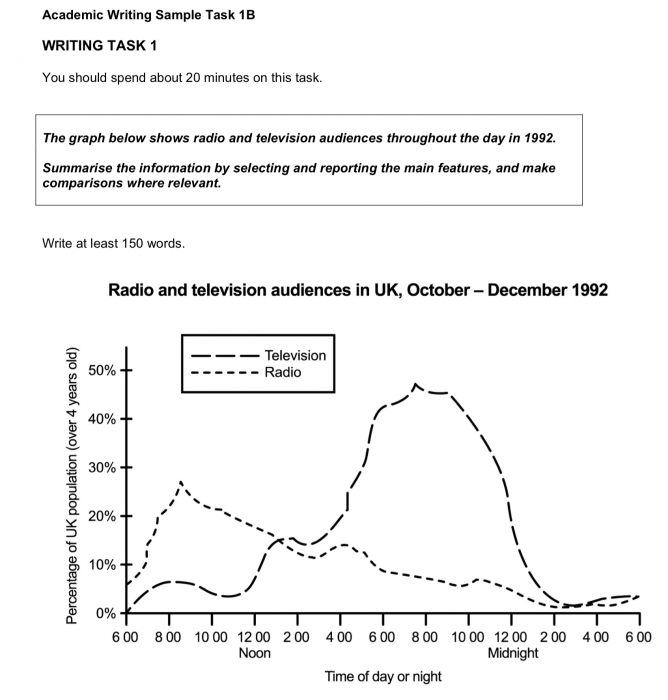
The line graph illustrates the percentage of the UK population (aged above four) that listened to the radio or watched television at different times of the day over the final quarter of 1992.
Overall, television attracted more viewers in the evening, whereas radio had higher engagement in the early morning. Both media experienced significant fluctuations in usage throughout the day.
Radio usage saw a rapid increase just before 8 a.m., peaking at around 27%, likely due to people catching the news or morning shows. After this peak, listenership declined steadily, hovering between 10% and 15% throughout the day and evening. It dipped below 5% after 10 p.m.
In contrast, television audiences remained low through the morning, staying below 10% until midday. Viewership began to climb significantly from 2 p.m., hitting a peak of approximately 45% at 8 p.m. This was the highest recorded figure for either medium. After 9 p.m., TV viewership declined sharply, dropping to under 15% by midnight and falling further in the early morning hours.
The data suggests a difference in audience behavior: radio is preferred in the morning, while television dominates prime time in the evening.
Refer to more IELTS Writing Task 1 Samples:
- IELTS Writing Task 1 Pie Chart: Usage of Water Chart
- IELTS Writing Task 1 Cambridge 12: Geothermal Energy Diagram
- IELTS Writing Task 1: Food Pie Chart Percentages
Final Thoughts: Precision Beats Complexity
In IELTS Writing Task 1 Academic, your goal is not to sound overly academic — it’s to be clear, accurate, and well-organized. Focus on logical grouping, appropriate comparisons, and consistent grammar. Simplicity done well will outscore complexity done poorly.
By practicing with purpose and mastering each task type, you’ll build a foundation not only for Task 1 but also for professional and academic writing in English.