


Understanding how to analyze and describe scientific diagrams forms a crucial skill for IELTS Writing Task 1 success. The evolution of horse diagram presents a fascinating case study that demonstrates evolutionary changes over millions of years, requiring precise vocabulary and clear structural organization to achieve high band scores.
Evolution of Horse Diagram – Question Analysis
The diagrams below show the development of the horse over a period of 40 million years. Summarise the information by selecting and reporting the main features, and make comparisons where relevant.
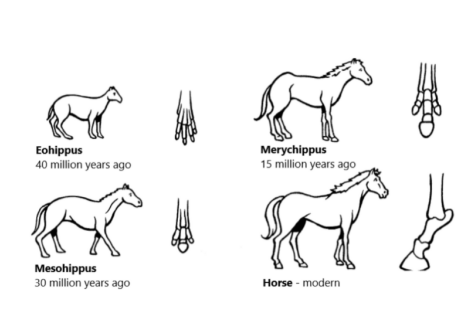
In task 1 evolution of horse diagram, you need to examine multiple diagrams showing evolutionary progression and identify key developmental changes. Your response must demonstrate ability to:
- Select significant information
- Organize data chronologically
- Make meaningful comparisons between different evolutionary stages
The task demands approximately 150-180 words with clear overview statements and detailed analysis of anatomical modifications over time.
Evolution of Horse Diagram Model Responses ( Easy to Advanced)
Effectively describing diagrams—such as the evolution of the horse—in IELTS Writing Task 1 requires more than just listing facts; it involves presenting observations clearly, analytically, and in well-structured paragraphs. Use the following framework to elevate your band score potential.
Model Answer 1 (Basic Band 6.5–7 Level)
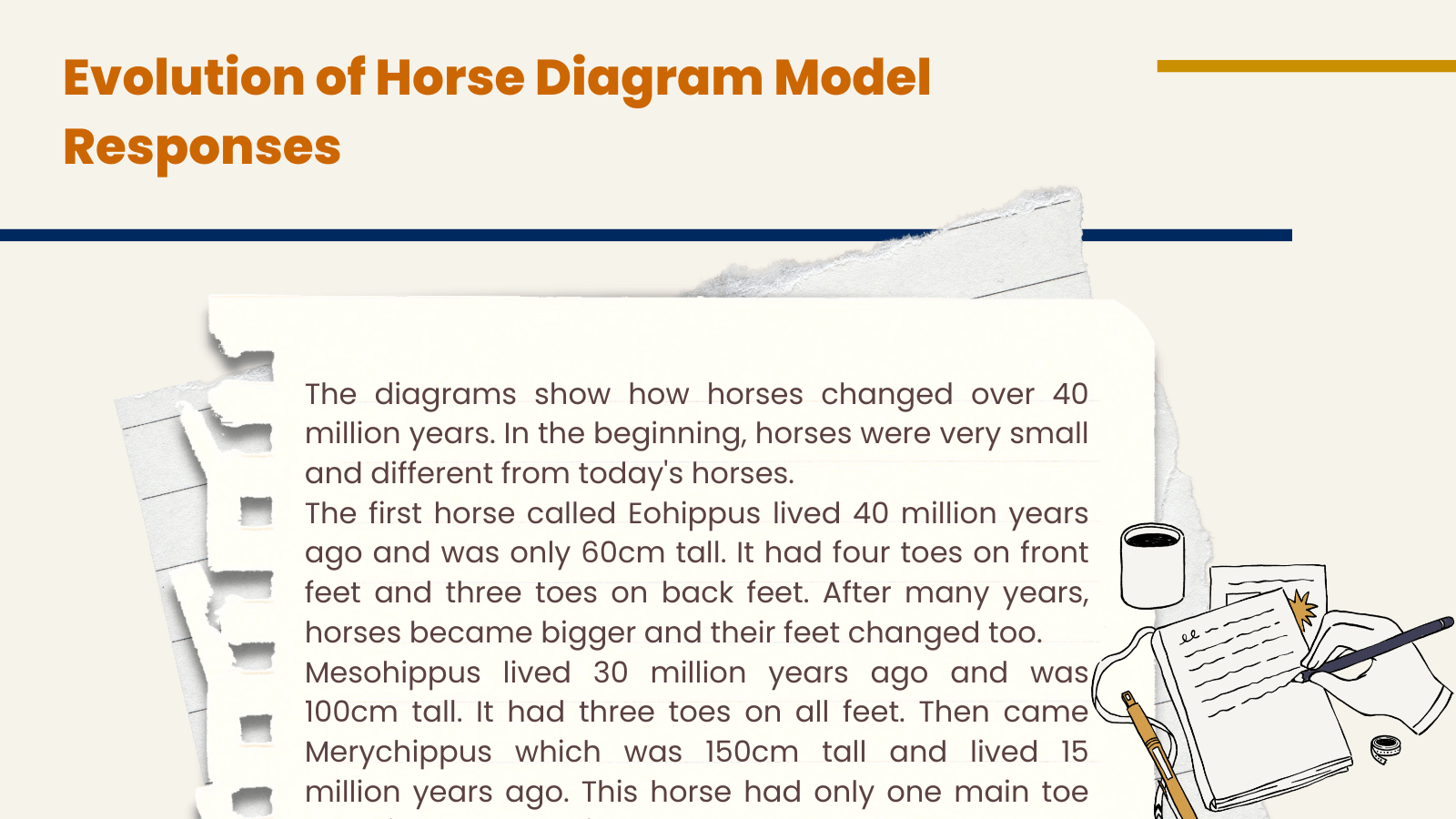
The diagram shows the evolution of the horse over a period of 40 million years. It highlights changes in the horse’s body shape and foot structure from the Eohippus to the modern horse.
Around 40 million years ago, the earliest ancestor, Eohippus, was small in size, with four distinct toes. After that, Mesohippus, which existed 30 million years ago, was slightly larger and had three toes on each foot. Over time, the species kept evolving. Merychippus, seen 15 million years ago, resembled the modern horse more closely, with stronger legs and the middle toe becoming more prominent.
Finally, the modern horse has a much larger body and walks on a single, strong central toe, indicating a clear pattern of physical adaptation and development over time.
Model Answer 2 (Advanced Band 8–9 Level)
The provided diagram illustrates the evolutionary process of the modern horse over a span of approximately 40 million years, focusing on significant anatomical transformations, particularly in limb and foot structure.
The earliest ancestor, Eohippus, which appeared around 40 million years ago, was a small, multi-toed mammal characterized by four slender digits on each foot. This species was succeeded by Mesohippus, about 10 million years later, which exhibited modest growth in body size and possessed three distinct toes, suggesting a reduction in digit number as part of a gradual evolutionary shift.
By 15 million years ago, Merychippus had evolved with more defined equine features—namely, a larger body and weight-bearing focused on the central toe, while the side toes became less functional. In the modern horse, the transformation is fully realized: it possesses a robust build and a single, well-developed hoof, indicating a complete adaptation for running and endurance.
Overall, the diagram demonstrates a clear chronological development in both stature and foot anatomy, reflecting the horse’s adaptation to its environment over millions of years.
Detailed Analysis Framework for Success

- Introduction Techniques: Begin your response to evolution of horse diagram by paraphrasing the original question using alternative vocabulary while maintaining identical meaning. Transform “development of the horse” into “evolutionary progression of equine species” and “40 million years” into “four-decade million timeframe” to demonstrate lexical resource skills.
- Overview Construction: Your overview paragraph must identify the most significant trends visible across all diagrams without specific data details. Focus on overall patterns such as size increases, anatomical simplification, and structural adaptations that characterize the entire evolutionary sequence.
- Body Paragraph Organization: Structure your detailed analysis chronologically, grouping related information logically. Compare consecutive evolutionary stages directly, highlighting specific measurements, anatomical features, and temporal relationships between developmental phases.
- Comparative Analysis Integration: Weave comparisons throughout your response rather than listing isolated facts. Use phrases like “in contrast to the earlier stage” and “significantly more developed than its predecessor” to create cohesive analytical flow.
Essential Academic Vocabulary for Evolution of Horse Diagram
To accurately describe an evolution of the horse diagram in IELTS Writing Task 1, you need to use a mix of clear time-sequencing phrases, comparative vocabulary, and scientific terminology. The table below distinguishes between basic and more advanced vocabulary, helping you elevate your writing to meet higher band criteria.
| Category | Basic Level | Advanced Level |
| Size Changes |
|
|
| Time Progression |
|
|
| Anatomical Features |
|
|
| Comparisons |
|
|
| Evolutionary Terms |
|
|
- Transitional Expressions: Master sophisticated linking devices including “furthermore,” “consequently,” “in comparison,” and “correspondingly” to create seamless connections between evolutionary stages and enhance coherence scores.
- Quantitative Language: Utilize precise measurement vocabulary such as “measured,” “reached,” “achieved,” and “attained” when describing specific heights and anatomical dimensions throughout the evolutionary timeline.
Strategic Approach for Maximum Achievement
Successful analysis of the evolution of horse diagram requires systematic examination methodology combined with sophisticated language application. Begin by identifying all evolutionary stages chronologically, noting specific measurements and anatomical characteristics for each developmental phase.
Focus your attention on the most dramatic transformations occurring between consecutive stages, particularly the progressive reduction in digit number and corresponding increases in body size of evolution of horse easy diagram. These represent the most significant evolutionary adaptations worthy of detailed analytical attention.
Conclude your response by synthesizing the overall evolutionary pattern without introducing new specific details, emphasizing the successful environmental adaptation achieved through millions of years of gradual anatomical refinement and specialization for terrestrial survival.