

Transforming complex biological processes into compelling written descriptions represents one of IELTS Writing Task 1’s most challenging territories. The monarch butterfly’s remarkable metamorphosis from egg to soaring adult captures nature’s extraordinary transformations, yet describing this intricate cycle demands precision, scientific vocabulary, and structured thinking.
This expertly crafted guide unlocks the secrets to conquering monarch butterfly life cycle diagram through proven model answers, strategic vocabulary selection, and time-tested techniques that elevate your writing from basic description to sophisticated academic analysis, ensuring confident performance across all biological process tasks.
Writing Task 1 Monarch Butterfly Life Cycle Diagram Analysis
The diagram shows the life cycle of a monarch butterfly. Summarize the information by selecting and reporting the main features, and make comparisons where relevant.
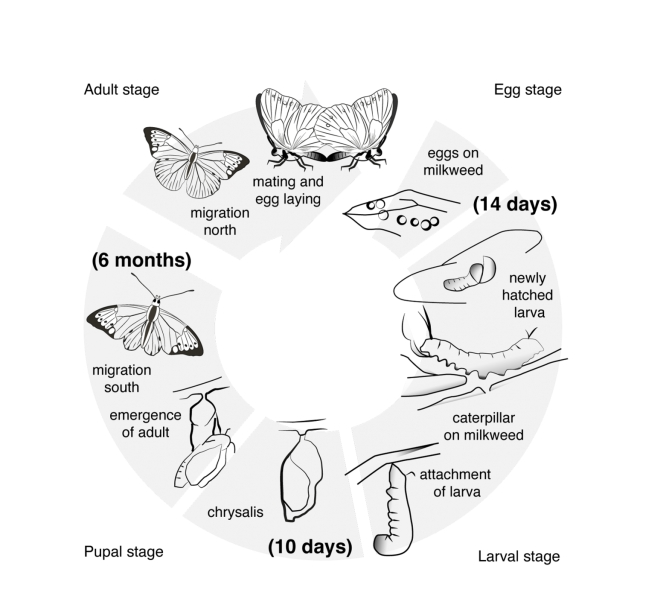
The monarch butterfly life cycle diagram requires you to describe a cyclical biological process involving four distinct stages of development. You must identify the starting point, describe each transformation stage clearly, and explain how the cycle continues perpetually. The monarch butterfly life cycle represents a complete metamorphosis, demonstrating dramatic changes in form and function throughout each developmental phase.
Your response should demonstrate ability to organize information logically, use appropriate scientific terminology, and maintain coherence while describing sequential monarch butterfly life cycle diagrams. Focus on the main transformations rather than minor details, ensuring your description flows naturally from one stage to the next..
Systematic Writing Guide – Describing the Monarch Butterfly Life Cycle
To effectively describe the life cycle of a monarch butterfly in IELTS Writing Task 1, it’s important to follow a step-by-step approach that demonstrates clarity, coherence, and accurate vocabulary. The points below outline a systematic strategy for organizing your response.
- Opening Statement Construction: Paraphrase the prompt to show lexical range. Replace generic phrases like “the diagram shows” with illustrates, demonstrates, or depicts to create a strong academic tone from the start.
- Process Overview Development: Summarize the full life cycle briefly before detailing individual stages. Mention its cyclical nature and highlight major phases (egg, larva, pupa, adult) to frame your analysis effectively.
- Sequential Stage Analysis: Present each stage in order using clear connectors (e.g., first, then, next, finally). Focus on the most important changes—emergence, metamorphosis, migration—rather than minor visual details.
- Cyclical Connection Establishment: End your response by reconnecting the final stage to the first. Reinforcing the cycle shows full understanding and provides strong closure to a process-based description.
Monarch Butterfly Life Cycle Diagram Model Essays
Monarch Butterfly Life Cycle Diagram Sample 1
The diagram illustrates the life cycle of a Monarch butterfly, depicting its development through four distinct stages: egg, larva, pupa, and adult, along with the timeframes and migration patterns involved.
The process begins when adult butterflies migrate northwards to lay eggs on milkweed plants. This marks the egg stage, lasting approximately 14 days, during which the larvae eventually hatch. Once emerged, the larva begins feeding on milkweed and grows into a caterpillar. During the larval stage, the caterpillar attaches itself to a surface in preparation for transformation.
Following this, the butterfly enters the pupal stage, where it forms a protective casing known as a chrysalis. This stage lasts for about 10 days, after which the adult butterfly emerges. In the final stage, adults begin their six-month migration southward, completing the life cycle and repeating the process.
Overall, the cycle not only involves physical transformation but also includes long-distance migration, reflecting the complexity of the Monarch butterfly’s reproductive and survival pattern.
Monarch Butterfly Life Cycle Diagram Sample 2
The diagram shows the life cycle of a Monarch butterfly, including how it grows and changes through several stages in a circular process.
The cycle begins when Monarch butterflies migrate north and lay eggs on milkweed. This is known as the egg stage, which takes about 14 days. After this time, the eggs hatch, and a small larva comes out. The larva eats the milkweed and becomes a caterpillar. Then, it attaches itself to a branch to start changing.
In the third stage, known as the pupal stage, the caterpillar turns into a chrysalis. This stage lasts for about 10 days. After that, the adult butterfly comes out and begins its **six-month migration **back south.
In summary, the Monarch butterfly goes through four main stages and also migrates as part of its natural life cycle, repeating the process after becoming an adult.
Must-know Vocabulary for Monarch Butterfly Life Cycle Diagram
Understanding the monarch butterfly life cycle ielts requires mastery of specific terminology and grammatical structures that effectively communicate scientific processes to academic audiences.
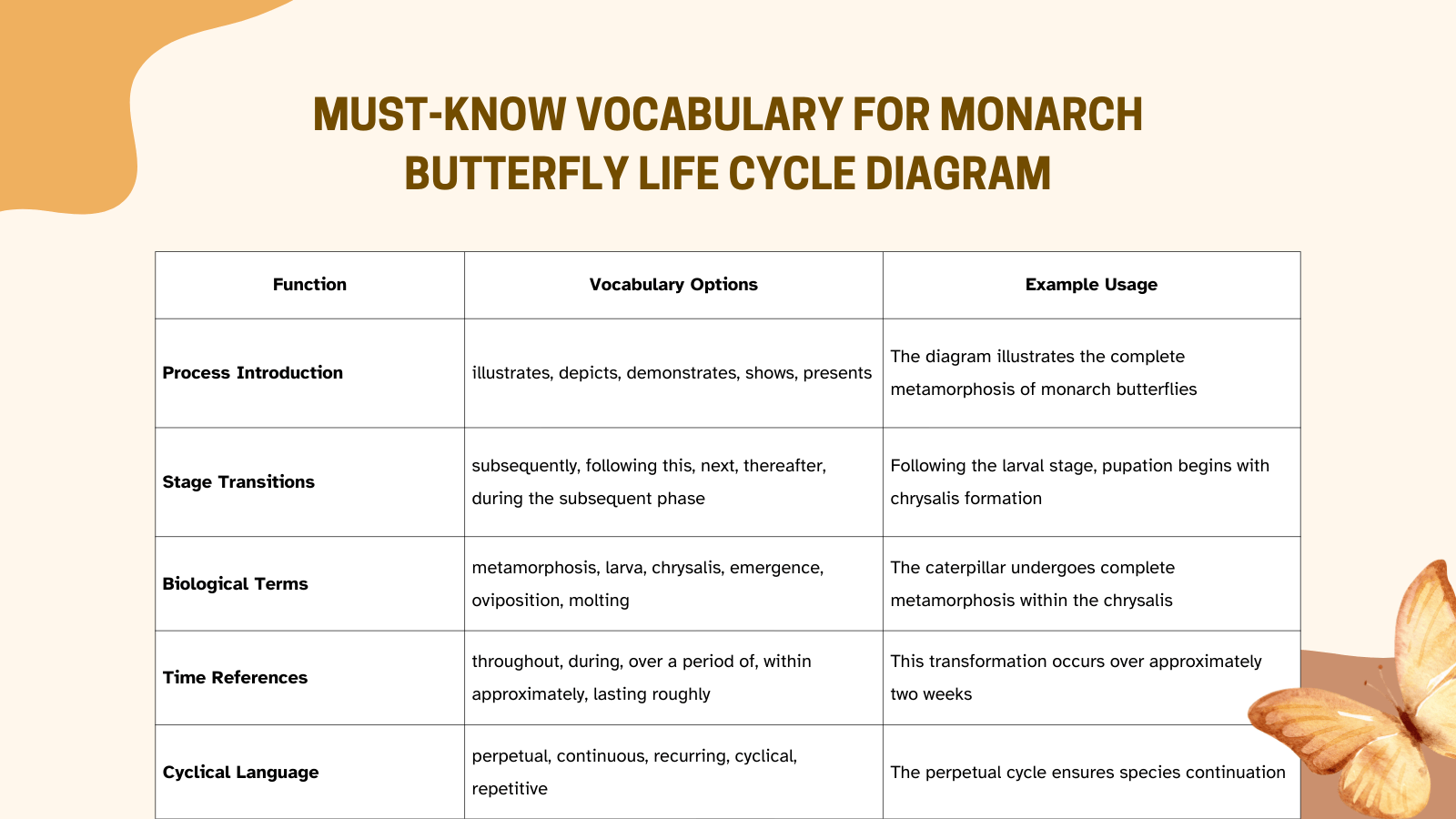
| Function | Vocabulary Options | Example Usage |
| Process Introduction | illustrates, depicts, demonstrates, shows, presents | The diagram illustrates the complete metamorphosis of monarch butterflies |
| Stage Transitions | subsequently, following this, next, thereafter, during the subsequent phase | Following the larval stage, pupation begins with chrysalis formation |
| Biological Terms | metamorphosis, larva, chrysalis, emergence, oviposition, molting | The caterpillar undergoes complete metamorphosis within the chrysalis |
| Time References | throughout, during, over a period of, within approximately, lasting roughly | This transformation occurs over approximately two weeks |
| Cyclical Language | perpetual, continuous, recurring, cyclical, repetitive | The perpetual cycle ensures species continuation |
- Grammatical Structures for Scientific Description: Use passive voice constructions to emphasize processes rather than agents in your monarch butterfly life cycle diagram, such as “eggs are deposited” instead of “butterflies deposit eggs.” This approach aligns with academic writing conventions while maintaining objectivity.
- Comparative Language Application: When relevant, incorporate comparative structures to highlight differences between stages, such as “whereas larvae are terrestrial, adult butterflies are capable of flight.” However, avoid forced comparisons when natural progression is more appropriate.
- Sequential Linking Mechanisms: Employ sophisticated transitional phrases that demonstrate logical progression while avoiding repetitive basic connectors. Advanced options include “subsequent to,” “concurrent with,” and “culminating in” rather than simple “then” or “next” constructions.
Conclusion
The monarch butterfly life cycle diagram represents one of many possible biological processes you might encounter in IELTS Writing Task 1. Developing systematic approaches to process description will prepare you for success regardless of the specific content area presented in your examination.