

IELTS Speaking Part 2 challenges candidates to deliver a structured two-minute monologue on various personal topics. When you encounter the task to describe a family member that you spend most time with, you need to demonstrate fluency, coherence, and rich vocabulary while sharing personal experiences. This comprehensive guide provides you with essential ideas, structured notes, sample responses, and valuable vocabulary to help you excel in both Part 2 and Part 3 discussions about family relationships.
IELTS Speaking Part 2 Describe a Family Cue Card
Describe a family member that you spend most time with
You should say:
- Who this person is
- What you like to do together
- When you usually spend time together
- And explain why you spend so much time with him/her
You have one minute to prepare and should speak for 1-2 minutes.
Ideas and Outline for the Cue Card

When preparing to describe a family member, consider these comprehensive approaches that will help you create a compelling narrative. You might choose your mother, who serves as both your confidant and daily companion during morning coffee sessions and evening walks. Alternatively, you could discuss your younger sibling, with whom you share gaming sessions, study time, and weekend adventures that strengthen your bond.
Another excellent choice would be your grandmother, whose wisdom and storytelling create special moments during Sunday family dinners and afternoon tea gatherings. You might also select your father, particularly if you share common interests like sports, cooking, or DIY projects that bring you together regularly.
One-minute note-taking example for describe a family member topic:
- Person: younger brother (Alex, 16)
- Activities: gaming, homework help, basketball
- Time: evenings after school, weekends
- Why: shared interests, responsibility, genuine friendship
- Adjectives: supportive, funny, energetic, curious
Describe a Family Member Sample Answers – Beginner to Advanced
Describe A Family Member Beginner Level (Band 5.5)
The family member I spend most time with is my mother. She is 45 years old and works as a teacher in a primary school near our house.
We spend time together every day, especially in the evening. We like to watch TV shows together, usually Korean dramas or cooking programs. Sometimes we cook dinner together on weekends. My mother teaches me how to make traditional dishes from our country. We also go shopping together every Saturday morning.
I spend a lot of time with my mother because she is very kind and helpful. When I have problems with my studies or friends, she always listens to me and gives me good advice. She understands me very well and never gets angry when I make mistakes. Also, my father works late every day, so my mother and I are often alone at home in the evening.
My mother is very important to me. She supports me in everything I do and makes me feel comfortable when I am worried.
Describe A Family Member Intermediate Level (Band 6.5)
The family member I spend the most time with is definitely my younger brother David, who is currently 17 years old and studying in his final year of high school. We have developed an incredibly close relationship over the years.
We spend approximately two to three hours together every evening after school. We usually start by sharing stories about our day while having dinner together. After dinner, we often watch Netflix series or YouTube videos, particularly comedy shows and sports highlights. During weekends, we enjoy playing basketball at the local court, going to the cinema, or having bicycle rides around our neighborhood while discussing our future plans.
The main reason I spend so much time with David is that we have compatible personalities and share similar interests in sports, technology, and music. Unlike many sibling relationships with constant arguments, we genuinely enjoy each other’s company. Additionally, as the older sibling, I feel responsible for providing guidance during his stressful final school year.
This relationship has become one of the most rewarding aspects of my daily life, providing companionship and personal growth opportunities.
Describe A Family Member Advanced Level (Band 7.0+)
The family member with whom I share the most substantial time is my father, who is 52 years old and works as an engineer for a renewable energy company. Our relationship has evolved from a traditional parent-child dynamic into genuine friendship built on mutual respect.
We typically spend four to five hours together during weekends, primarily engaging in hands-on projects and outdoor activities. Saturday mornings find us collaborating on home improvement projects, where his technical expertise combines with my enthusiasm to tackle everything from smart home installations to garage renovations. Sunday afternoons are reserved for hiking expeditions, during which we engage in deep conversations about environmental sustainability, career strategies, and philosophical questions about life’s priorities.
What draws me most to spend considerable time with my father is his remarkable ability to challenge my thinking while providing unwavering support and practical guidance. His analytical problem-solving approach, combined with decades of professional experience, offers invaluable perspectives on navigating complex decisions. Furthermore, his curiosity about my generation’s perspectives creates fascinating intergenerational dialogue.
This relationship represents far more than family obligation; it constitutes unique mentorship that continuously shapes my personal development and critical thinking abilities.
Vocabulary Highlights for Describe A Family Member topic
When you describe a family member in IELTS Speaking, using sophisticated vocabulary can significantly enhance your band score and demonstrate your language proficiency. The following key terms, expressions and adjectives about family from the sample answer will help you articulate your thoughts more precisely and naturally during your speaking test.
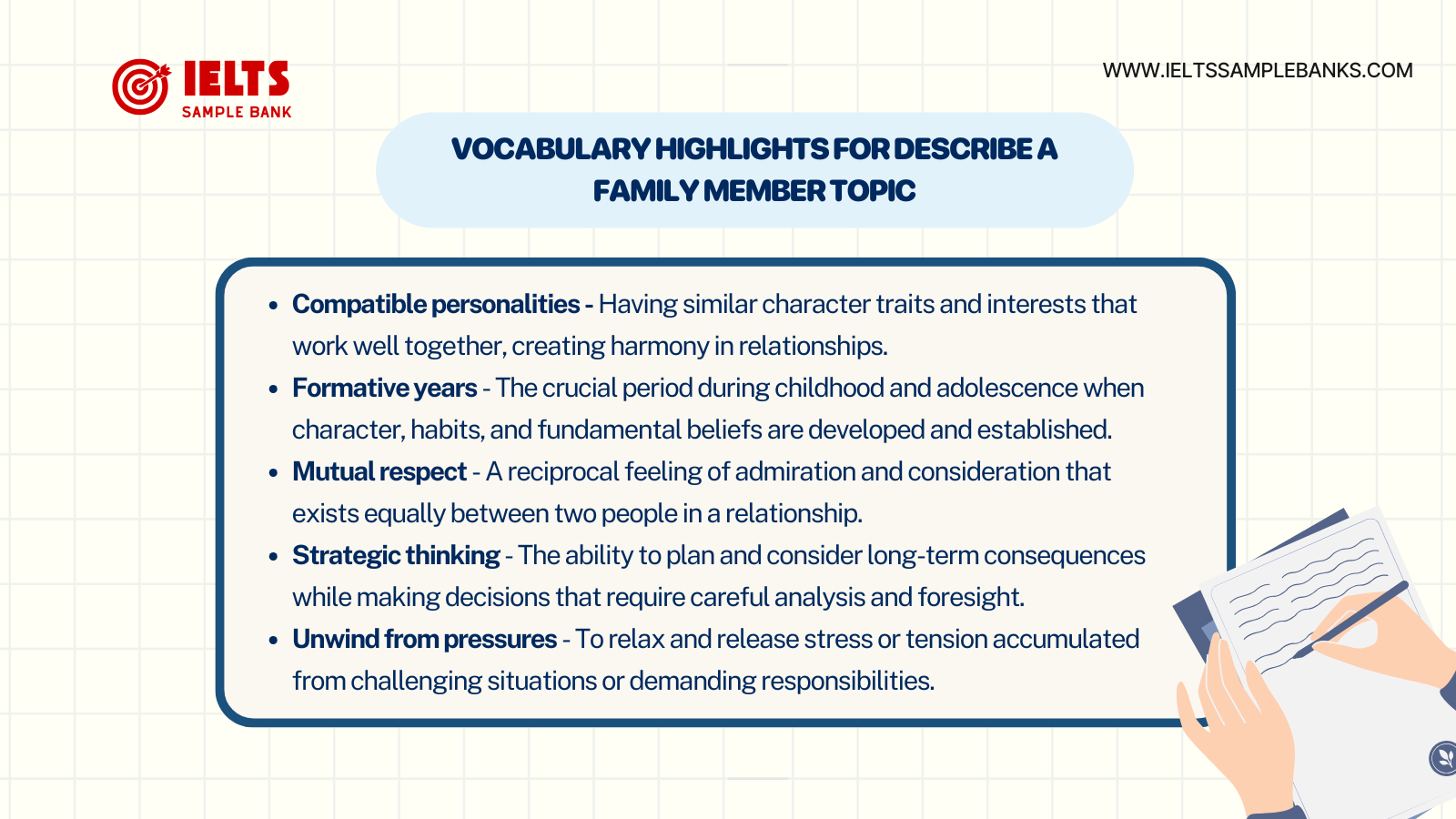
- Compatible personalities – Having similar character traits and interests that work well together, creating harmony in relationships.
- Formative years – The crucial period during childhood and adolescence when character, habits, and fundamental beliefs are developed and established.
- Mutual respect – A reciprocal feeling of admiration and consideration that exists equally between two people in a relationship.
- Strategic thinking – The ability to plan and consider long-term consequences while making decisions that require careful analysis and foresight.
- Unwind from pressures – To relax and release stress or tension accumulated from challenging situations or demanding responsibilities.
- Cooperative adventure – Activities that require teamwork and collaboration to achieve common goals while experiencing excitement and challenge together.
- Academic and professional experience – Knowledge and skills gained through formal education combined with practical work experience in specific fields.
IELTS Speaking Part 3 Discussion Questions and Sample Answers
1. How have family relationships changed in modern society compared to previous generations?
Modern family relationships have undergone significant transformations due to technological advancement and changing social structures. Unlike previous generations where extended families often lived together in close proximity, contemporary families frequently experience geographical separation due to career opportunities and educational pursuits. However, technology has created new ways to maintain connections through video calls, social media, and instant messaging, allowing families to share daily experiences despite physical distance.
- Undergone (v): experienced or endured something
- Transformations (n): complete changes in form, appearance, or nature
- Close proximity (phrase): very near in distance or location
- Geographical separation (phrase): physical distance between family members
- Educational pursuits (phrase): activities related to learning and academic advancement
- Contemporary (adj): belonging to the present time; modern
2. What role do family members play in shaping a person’s character and values?
Family members serve as the primary architects of an individual’s moral compass and behavioral patterns during crucial developmental stages. Parents typically establish fundamental values through consistent modeling and guidance, while siblings contribute to social skills development through daily interaction and conflict resolution. The experience of describing a family member often reveals how these relationships create lasting impacts on personal growth, emotional intelligence, and future relationship patterns that extend throughout adult life.
- Architects (n): creators or designers of something important
- Moral compass (phrase): internal sense of right and wrong
- Behavioral patterns (phrase): consistent ways of acting or responding
- Developmental stages (phrase): periods of growth and change in life
- Conflict resolution (phrase): process of solving disagreements peacefully
- Emotional intelligence (phrase): ability to understand and manage emotions
3. Do you think children today spend enough quality time with their family members?
Contemporary children face unprecedented competition for their attention from digital devices, academic pressures, and extracurricular activities, which can significantly reduce meaningful family interaction time. While families may physically coexist in the same household, genuine quality time involving deep conversation, shared activities, and emotional connection has unfortunately decreased in many households. This trend represents a concerning shift from traditional family dynamics where regular family meals, storytelling sessions, and collaborative household activities naturally fostered stronger intergenerational bonds.
- Unprecedented (adj): never experienced or encountered before
- Competition for attention (phrase): various things trying to capture focus
- Extracurricular activities (phrase): activities outside regular school curriculum
- Coexist (v): exist together at the same time or place
- Family dynamics (phrase): patterns of interaction between family members
- Intergenerational bonds (phrase): connections between different age groups
4. How can families maintain strong relationships despite busy modern lifestyles?
Successful families prioritize intentional relationship-building activities by establishing regular family traditions such as weekly game nights, monthly outdoor adventures, or daily technology-free meal times. Creating consistent communication patterns through scheduled check-ins, family meetings, and shared responsibility systems helps maintain connection despite individual scheduling challenges. Additionally, involving all family members in decision-making processes and encouraging open dialogue about personal experiences strengthens mutual understanding and emotional intimacy.
- Intentional (adj): done with purpose and planning
- Relationship-building activities (phrase): actions designed to strengthen connections
- Communication patterns (phrase): regular ways of exchanging information
- Scheduled check-ins (phrase): planned times for conversation and updates
- Decision-making processes (phrase): methods used to make choices
- Emotional intimacy (phrase): close personal connection and understanding
5. What are the benefits of having close relationships with extended family members?
Extended family relationships provide invaluable cultural continuity, wisdom transfer, and emotional support networks that nuclear families alone cannot offer completely. Grandparents often share historical family stories, traditional values, and life lessons gained through decades of experience, while aunts, uncles, and cousins create broader social connections and alternative perspectives. These relationships also serve as crucial support systems during challenging periods, offering practical assistance, emotional guidance, and diverse role models that contribute to well-rounded personal development.
- Cultural continuity (phrase): preservation of traditions across generations
- Wisdom transfer (phrase): sharing of knowledge and life experience
- Support networks (phrase): groups of people who provide help and encouragement
- Historical family stories (phrase): accounts of past family events and experiences
- Alternative perspectives (phrase): different ways of viewing situations
- Well-rounded (adj): having many different aspects; complete and balanced
6. Should husbands and wives have different roles within the family? Why or why not?
I believe that modern families benefit most from flexible role distribution based on individual strengths, interests, and circumstances rather than traditional gender-based expectations. While some couples may naturally fall into complementary roles that work effectively for their specific situation, the key factor should be mutual agreement and respect rather than societal pressure or outdated conventions. Contemporary partnerships thrive when both spouses contribute equally to household responsibilities, childcare duties, and financial obligations according to their abilities and availability.
- Flexible role distribution (phrase): adaptable division of duties and responsibilities
- Gender-based expectations (phrase): assumptions about roles based on being male or female
- Complementary roles (phrase): different but supporting functions that work together
- Mutual agreement (phrase): consensus reached by both parties
- Outdated conventions (phrase): old-fashioned social rules and customs
- Financial obligations (phrase): money-related duties and responsibilities
Conclusion
Mastering the ability to describe a family member effectively requires combining personal authenticity with structured presentation skills and sophisticated vocabulary usage. The sample answers and strategies provided serve as valuable frameworks for developing your own unique responses while maintaining the natural conversational flow that IELTS examiners value highly.
Remember that genuine personal experiences resonate more powerfully than memorized generic responses, so adapt these examples to reflect your actual family relationships and shared experiences. Regular practice with different family member scenarios will build your confidence and improve your ability to handle unexpected variations of this common IELTS Speaking topic successfully.