

The IELTS Speaking Part 2 challenges test-takers to speak fluently for 1-2 minutes on a given topic with minimal preparation time. This comprehensive guide provides you with expert sample answers for “describe a hotel you have stayed in” topic, essential vocabulary, and strategic approaches to excel when discussing hotel experiences. You’ll discover practical ideas for note-taking, high-scoring responses, and valuable insights for the follow-up discussion questions.
IELTS Speaking Part 2 Cue Card
Describe a hotel you have stayed in.
You should say:
- Where it is
- When you went there
- Why you went there
And explain why you think it is a special hotel.
You will have one minute to prepare your response and should speak for 1-2 minutes.
Ideas and Outline for the Cue Card
When approaching the “describe a hotel you have stayed in” topic about describing a hotel you have stayed in, consider these potential angles for your response. You might discuss a luxury resort during a honeymoon trip, a budget hostel from your backpacking adventures, a business hotel during a work conference, a boutique hotel in a historic district, or even a unique accommodation like a castle hotel or eco-lodge.
1-Minute Note-Taking Example:
- Location: Bangkok, Thailand – riverside area
- When: Last summer vacation (July 2023)
- Why: Family holiday, wanted luxury experience
- Special aspects: River views, traditional Thai architecture, exceptional service
- Details: Infinity pool, spa treatments, local cultural shows
Describe a Hotel You Have Stayed in Sample Answer
I’d like to talk about the Mandarin Oriental in Bangkok, which I stayed at during my family vacation last summer. This magnificent hotel sits along the Chao Phraya River in the heart of Thailand’s capital city, offering breathtaking views of the bustling waterway and the city’s glittering skyline.
We chose this destination for our annual family retreat because my parents wanted to experience authentic Thai culture while enjoying modern luxury. The timing coincided perfectly with the cooler season in July, making it ideal for exploring Bangkok’s temples and markets during the day while returning to air-conditioned comfort each evening.
What makes this hotel truly exceptional goes beyond its five-star amenities and prime location. The staff demonstrated remarkable attention to detail, remembering our preferences after just one day and surprising us with traditional Thai welcome ceremonies each time we returned from sightseeing. The architecture seamlessly blends contemporary elegance with traditional Thai design elements, creating an atmosphere that feels both sophisticated and culturally immersive.
The infinity pool overlooking the river became our daily sanctuary, while the spa treatments using authentic Thai techniques helped us unwind completely. Most memorable were the evening cultural performances in the hotel’s courtyard, where local artists shared traditional dances and music under the stars, creating magical moments that transformed our stay from merely comfortable to truly unforgettable.
Vocabulary Highlights of IELTS Speaking Accomodation Topic
| Word/Phrase | Definition |
| Magnificent | Extremely beautiful, elaborate, or impressive; grand and striking in appearance |
| Bustling | Full of energetic and noisy activity; busy and lively with movement |
| Coincided | Occurred at the same time; happened simultaneously with another event |
| Seamlessly | In a smooth and continuous way without any apparent gaps or spaces |
| Sanctuary | A place of refuge or safety; somewhere peaceful where you can escape |
| Immersive | Providing a completely engaging experience that surrounds you entirely |
| Breathtaking views | Spectacular scenery that is so impressive it takes your breath away |
| Attention to detail | Careful consideration of small but important elements |
| Unforgettable | So remarkable or special that it cannot be forgotten; memorable |
| Cultural immersion | Deep involvement in experiencing local customs and traditions |
IELTS Speaking Part 3 Discussion Questions and Sample Answers
1.What factors do people consider when choosing accommodation for travel?
Most travelers prioritize location and budget when selecting hotels, as these factors significantly impact both convenience and overall trip costs. Business travelers often value proximity to conference centers or airports, while leisure tourists prefer accommodations near major attractions or scenic areas. Modern travelers also increasingly consider sustainability practices, online reviews from previous guests, and amenities like fitness centers or complimentary breakfast services.
2. How has the hospitality industry changed in recent decades?
The hospitality sector has undergone dramatic transformation through technology integration and evolving customer expectations. Online booking platforms have revolutionized how people research and reserve accommodations, while contactless check-in systems and mobile room keys have become standard features. Hotels now focus heavily on personalized experiences, using data analytics to customize services for individual guests rather than providing one-size-fits-all approaches.
3. Do you think traditional hotels will survive competition from alternative accommodations?
Traditional hotels will likely adapt and coexist with alternative options rather than disappear entirely. While platforms like Airbnb offer unique local experiences and often lower costs, established hotels provide consistent service standards, professional housekeeping, and reliable amenities that many travelers still value. The key lies in hotels differentiating themselves through exceptional service, prime locations, and specialized experiences that home-sharing platforms cannot replicate.
4. What role does accommodation play in tourism development?
Quality accommodation serves as the foundation for successful tourism destinations, directly influencing visitor satisfaction and repeat tourism rates. Well-developed hospitality infrastructure attracts international investment, creates employment opportunities for local communities, and generates substantial tax revenue for governments. Additionally, unique accommodation offerings like heritage hotels or eco-resorts can become attractions themselves, extending average stay durations and increasing tourism spending in local economies.
5. How do cultural differences affect hotel services globally?
Cultural variations significantly shape hospitality expectations and service delivery across different regions worldwide. Asian hotels often emphasize formal politeness and anticipatory service, while European establishments may focus more on efficiency and privacy. Understanding local customs becomes crucial for international hotel chains, as they must balance maintaining brand consistency with adapting to regional preferences regarding dining hours, communication styles, and recreational activities.
Tips for IELTS Speaking Part 2 and 3
Successful IELTS Speaking preparation for “describe a hotel you have stayed in” topics demands strategic note-taking and structured response development. During your one-minute preparation, focus on concrete details like specific room features, staff interactions, and architectural elements rather than vague generalizations. This foundation enables natural speech flow while demonstrating vocabulary range through sensory descriptions and confident opinion expression.
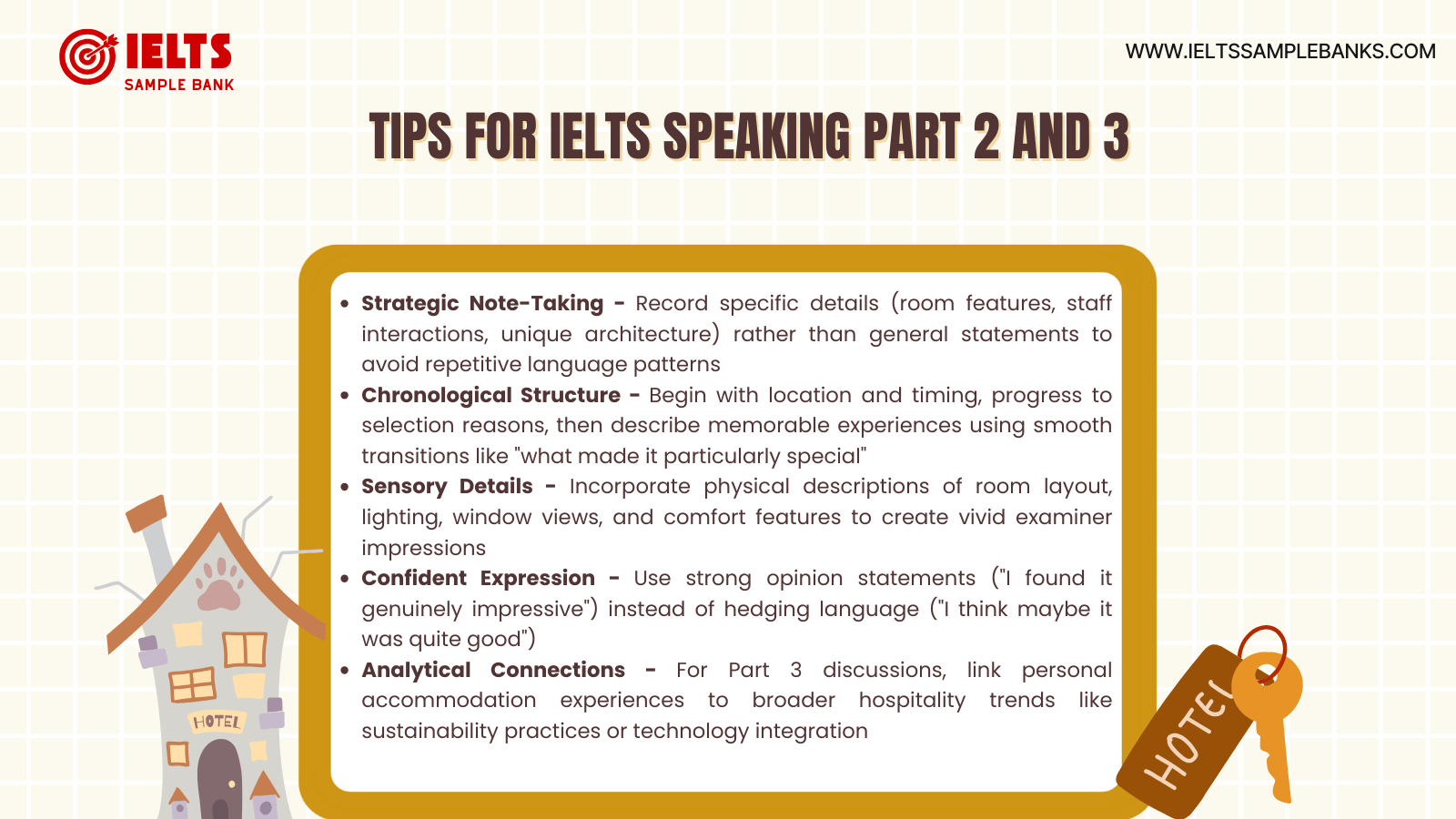
Key Preparation Strategies for “Describe A Hotel You Have Stayed in”:
- Strategic Note-Taking – Record specific details (room features, staff interactions, unique architecture) rather than general statements to avoid repetitive language patterns
- Chronological Structure – Begin with location and timing, progress to selection reasons, then describe memorable experiences using smooth transitions like “what made it particularly special”
- Sensory Details – Incorporate physical descriptions of room layout, lighting, window views, and comfort features to create vivid examiner impressions
- Confident Expression – Use strong opinion statements (“I found it genuinely impressive”) instead of hedging language (“I think maybe it was quite good”)
- Analytical Connections – For Part 3 discussions, link personal accommodation experiences to broader hospitality trends like sustainability practices or technology integration
Conclusion
Mastering the “describe a hotel you have stayed in” topic requires combining specific personal experiences with broader vocabulary about hospitality and travel. Practice describing various types of accommodations you have encountered, from budget options to luxury establishments, ensuring you can discuss both positive and challenging aspects authentically.
Remember that examiners value genuine responses over memorized scripts, so adapt these sample frameworks to reflect your actual experiences while incorporating the vocabulary and structures demonstrated here. Regular practice with timing constraints will help you deliver confident, well-organized responses that showcase your English proficiency effectively.