


The Cambridge 16 Task 4 question presents one of the most challenging yet rewarding process diagrams in IELTS Writing Task 1. This comprehensive analysis of the diagram of plastic recycling process demands precise vocabulary, logical structure, and a systematic approach.
At IELTS Sample Banks, we provide examiner-verified model essays and Band 9 strategies that teach you how to describe industrial and natural processes confidently—turning complex visuals into clear, coherent academic reports.
Diagram of Plastic – Question Analysis and Requirements
The diagram below shows the recycling process of plastics. Summarise the information by selecting and reporting the main features, and make comparisons where relevant.
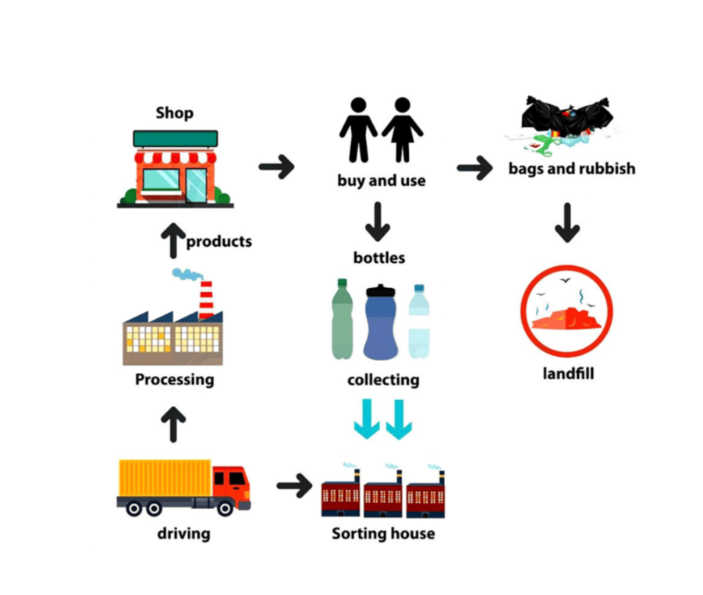
This task demands that you demonstrate your ability to interpret and describe a complex plastic recycling process diagram that illustrates multiple stages of industrial transformation. The examiner expects you to:
- Identify the most significant stages
- Explain the sequential nature of the process
- Highlight any notable patterns or cyclical elements within the system
Your response in the diagram of plastic must maintain academic objectivity while showcasing sophisticated vocabulary and grammatical structures that reflect advanced English proficiency.
To refine your structure and language, review the IELTS Process Chart Task 1 framework—its four-step method applies directly here.
The key requirements for this task include summarizing the main stages of the recycling process, describing the flow from one stage to another, and identifying any quality control measures or decision points within the system. You must avoid personal opinions or external knowledge, focusing solely on the information presented in the plastic diagram while maintaining clear, logical organization throughout your response.
Diagram of Plastic Sample Essays: Progressive Achievement Levels
Band 5-6 Response for Plastic Diagram
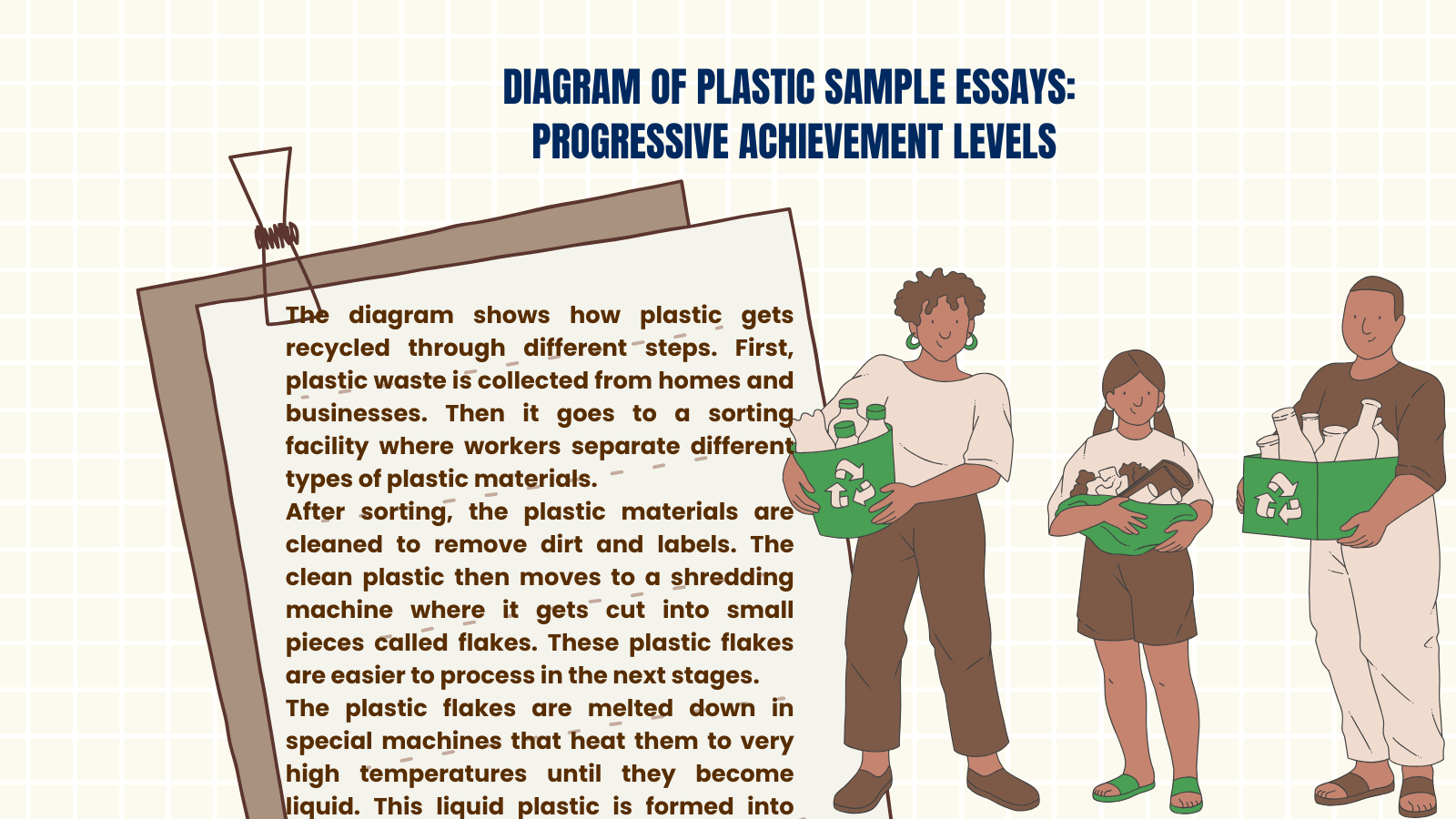
The diagram shows how plastic gets recycled through different steps. First, plastic waste is collected from homes and businesses. Then it goes to a sorting facility where workers separate different types of plastic materials.
After sorting, the plastic materials are cleaned to remove dirt and labels. The clean plastic then moves to a shredding machine where it gets cut into small pieces called flakes. These plastic flakes are easier to process in the next stages.
The plastic flakes are melted down in special machines that heat them to very high temperatures until they become liquid. This liquid plastic is formed into small pellets through pelletizing, which makes the material ready for manufacturing.
Finally, these pellets are sold to companies who use them to make new plastic items like bottles and containers. This plastic recycling process flow chart shows that recycling creates a cycle where old plastic becomes new products, helping reduce waste.
(Word count: 156)
Vocabulary Complexity
- Level: B2
- General Overview: The vocabulary in band 5 -6 diagram of plastic demonstrates adequate range for describing basic processes, though it relies heavily on simple terms and could benefit from more sophisticated academic language.
- Suggestions for Improvement: Replace basic words like “gets” with more precise verbs such as “undergoes” or “proceeds through.” Use technical terminology like “contamination removal” instead of “cleaning.”
Grammar Mistakes
- Total Mistakes: 3
- Mistake 1: “plastic gets recycled” – informal register; should use “plastic materials undergo recycling”
- Mistake 2: This diagram of plastic is missed article usage in several instances
- Mistake 3: Inconsistent tense usage between present simple and continuous
Vocabulary Repetition
- Word: plastic (8 times)
- Word: process (4 times)
- Suggestions for Improvement: Utilize synonyms such as “materials,” “polymers,” or “substances” for plastic. Replace “process” with “procedure,” “operation,” or “stage” to enhance lexical variety.
Practice technical process description through related visuals such as the Sugar Manufacturing Process and the Hydroelectricity Diagram.
Band 6-7 Response for Plastic Diagram
The diagram illustrates a comprehensive plastic recycling process diagram that transforms discarded materials into reusable manufacturing pellets through six distinct stages. This cyclical system demonstrates how post-consumer waste undergoes systematic processing to create new commercial products.
Initially, plastic waste collection occurs from residential and commercial sources, where materials are transported to specialized recycling facilities. Subsequently, sorting involves separating different polymer types based on chemical composition and color classification, ensuring optimal processing efficiency.
The third stage focuses on contamination removal through intensive washing procedures that eliminate adhesive residues and foreign substances. Following decontamination, clean materials proceed to shredding operations, where industrial machinery reduces items into uniform flakes measuring approximately 8-10 millimeters.
The penultimate stage involves melting these flakes at temperatures ranging from 200-300 degrees Celsius. Finally, molten plastic undergoes pelletizing, forming small cylindrical granules that serve as raw materials for manufacturing new products, completing the circular economy cycle.
(Word count: 162)
Vocabulary Complexity
- Level: C1
- General Overview: The band 6 – 7 diagram of plastic response demonstrates sophisticated vocabulary with technical terminology and precise academic language that effectively describes industrial processes.
- Suggestions for Improvement: Consider incorporating more varied process verbs and advanced linking expressions to further enhance linguistic sophistication.
Grammar Mistakes
- Total Mistakes: 1
- Mistake 1: Minor punctuation inconsistency in complex sentence structure
Vocabulary Repetition
- Word: plastic (6 times)
- Word: stage (5 times)
- Suggestions for Improvement: Excellent use of synonyms including “materials,” “polymers,” and “substances.” Consider using “phase” or “step” as alternatives to “stage.”
Band 7+ Response for Plastic Diagram
The diagram delineates a sophisticated diagram of plastic recycling methodology that systematically converts post-consumer polymer waste into high-quality manufacturing pellets through six interconnected operational phases. This comprehensive industrial process exemplifies circular economy principles by transforming discarded materials into valuable commercial resources.
Initial collection encompasses gathering diverse plastic materials from municipal and commercial sources. Advanced sorting technology then categorizes materials according to polymer classification systems, utilizing infrared spectroscopy and density separation techniques to ensure optimal compatibility.
Contamination elimination employs multi-stage washing systems utilizing specialized detergents and mechanical agitation to remove adhesive residues and organic contaminants. Mechanical reduction transforms cleaned materials into uniform flakes through precision shredding equipment operating at controlled speeds.
Thermal processing occurs at precisely calibrated temperatures varying according to specific polymer characteristics, ensuring molecular integrity. Finally, pelletizing employs extrusion technology to form molten polymer into standardized cylindrical granules, serving as premium feedstock for manufacturing diverse products from packaging to automotive components.
(Word count: 171)
Vocabulary Complexity
- Level: C2
- General Overview: The response showcases exceptional vocabulary sophistication with technical terminology, advanced academic constructions, and precise scientific language that demonstrates expert-level proficiency.
- Suggestions for Improvement: The vocabulary in this diagram of plastic answer usage is already at the highest level with excellent variety and precision throughout the response.
Grammar Mistakes
- Total Mistakes: 0
- Error-free response: Demonstrates mastery of complex grammatical structures with varied sentence construction and accurate punctuation usage.
Vocabulary Repetition
- Word: materials (4 times)
- Word: process/processing (3 times)
- Suggestions for Improvement: Exceptional synonym usage including “polymers,” “substances,” “feedstock,” and “operations” demonstrates advanced lexical resource management.
Systematic Analysis of the Model Response Structure
- Introduction Techniques: Effective paraphrasing requires transforming the original task statement while maintaining its essential meaning and scope.
Begin your diagram of plastic essay by identifying key terms such as “recycling process” and “plastics,” then substitute them with sophisticated alternatives like “systematic transformation methodology” and “polymer materials” to demonstrate lexical resource capabilities.
- Overview Development: The overview section must capture the most significant aspects of the entire process without delving into specific details that belong in body paragraphs. Focus on the cyclical nature of the system, the number of distinct stages involved, and the overall transformation from waste materials to usable products, establishing a clear roadmap for readers.
- Body Paragraph Organization: Structure your analysis in a diagram of plastic by grouping related stages together, typically organizing the first body paragraph around initial processing steps (collection, sorting, cleaning) and the second paragraph covering transformation stages (shredding, melting, pelletizing). This logical arrangement helps readers follow the sequential flow while maintaining coherent paragraph development.
- Concluding Elements: Strong responses often conclude by reinforcing the cyclical nature of the process or highlighting how the final stage connects back to manufacturing new products, demonstrating understanding of the complete system rather than just individual components.
Essential Vocabulary and Structural Elements for Diagram of Plastic

The following vocabulary framework provides the foundation for describing complex industrial processes with academic precision and sophistication.
| Process Stage | Basic Vocabulary | Advanced Alternatives | Academic Expressions |
| Beginning | starts | commences | the process originates |
| begins | initiates | the procedure commences | |
| opens | originates | the operation initiates | |
| launches | inaugurates | the system begins | |
| kicks off | embarks | the cycle starts | |
| Continuation | next | subsequently | following this stage |
| then | thereafter | subsequent to this phase | |
| after | consequently | proceeding to the next step | |
| following | concurrently | advancing to the following operation | |
| later | simultaneously | transitioning to the next phase | |
| Transformation | changes into | converts to | undergoes conversion |
| turns into | transforms | experiences transformation | |
| becomes | evolves into | proceeds through modification | |
| shifts to | metamorphoses | encounters alteration | |
| moves to | transitions | sustains metamorphosis | |
| End Result | finally | ultimately | the culminating stage |
| lastly | consequently | the final phase | |
| at the end | eventually | the concluding operation | |
| in the end | as a result | the terminal step | |
| to finish | in conclusion | the ultimate outcome |
- Sequential Connectors: Mastering transition language enables smooth flow between process stages while maintaining reader engagement and comprehension. Utilize expressions such as “subsequent to this operation,” “following decontamination procedures,” and “upon completion of the sorting phase” to create sophisticated linkage between ideas.
- Technical Terminology: Incorporate industry-specific vocabulary that demonstrates your understanding of manufacturing processes, including terms like “contamination removal,” “particle size reduction,” “thermal processing,” and “extrusion technology” to elevate your response above basic descriptive language.
- Measurement and Precision: Include specific details when describing temperatures, sizes, or durations mentioned in the diagram, using both metric and imperial measurements where appropriate to demonstrate comprehensive understanding of technical specifications.
Mastering Complex Process Analysis
Excellence in IELTS Writing Task 1 diagram of plastic transform challenging visual data into compelling academic narratives. The plastic recycling process flow chart serves as your gateway to understanding industrial complexity while building essential vocabulary foundations. Through systematic practice with process descriptions, you develop analytical precision that extends beyond examination success into professional communication mastery. Each Writing Task 1 Task becomes an opportunity to demonstrate linguistic sophistication, turning technical information into clear, engaging prose that showcases your English proficiency at its finest level.