

Understanding process diagrams represents a crucial skill for IELTS Writing Task 1, particularly when examining industrial procedures like the manufacturing of brick production. These diagram-based questions challenge test-takers to describe sequential stages while demonstrating academic vocabulary and precise language structures that examiners expect at higher band levels.
Process diagrams differ significantly from data-based charts because they require you to explain how something transforms through various stages rather than analyzing numerical trends or comparisons. The manufacturing of brick serves as an excellent example of this task type, involving multiple sequential steps that transform raw clay into finished building materials.
IELTS Writing Task 1 Question – Brick Manufacturing Process
The diagram below shows how bricks are made using clay in a factory.
Summarise the information by selecting and reporting the main features, and make comparisons where relevant.
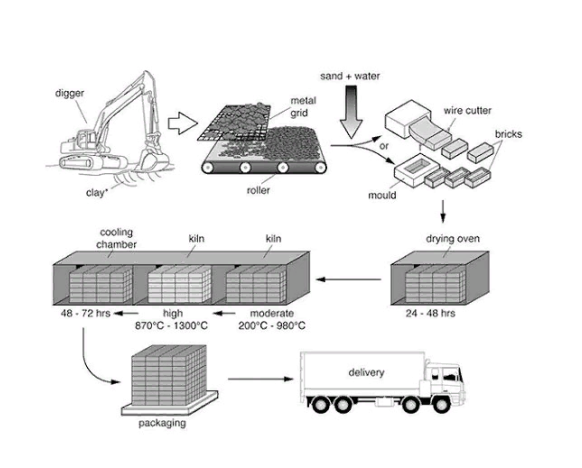
The process chart task 1 question, particularly manufacturing of brick process diagram requires describing the complete manufacturing of the brick process while highlighting significant stages and transformations. Focus on main features rather than minor details, ensuring your response demonstrates clear organization and appropriate academic vocabulary reflecting your understanding of industrial procedures.
Manufacturing of Brick Sample Essays: Beginner to Advanced Levels
Band 5-6 Response
The diagram shows how bricks are made in a factory using clay through several steps.
First, clay is dug from the ground using a big machine and transported by conveyor belt. Then the clay goes through a roller where it gets crushed into smaller pieces. After that, sand and water are mixed with the clay to make it suitable for brick making.
Next, the mixture passes through a wire cutter that shapes it into individual bricks. These bricks are placed on a conveyor belt and moved to a drying oven where they remain for 24 to 48 hours at temperatures between 60 to 100 degrees Celsius.
Following the drying process, the bricks go to a kiln where they are heated at very high temperatures ranging from 870 to 1300 degrees Celsius. This firing process makes the bricks hard and durable. Finally, the bricks are cooled in a cooling chamber for 48 to 72 hours before being packaged and prepared for sale.
Vocabulary Complexity
- Level: B1-B2
- General Overview: The vocabulary demonstrates basic proficiency with simple terminology that adequately describes the manufacturing of brick process, though lacking sophistication expected at higher levels.
- Suggestions for Improvement: Incorporate precise technical vocabulary such as “extraction,” “pulverization,” “tempering,” and “firing” to demonstrate advanced language skills.
Grammar Mistakes
- Total Mistakes: 2
- Mistake 1: “mixed with the clay to make it suitable” – awkward phrasing
- Mistake 2: “very high temperatures” – repetitive language pattern
Vocabulary Repetition
- clay: 4 times
- bricks/brick: 6 times
- Suggestions for Improvement: Replace repetitive terms with synonyms like “raw material,” “building blocks,” and “manufactured units” for enhanced variety of your manufacturing of brick essay.
- Improvement Tips:
Replace simple verbs like “goes through” with technical terms such as “undergoes crushing” or “is conveyed through a roller assembly.”
Study similar industrial processes in Sugar Manufacturing Process to strengthen sequencing and passive constructions.
Band 6-7 Response
The diagram illustrates the industrial manufacturing of brick production process, transforming raw clay into finished building materials through seven distinct stages involving specialized equipment and controlled thermal conditions.
Initially, clay extraction occurs using heavy machinery that removes raw material from underground deposits and transports it via conveyor systems to processing facilities. The extracted clay undergoes pulverization in metal roller mechanisms that break down large chunks into smaller, manageable particles.
Subsequently, the clay receives sand and water additives that enhance moldability during the manufacturing of brick formation process. This tempered mixture passes through wire cutters that shape individual brick units with precise dimensions.
The newly formed bricks enter drying chambers where controlled temperatures ranging from 60 to 100 degrees Celsius remove excess moisture over 24 to 48 hours. Following dehydration, the units undergo firing in high-temperature kilns operating between 870 and 1300 degrees Celsius, hardening the clay through chemical transformation.
Finally, the fired bricks complete the cycle in cooling chambers where temperatures gradually decrease over 48 to 72 hours before packaging and distribution.
Vocabulary Complexity
- Level: B2-C1
- General Overview: This response demonstrates sophisticated vocabulary with technical terminology and varied expression that effectively describes the brick diagram manufacturing process with academic precision.
- Suggestions for Improvement: Consider incorporating advanced process-specific terms like “vitrification” and “thermal treatment” for higher sophistication.
Grammar Mistakes
- Total Mistakes: 0
- Exceptional accuracy: Demonstrates strong grammatical control with complex sentence structures.
Vocabulary Repetition
- manufacturing: 2 times
- temperature/temperatures: 3 times
- Suggestions for Improvement: Vary technical vocabulary with alternatives like “production cycle” and “thermal conditions” to enhance lexical diversity.
Band 7+ Response
The diagram delineates the comprehensive manufacturing of brick production methodology, encompassing seven sequential phases that systematically transform raw clay deposits into commercially viable construction materials through precisely controlled industrial processes.
The manufacturing cycle commences with mechanical extraction whereby specialized earth-moving equipment excavates clay from subterranean sources and channels raw material through automated conveyor networks toward processing stations. Subsequently, extracted clay undergoes pulverization within cylindrical roller assemblies that fragment larger masses into uniformly sized particles, optimizing material consistency.
The preparation phase involves incorporating sand additives and regulated water quantities that enhance clay’s plasticity characteristics essential for the manufacturing of brick formation procedures. This homogenized composite advances through precision wire-cutting mechanisms that fabricate individual units with standardized dimensions.
Manufactured units then undergo controlled dehydration within specialized chambers operating at temperatures between 60 and 100 degrees Celsius for 24 to 48 hours, eliminating residual moisture while preserving structural integrity. The brick manufacturing process flow chart indicates units proceed to high-intensity kilns where exposure to temperatures ranging from 870 to 1300 degrees Celsius facilitates vitrification processes that permanently alter clay’s molecular structure. Production concludes with gradual thermal reduction within cooling chambers over 48 to 72 hours, preventing thermal shock before commercial distribution.
Vocabulary Complexity
- Level: C1-C2
- General Overview: This response exemplifies advanced vocabulary mastery with sophisticated technical terminology and precise academic language that thoroughly describes the manufacturing of brick ielts process.
- Suggestions for Improvement: Vocabulary level demonstrates exceptional proficiency; consider specialized ceramics terminology for greater technical precision.
Grammar Mistakes
- Total Mistakes: 0
- Exceptional accuracy: Complex sentence structures and advanced grammatical constructions demonstrate mastery-level control.
Vocabulary Repetition
- manufacturing: 3 times (appropriate for topic focus)
- temperature/thermal: 3 times (necessary technical precision)
- Suggestions for Improvement: Repetition serves thematic coherence; variation demonstrated through synonyms maintains sophisticated expression.
Systematic Analysis of the Model Response Structure
To write an effective IELTS Task 1 essay on the brick manufacturing process, it’s important to understand how high-scoring responses are structured. The breakdown below explains the key components of a well-developed report, helping candidates organize ideas clearly and meet the assessment criteria.
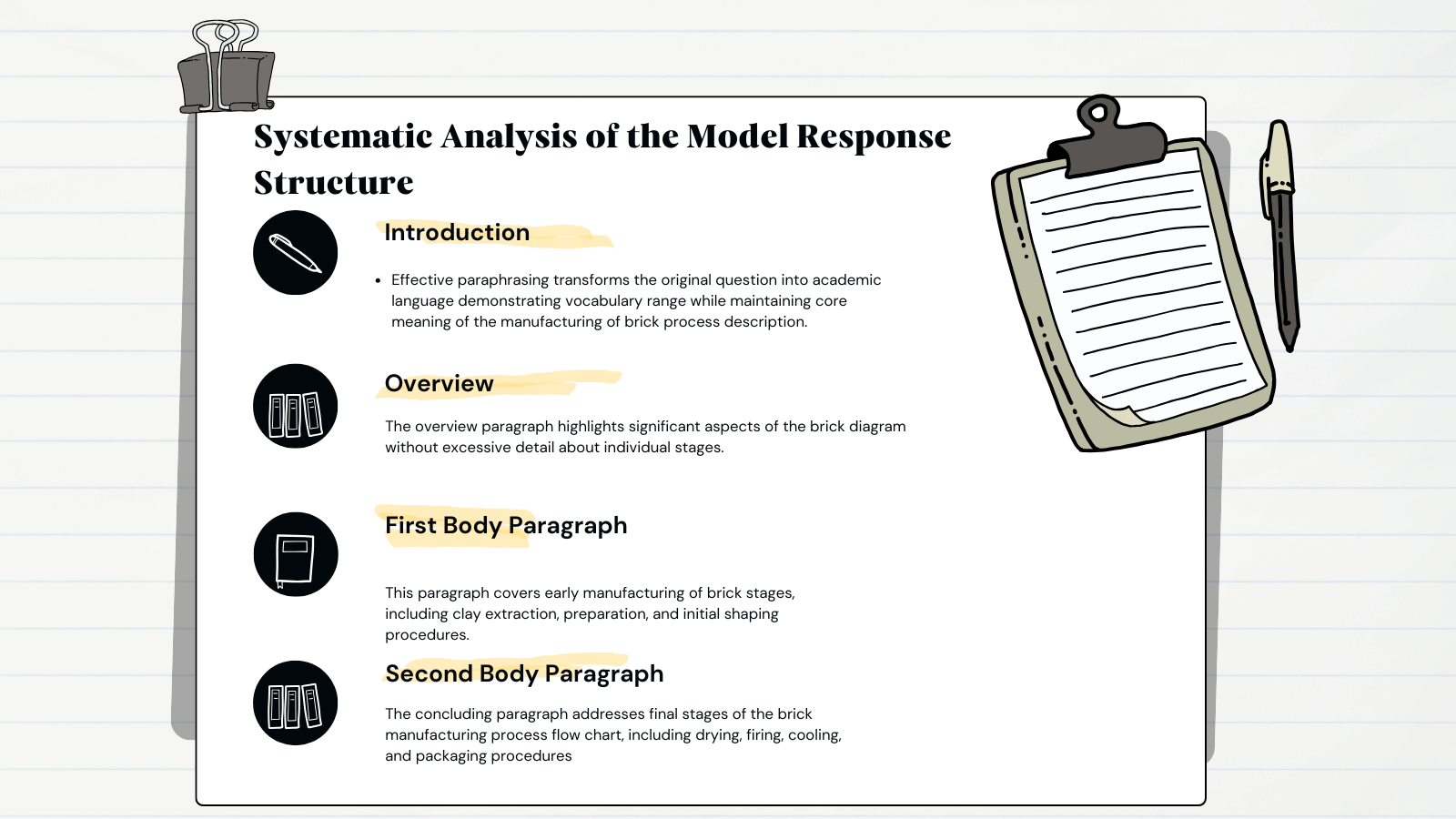
- Introduction: Effective paraphrasing transforms the original question into academic language demonstrating vocabulary range while maintaining core meaning of the manufacturing of brick process description. Strong introductions identify the diagram’s purpose, specify stage numbers, and establish overall transformation from raw materials to finished products.
- Overview: The overview paragraph highlights significant aspects of the brick diagram without excessive detail about individual stages. This section identifies starting and ending points, mentions approximate stage numbers, and notes important transformations or equipment involved in the manufacturing process.
- First Body Paragraph: This paragraph covers early manufacturing of brick stages, including clay extraction, preparation, and initial shaping procedures. Describe how raw materials enter the system, what happens during preliminary processing, and material progression toward subsequent production phases.
- Second Body Paragraph: The concluding paragraph addresses final stages of the brick manufacturing process flow chart, including drying, firing, cooling, and packaging procedures completing transformation from shaped clay to finished building materials ready for commercial use.
Top Useful and Important Vocabulary for Manufacturing of Brick Topic
The following table categorizes essential vocabulary by process stage, equipment, sequencing language, temperature-related terms, time duration, and key transformation verbs. These terms will help you accurately describe every phase of the brick manufacturing process in a formal, academic tone.
| Category | Vocabulary | Meaning |
| Process Stages | extraction | removing materials from source |
| excavation | digging out clay from ground | |
| pulverization | crushing into small particles | |
| tempering | mixing with water and additives | |
| formation | shaping into brick form | |
| molding | creating specific shape | |
| fabrication | manufacturing process | |
| dehydration | removing moisture content | |
| firing | heating at high temperatures | |
| vitrification | glass-like hardening process | |
| consolidation | making firm and solid | |
| packaging | preparing for distribution | |
| Equipment | excavator | machine for digging clay |
| conveyor | belt system for transport | |
| roller | crushing mechanism | |
| cutter | wire device for shaping | |
| chamber | enclosed processing space | |
| kiln | high-temperature heating unit | |
| furnace | intense heating apparatus | |
| apparatus | specialized equipment | |
| mechanism | working system or device | |
| assembly | complete equipment unit | |
| Sequencing | initially | at the beginning |
| subsequently | following after | |
| thereafter | after that point | |
| simultaneously | at the same time | |
| ultimately | in the final stage | |
| preceding | coming before | |
| Temperature | moderate | medium level heat |
| intense | very high level | |
| controlled | regulated precisely | |
| thermal | relating to heat | |
| regulated | carefully managed | |
| optimal | best possible condition | |
| Duration | spanning | lasting for period |
| extending | continuing over time | |
| duration | length of time | |
| lasting | continuing for time | |
| Transformation | transforms | changes completely |
| converts | changes into different form | |
| hardens | becomes solid and firm | |
| solidifies | turns from liquid to solid | |
| strengthens | makes stronger | |
| alters | changes characteristics | |
| modifies | makes adjustments | |
| develops | grows or progresses | |
| emerges | comes out as result | |
| culminates | reaches final stage |
To improve your technical lexis, see Diagram of Plastic for recycling verbs and Biofuel Diagram for transformation phrasing like conversion, combustion, and reformation.
Summary and Key Takeaways
Mastering process diagram descriptions requires understanding that manufacturing of brick involves systematic progression through defined stages transforming raw materials into finished products. Success depends on demonstrating vocabulary range, accurate grammar, and clear organization guiding readers through complex manufacturing sequences while balancing comprehensive coverage with selective focus on significant features.
For more model essays and detailed grammar frameworks, visit IELTS Sample Banks — your complete guide to achieving Band 9 in IELTS Writing Task 1.