

Every IELTS Speaking test starts with Part 1—a 4–5 minute warm-up conversation where the examiner asks about familiar, everyday subjects. You might discuss your job, your family, your interests—or something as universal as the weather.
Though it seems straightforward, weather is actually one of the trickiest Speking Part 1 topics. Examiners don’t just want to know if it’s sunny or rainy where you live. They’re looking for your ability to express opinions, make comparisons, and discuss how weather influences your daily life and emotions.
This guide will walk you through common IELTS weather questions, provide high-scoring sample responses, introduce essential vocabulary, and share practical strategies to help you answer naturally and impressively.
Most Common IELTS Speaking about Weather Part 1 Questions
In IELTS Speaking Part 1, weather-related questions are simple and subjective. You don’t need any technical knowledge—just be clear, natural, and expressive. Below are 5 common questions the examiner might ask in relation to ielts speaking part 1 weather:
Below are detailed and realistic sample answers for each IELTS speaking about weather questions listed above. Each answer uses natural language, topic-specific vocabulary, and sentence structures suitable for Band 6.5 to 8.0 proficiency.
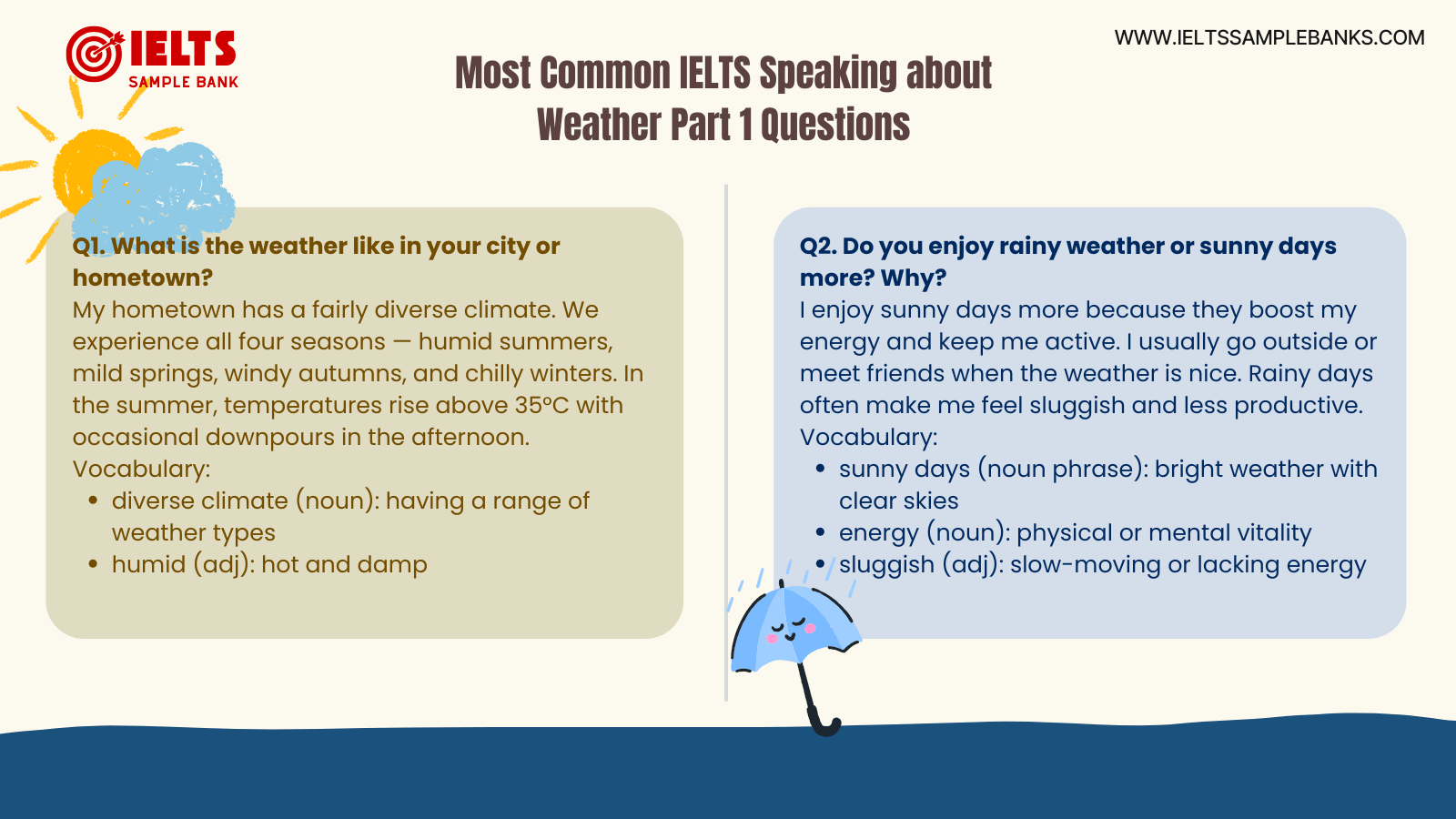
Q1. What is the weather like in your city or hometown?
My hometown has a fairly diverse climate. We experience all four seasons — humid summers, mild springs, windy autumns, and chilly winters. In the summer, temperatures rise above 35°C with occasional downpours in the afternoon.
Vocabulary:
- diverse climate (noun): having a range of weather types
- humid (adj): hot and damp
- chilly (adj): slightly cold
- downpour (noun): heavy rainfall
This question connects easily to IELTS Speaking Hometown, where describing your city’s environment and seasons is a common cue.
Q2. Do you enjoy rainy weather or sunny days more? Why?
I enjoy sunny days more because they boost my energy and keep me active. I usually go outside or meet friends when the weather is nice. Rainy days often make me feel sluggish and less productive.
Vocabulary:
- sunny days (noun phrase): bright weather with clear skies
- energy (noun): physical or mental vitality
- sluggish (adj): slow-moving or lacking energy
Q3. Which season do you like best in your country?
My favorite season is autumn. The temperature becomes pleasant, and the scenery looks beautiful with colorful leaves. I enjoy outdoor walks during that time because the weather is calm and refreshing.
Vocabulary:
- pleasant (adj): comfortable and enjoyable
- colorful (adj): full of vibrant colors
- refreshing (adj): making you feel fresh and lively
Q4. Do you check the weather forecast regularly?
Yes, I check the weather forecast almost every morning. It helps me prepare for the day, especially in the rainy season. If the forecast says it’s going to rain, I bring an umbrella just in case.
Vocabulary:
- weather forecast (noun): a report predicting future weather
- rainy season (noun phrase): a time of frequent rainfall
- umbrella (noun): an object used to protect from rain
Q5. Has the weather changed much compared to the past?
Yes, I think the weather has changed a lot over the past few years. These days, summers are hotter and winters are milder. Also, storms and rainfall have become more unpredictable than before.
Vocabulary:
- unpredictable (adj): difficult to predict
- mild (adj): not extreme; gentle
- storm (noun): violent weather with strong wind, rain, etc.
Q6. Do you like hot or cold weather?
I prefer cold weather because it keeps me more comfortable throughout the day. In hot weather, I sweat a lot and get tired easily. When it’s cold, I like bundling up in warm clothes and staying cozy indoors.
Vocabulary:
- sweat (verb): to release moisture from the skin due to heat
- cozy (adj): warm and comfortable
- bundle up (phrasal verb): to wear warm clothing
Q7. How does the weather affect your mood?
Weather definitely influences my mood. On sunny days, I feel optimistic and energetic. But when it’s rainy or grey outside, I sometimes feel tired or a bit down.
Vocabulary:
- optimistic (adj): having a positive outlook
- grey (adj): dull or cloudy
- feel down (phrase): to feel sad or low
Practice emotional tone and vocabulary using guides like IELTS Speaking About My Best Friend or Describe a Person You Admire, where feelings and reflection are key.
Q8. What do you usually do when the weather is bad?
When the weather is bad, I usually stay indoors and relax. I might read, watch movies, or do light chores. Bad weather makes me slow down and take a break from my busy routine.
Vocabulary:
- stay indoors (verb phrase): remain inside a building
- relax (verb): rest and reduce stress
- routine (noun): a regular way of doing things
Q9. What’s the best weather for outdoor activities in your opinion?
I think mild and dry weather is best for outdoor activities. It’s great to walk around, play sports, or have a picnic when it’s not too hot or too cold. A little sunshine and light breeze make everything better.
Vocabulary:
- mild (adj): moderate in temperature
- dry weather (noun phrase): no rain; low moisture
- breeze (noun): a gentle wind
Q10. Have you ever experienced extreme weather?
Yes, I once experienced a strong typhoon that caused flooding and power outages in my city. We had to stay indoors for two days. It was a little frightening and made me realize how powerful nature can be.
Vocabulary:
- typhoon (noun): a powerful tropical storm
- flooding (noun): excessive water covering the land
- power outage (noun): loss of electrical power
Key Vocabulary & Phrases for IELTS Speaking About Weather Part 1
| Word / Phrase | Part of Speech | Pronunciation | Meaning |
| sunny | adjective | /ˈsʌni/ | bright with sunlight |
| overcast | adjective | /ˌəʊvəˈkɑːst/ | cloudy, with no sun |
| humid | adjective | /ˈhjuːmɪd/ | hot and damp |
| chilly | adjective | /ˈtʃɪli/ | slightly cold |
| freezing (cold) | adjective | /ˈfriːzɪŋ/ | very cold |
| scorching (hot) | adjective | /ˈskɔːtʃɪŋ/ | extremely hot |
| mild | adjective | /maɪld/ | moderate weather temperature |
| gloomy | adjective | /ˈɡluːmi/ | dull, dark or depressing weather |
| drizzle | noun/verb | /ˈdrɪzl/ | light rain |
| downpour | noun | /ˈdaʊnpɔː/ | heavy rain |
| heatwave | noun | /ˈhiːtweɪv/ | a long period of very hot weather |
| thunderstorm | noun | /ˈθʌndəstɔːm/ | storm with thunder and lightning |
| snowflake | noun | /ˈsnəʊfleɪk/ | a piece of falling snow |
| icy | adjective | /ˈaɪsi/ | very cold, with ice |
| foggy | adjective | /ˈfɒɡi/ | with thick mist or low visibility |
| breeze | noun | /briːz/ | a light wind |
| thunder | noun | /ˈθʌndə/ | a loud noise during a storm |
| lightning | noun | /ˈlaɪtnɪŋ/ | a flash of electricity in a thunderstorm |
| storm | noun | /stɔːm/ | violent weather with wind/rain |
| forecast | noun | /ˈfɔːkɑːst/ | prediction of weather |
| climate | noun | /ˈklaɪmət/ | typical weather of a region |
| wet season / rainy season | noun phrase | /wɛt ˈsiːzn/ | months with frequent rainfall |
| dry season | noun phrase | /draɪ ˈsiːzn/ | months with little or no rain |
| sunny spells | noun phrase | /ˈsʌni spɛlz/ | short periods of sunshine |
| cold spells | noun phrase | /kəʊld spɛlz/ | short periods of cold temperatures |
Tips for Weather Speaking Part 1
To score well in IELTS speaking about weather part 1 —especially when it comes to topics like weather—you need a consistent strategy. You don’t need advanced ideas, but you do need fluent delivery, personal perspectives, and relevant examples. Here are 5 expert tips to help you succeed:
- Speak must be natural, not memorized: Memorized answers sound robotic and often confuse fluency with performance. Practice flexible ideas instead.
- Use personal experiences: When replying to weather-related questions in ielts speaking about weather, refer to real weather you’ve experienced or how it impacted your day.
- Don’t just say “yes” or “no”: Always add a short reason or example. For instance, if asked whether you like cold weather, explain why or share an experience.
- Stay within 2–3 sentences: IELTS Speaking Part 1 does not require long answers. Be clear, focused, and avoid giving too much or irrelevant detail.
- Practice with real IELTS questions: Look for real IELTS sample questions, record your answers, and review your fluency, pronunciation, and vocabulary use.
These simple yet highly effective recommendations will make your IELTS speaking about weather answers more engaging and help you tackle ielts speaking part 1 weather questions with confidence.
Conclusion
Preparing for ielts speaking about weather helps strengthen your confidence from the very start of your IELTS Speaking test. Since Part 1 includes such familiar topics, mastering typical weather-related questions allows you to build momentum early in the interview. By learning high-frequency vocabulary, structuring your answers in 2–3 sentences, and practicing aloud, IELTS Sample Bank hope you will increase your chances of reaching a higher band score.