

Navigating IELTS Writing Task 1 process diagrams challenges even experienced test-takers, particularly with life cycle of silkworm diagram questions. These dual-process tasks demand precise scientific vocabulary and clear structural organization to reach target bands.
In this article, IELTS Sample Banks will provide examiner-reviewed methods and Band 9 model answers for every major diagram type—from biological cycles to industrial workflows—so you can structure, paraphrase, and sequence with confidence.
Explain Question Requirements – Life Cycle of Silkworm Diagram Analysis
You should spend about 20 minutes on this task.
The diagrams below show the life cycle of the silkworm and the stages in the production of silk cloth.
Summarize the information by selecting and reporting the main features, and make comparisons where relevant.
Write at least 150 words.
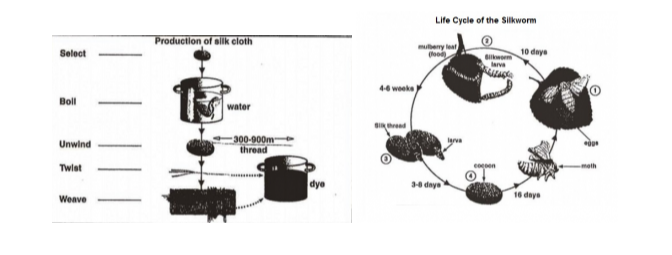
Life cycle of silkworm diagram questions test your ability to describe natural processes and manufacturing procedures using appropriate sequencing language and technical vocabulary. You must identify key stages, explain the progression from one phase to another, and highlight important transformations occurring throughout both cycles.
The life cycle of silkworm ielts questions typically present two interconnected diagrams showing natural biological processes alongside human manufacturing activities. These dual-process questions challenge your ability to link related concepts while maintaining distinct explanations for each cycle.
Life Cycle of Silkworm Diagram IELTS Sample Essays – for Every Levels
Understanding what makes a strong IELTS essay is key to improving your band score. Below is a structured breakdown of how each part of a high-scoring response should be crafted. Whether you’re aiming for Band 5 or Band 7+, this framework will help you analyze, plan, and write your life cycle of silkworm diagram essay with clarity and precision.
Band 5-6 Essay Sample
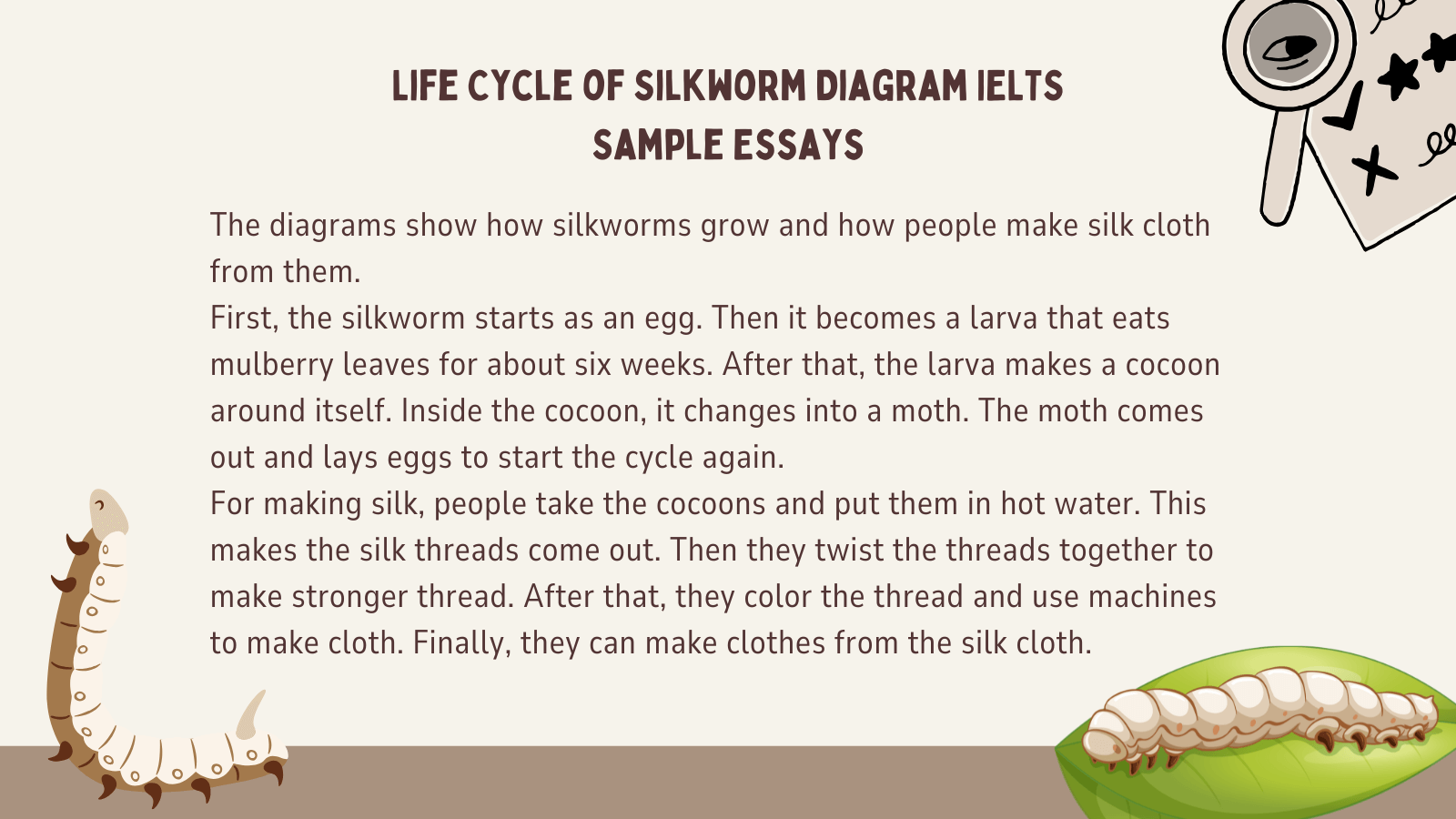
The diagrams show how silkworms grow and how people make silk cloth from them.
First, the silkworm starts as an egg. Then it becomes a larva that eats mulberry leaves for about six weeks. After that, the larva makes a cocoon around itself. Inside the cocoon, it changes into a moth. The moth comes out and lays eggs to start the cycle again.
For making silk, people take the cocoons and put them in hot water. This makes the silk threads come out. Then they twist the threads together to make stronger thread. After that, they color the thread and use machines to make cloth. Finally, they can make clothes from the silk cloth.
The silkworm diagram shows that both processes are connected because people need the cocoons from the silkworm’s life cycle to make silk products. The natural process gives materials for the making process.
Band 6-7 Essay Sample
The diagrams illustrate the complete life cycle of silkworms and the subsequent manufacturing process required to produce silk cloth from their cocoons.
The silkworm life cycle begins with eggs that hatch into larvae, which feed continuously on mulberry leaves for approximately 4-6 weeks until reaching maturity. Subsequently, the mature larvae spin protective cocoons around themselves using silk fibers, entering the pupation stage where they undergo metamorphosis. After 3-5 weeks, adult moths emerge from their cocoons and mate to lay eggs, completing the natural cycle.
The silk production process commences when cocoons are collected and subjected to boiling water treatment, which softens the protective casing and enables extraction of continuous silk threads. These raw threads undergo twisting procedures to create stronger, more durable yarn suitable for textile manufacturing. The processed silk then receives dyeing treatment to achieve desired colors before being woven into fabric using specialized machinery.
Notably, the life cycle of silkworm diagram demonstrates the interconnected relationship between natural biological processes and human industrial activities.
Band 7+ Essay Sample
The accompanying diagrams delineate the intricate biological life cycle of silkworms alongside the sophisticated manufacturing process employed in silk cloth production, revealing the symbiotic relationship between natural phenomena and industrial textile manufacturing.
The silkworm’s life cycle exemplifies complete metamorphosis, commencing with fertilized eggs that undergo incubation before hatching into voracious larvae. These caterpillars consume mulberry leaves extensively during their 4-6 week growth period, molting periodically as they increase in biomass. Upon reaching maturity, larvae instinctively construct protective cocoons through secretion of continuous silk filaments, subsequently entering pupation where cellular reorganization transforms them into adult moths. The emergent moths engage in reproductive activities, with females depositing eggs to perpetuate the species cycle.
Conversely, the sericulture process intercepts this natural progression at the cocoon stage, subjecting these protective casings to controlled thermal treatment that dissolves sericin proteins while preserving valuable fibroin fibers. Skilled artisans employ reeling techniques to extract continuous filaments, which undergo twisting procedures to enhance tensile strength before receiving chemical dyeing treatments and mechanical weaving processes.
Systematic Analysis of the Model Response Structure
To write a high-scoring IELTS Writing Task 1 essay based on the life cycle of silkworm diagram, it’s essential to understand how effective responses are structured. The analysis below breaks down the core components of a well-organized model answer, helping learners of all levels approach the task with clarity and precision.
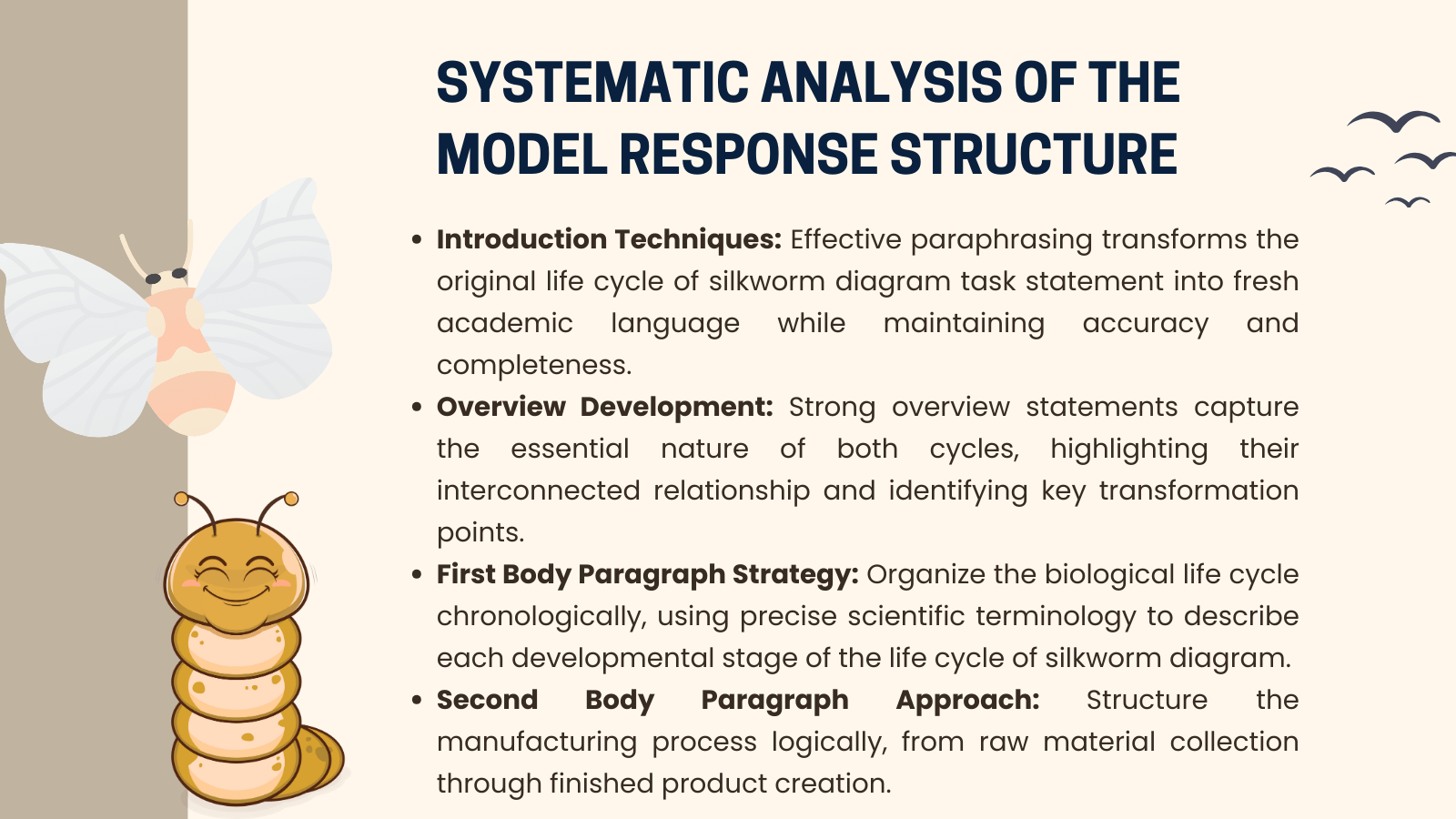
- Introduction Techniques: Effective paraphrasing transforms the original life cycle of silkworm diagram task statement into fresh academic language while maintaining accuracy and completeness. Your opening sentence should identify both processes clearly, establishing the scope of your analysis without simply copying the question format.
- Overview Development: Strong overview statements capture the essential nature of both cycles, highlighting their interconnected relationship and identifying key transformation points. Focus on the most significant stages rather than attempting to mention every detail, creating a roadmap for your detailed analysis.
- First Body Paragraph Strategy: Organize the biological life cycle chronologically, using precise scientific terminology to describe each developmental stage of the life cycle of silkworm diagram. Connect sequential phases with appropriate transitional language while explaining the duration and characteristics of each transformation period.
- Second Body Paragraph Approach: Structure the manufacturing process logically, from raw material collection through finished product creation. Emphasize the industrial techniques and machinery involved while maintaining clear connections between consecutive production stages.
Essential Vocabulary for Life Cycle of Silkworm Diagram Topic
Temporal Progression Language: Sequential processes require precise transitional expressions that guide readers through chronological development.
| Function | Expressions | Usage Context |
| Beginning | Initially
First Commencing with |
Opening stages of any process |
| Continuation | Subsequently
Following this Next |
Middle developmental phases |
| Simultaneity | Meanwhile
Concurrently At the same time |
Parallel activities or stages |
| Conclusion | Finally
Ultimately Upon completion |
Terminal phases or endpoints |
Transformation Vocabulary: Process descriptions demand specific verbs that accurately convey change and development.
| Change Type | Verb Options | Technical Application |
| Physical transformation | Convert
Transform metamorphose |
Biological development stages |
| Manufacturing action | Extract
Process Refine weave |
Industrial production steps |
| Natural development | Mature
Emerge Develop Envolve |
Organic growth processes |
| Human intervention | Collect
Treat Manufacture Produce |
Controlled industrial activities |
Technical Process Terminology: Academic vocabulary enhances precision while demonstrating language proficiency.
| Process Stage | Academic Terms | Practical Application |
| Raw materials | Substrate
Feedstock primary input |
Initial stage description |
| Intermediate stages | Intermediate products
semi-processed |
Middle phase analysis |
| Final products | End products
finished goods output |
Completion stage summary |
| Quality aspects | Specifications
Parameters characteristics |
Feature description |
Wrap Up
Understanding the life cycle of silkworm diagram questions requires recognizing dual biological and industrial processes in IELTS Writing Task 1. These interconnected systems challenge your ability to explain complex relationships between natural phenomena and manufacturing activities clearly.
Keep building diagram fluency with related guides on Process Chart Task 1, Diagram of Plastic, Sugar Manufacturing Process, and energy cycles like Hydroelectricity and Geothermal.
Successful responses demonstrate sophisticated vocabulary, accurate grammar, and logical organization. Practice with process diagrams strengthens your ability to identify key stages and structure responses effectively. Examiners evaluate your capacity to synthesize complex information into coherent explanations demonstrating language proficiency.